If you have seen “NTY” in a text message, Snapchat chat, or social media DM, you may wonder what it means.
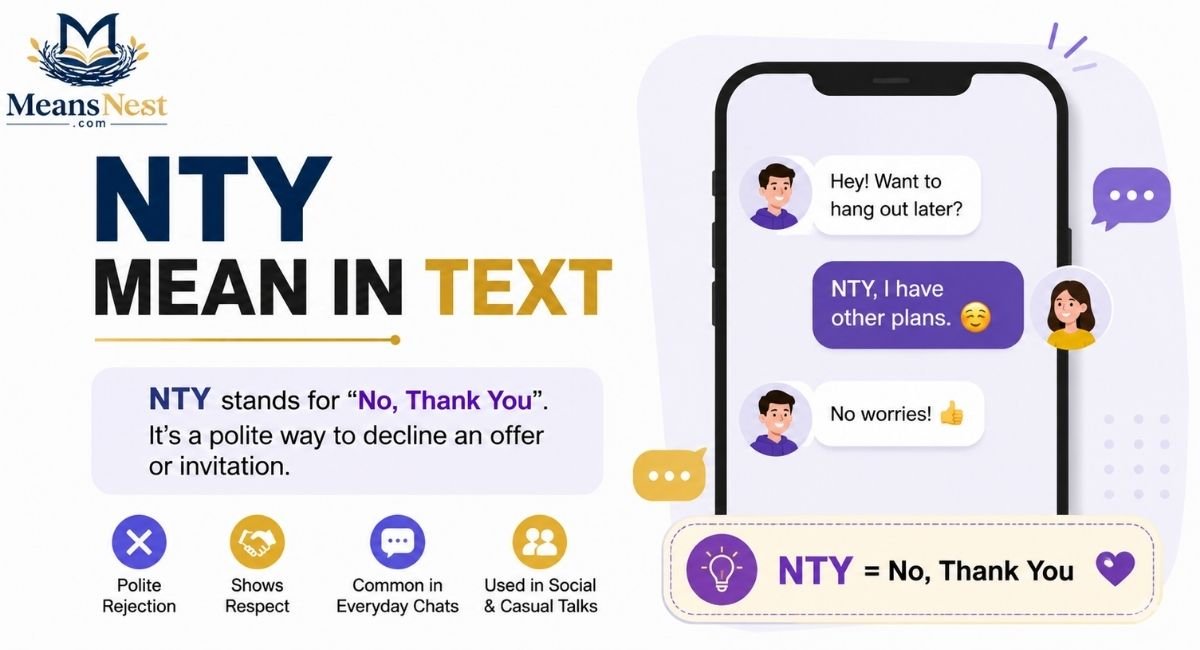
In most casual conversations, NTY means “No, thank you,” and it is used to politely decline an offer, invitation, suggestion, or request.
This short abbreviation is common in casual texting because it lets people respond quickly without typing the complete phrase.
You may also come across NTY as part of text slang, chat abbreviations, or modern texting language on platforms such as WhatsApp, Instagram, and TikTok.
While NTY is generally polite, its exact tone can depend on punctuation, emojis, and the surrounding conversation. Understanding the context helps you interpret NTY correctly.
What Does NTY Mean in Text?
NTY usually means “No, thank you” in text messages and online conversations.
It is a shortened form of the phrase “No, thank you.” People use the abbreviation when they want to reject something without typing the complete phrase.
For example:
Person A: Want some pizza?
Person B: NTY, I already ate.
Here, NTY simply means “No, thank you.”
The abbreviation is common in casual texting, where people often prefer quick and convenient messages.
NTY Definition at a Glance
| Term | Meaning | Typical Use |
| NTY | No, thank you | Declining an offer |
| NTY? | No, thank you? | Uncommon; depends on context |
| nty | No, thank you | Casual texting |
| NTY! | No, thank you! | Stronger or more energetic refusal |
| NTY 🙂 | No, thank you | Softer, friendly refusal |
So, if someone asks, “What does NTY stand for?” the simplest answer is “No, thank you.”
The capitalization does not normally change the basic meaning. NTY, nty, and Nty can all represent the same phrase.
When and Why Do People Use NTY?
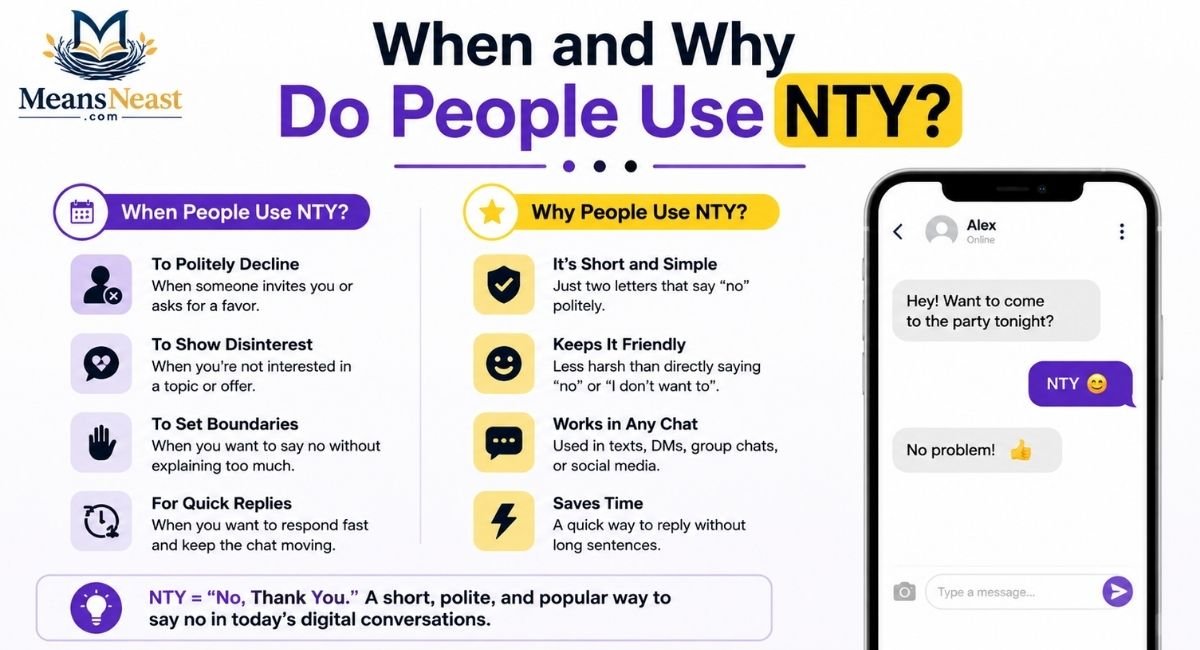
People use NTY when they want to say no quickly while still showing basic politeness.
It is especially useful when the conversation is informal and there is no need for a long explanation.
Common situations include:
- Declining an invitation
- Turning down food or drinks
- Rejecting an offer
- Saying no to a suggestion
- Refusing a request
- Politely avoiding something
- Ending an unwanted proposal
- Responding quickly in a group chat
For example:
Friend: Want to come to the movies tonight?
You: NTY, I have plans.
Or:
Friend: Want me to order one for you?
You: NTY, I’m good.
In both cases, NTY acts as a casual way to say no.
It saves time and keeps the message short. This is one reason chat abbreviations and messaging shorthand are so common in modern digital communication.
However, NTY is generally better suited to friends, classmates, coworkers you communicate casually with, or social media conversations. A formal email or professional message usually calls for the complete phrase.
NTY Meaning in Different Contexts
The basic NTY meaning stays the same in most situations, but its tone can change according to context.
NTY in Text Messages
In ordinary texting, NTY usually means “No, thank you.”
A: Want another slice?
B: NTY, I’m full.
The message sounds straightforward and polite.
NTY on WhatsApp
NTY on WhatsApp is often used in personal chats and group conversations.
A: We’re ordering burgers. Want one?
B: NTY, I ate already.
It is a convenient form of messaging shorthand.
See Also: AWL Meaning in Text: Slang, Uses, Replies & Examples
NTY on Instagram
NTY on Instagram can appear in DMs when someone declines an offer, invitation, or suggestion.
A: Want to join our live tonight?
B: NTY, maybe next time.
The addition of “maybe next time” makes the refusal warmer.
NTY on TikTok
NTY on TikTok may appear in comments or direct messages, especially in casual interactions.
A: You should try this challenge!
B: NTY 😂
Here, the laughing emoji can make the refusal feel playful rather than serious.
NTY in Social Media
Across social media slang, NTY generally keeps the same meaning: No, thank you.
However, readers should always consider the surrounding conversation before deciding whether the message is friendly, serious, or dismissive.
Is NTY Polite, Rude, or Dismissive?
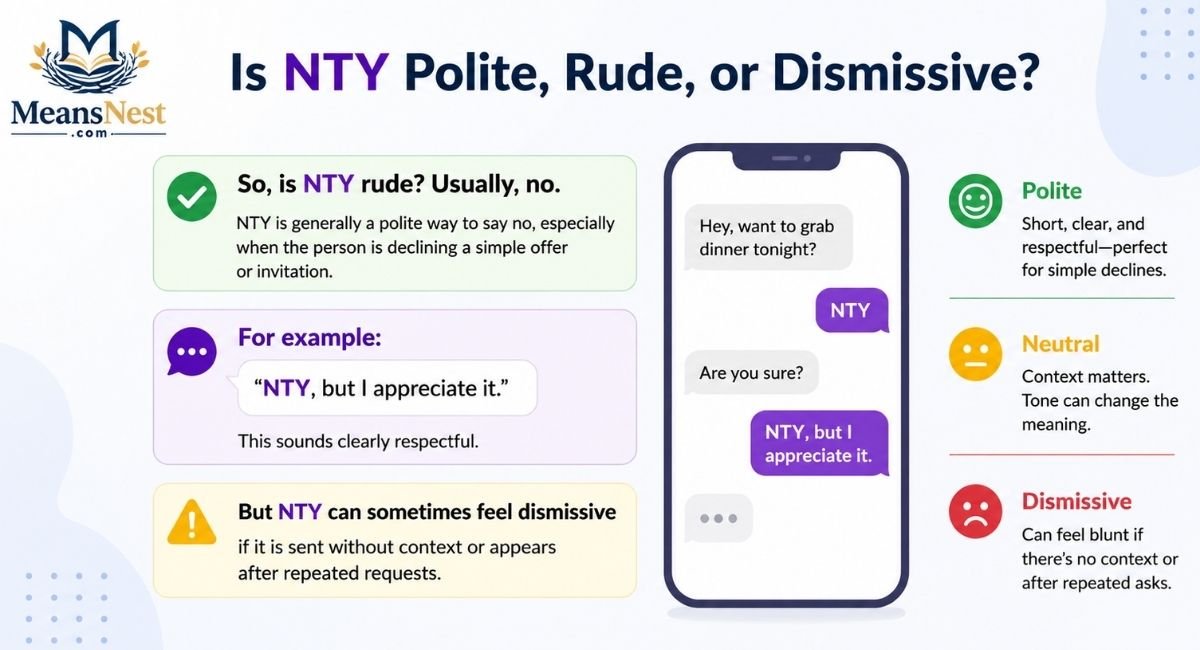
So, is NTY rude? Usually, no.
NTY is generally a polite way to say no, especially when the person is declining a simple offer or invitation.
For example:
“NTY, but I appreciate it.”
This sounds clearly respectful.
But NTY can sometimes feel dismissive if it is sent without context or appears after repeated requests.
Compare these:
Friendly:
NTY 😊 Thanks for offering!
Neutral:
NTY, I’m okay.
Potentially dismissive:
NTY.
The third example is not automatically rude. The person may simply prefer short messages. Still, a very brief reply can feel colder depending on the relationship.
This is why NTY tone matters as much as the abbreviation itself.
Factors that affect the tone include:
- The relationship between the people
- What was being offered
- Previous messages
- Punctuation
- Emojis
- Whether an explanation follows
- The overall conversational tone
In texting etiquette, context is often more important than the abbreviation alone.
How Tone and Punctuation Change NTY’s Meaning
Punctuation can slightly change how NTY feels without changing its basic definition.
“NTY”
This is short and neutral.
A: Want to come with us?
B: NTY.
It may sound direct, but it is not necessarily rude.
“NTY!”
The exclamation mark can make the message feel more energetic.
A: Want some cake?
B: NTY! I just had dessert.
Depending on the conversation, it can sound cheerful or firm.
See Also: STTM Meaning in Text: What Does STTM Mean?
“NTY 😊”
An emoji can soften the response.
A: Can I send you another video?
B: NTY 😊
The emoji adds a friendly response and makes the refusal feel less cold.
“NTY lol.”
Adding “lol” can make the message more playful.
A: You’re coming shopping with us, right?
B: NTY, lol.
The exact interpretation still depends on the conversation.
“NTY, thanks!”
This is one of the clearest friendly versions.
A: Want me to save you a seat?
B: NTY, thanks!
It communicates a refusal while maintaining polite texting language.
NTY Texting Examples in Real Conversations
The easiest way to understand NTY in texting is to see how people might use it naturally.
1: Declining Food
Sam: Want some fries?
Alex: NTY, I’m full.
Here, NTY is a simple and polite refusal.
2: Turning Down an Invitation
Mia: We’re going to the mall later. Wanna come?
Zoe: NTY, I need to finish some work.
The explanation makes the response feel considerate.
3: Rejecting an Offer
Chris: I can give you my old headphones.
Jay: NTY, I already have a pair.
The person appreciates the offer but does not need it.
4: Casual Conversation
A: Want to watch another episode?
B: NTY 😂 I’m going to sleep.
The emoji keeps the message light.
5: Group Chat
A: Anyone want coffee?
B: NTY, I’m good.
C: Yes, please!
Here, NTY quickly communicates that one person does not want coffee.
6: Social Media DM
A: You should check out this page.
B: NTY, not really my thing.
The person declines the recommendation.
7: Friendly Refusal
A: Need a ride home?
B: NTY! My brother is picking me up.
The exclamation mark and explanation make the response friendly.
These NTY conversation examples show that the abbreviation is flexible. The surrounding words usually provide the real clue about the speaker’s attitude.
How to Respond When Someone Says NTY
Wondering how to respond to NTY? In most cases, you do not need to make the conversation complicated.
If someone says NTY after an offer, simply respect their answer.
Simple Responses
You can reply with:
- “No problem!”
- “Okay!”
- “Sure, no worries.”
- “All good.”
- “That’s fine.”
- “Got it!”
- “No worries.” 😊
For example:
You: Want some coffee?
Friend: NTY.
You: No worries!
That’s enough.
If the person gives a reason, you can acknowledge it.
You: Want to join us for dinner?
Friend: NTY, I’ve already eaten.
You: No problem!
See Also: What Does RT Mean in Text? Full Guide to “RT” in Chat
If You Want to Keep the Conversation Going
You can respond naturally without pressuring them:
“No worries. Maybe another time!”
This is especially useful when someone declines an invitation but seems interested in doing something later.
The key part of a good NTY response is respecting the person’s no.
NTY vs Other Ways to Say No
NTY is only one way to decline something. Different expressions can carry slightly different levels of politeness and informality.
| Expression | Meaning | Tone |
| NTY | No, thank you | Casual and polite |
| No, thanks | No, thank you | Casual and natural |
| No thanks | No, thank you | Neutral |
| I’m good | I don’t need it | Casual |
| Maybe next time | Not this time | Friendly |
| I’ll pass | I don’t want it | Casual |
| Not today | No for now | Neutral |
| No, thank you. | Clear refusal | Polite and direct |
NTY works well when you want a short answer.
If you are speaking with someone in a professional situation, writing the full “No, thank you” may be more appropriate.
For example, instead of:
“NTY.”
You could write:
“No, thank you. I appreciate the offer.”
That sounds more formal and respectful.
The best choice depends on the relationship and the type of informal communication involved.
Common Misunderstandings About NTY
Although NTY is simple, several misunderstandings can occur.
NTY Does Not Usually Mean Something Negative
Some people assume that NTY is automatically rude because it is short.
That is not necessarily true.
Text messages often use abbreviations because people want to communicate quickly. A short message does not always indicate a negative attitude.
NTY Usually Means “No, Thank You”
The most common NTY slang meaning in casual messages is “No, thank you.”
The surrounding conversation should still be considered if the abbreviation seems unclear.
See Also: What Does POS Mean in Text? Meanings, Slang & Examples
Capitalization Usually Does Not Matter
“NTY” and “nty” generally have the same meaning.
Capital letters are often used simply because the abbreviation is written in its commonly recognized form.
NTY Is Not Always a Complete Conversation
A person may write:
“NTY.”
and leave it there.
That does not necessarily mean they are angry. They may simply have nothing else to add.
Context matters.
As with many text slang terms, meaning and tone depend heavily on context.
Someone saying “NTY 😊” to a friend can feel very different from “NTY” after repeated unwanted invitations.
NTY Origin, Popularity & Modern Usage
NTY developed as part of the broader growth of texting abbreviations, internet slang, and quick online communication.
Like many short forms, it became useful because mobile messaging encouraged people to communicate with fewer characters and less typing.
The phrase “No, thank you” was already common in everyday English. NTY simply compresses it into a short digital form.
Today, NTY can appear in the following:
- Text messages
- Group chats
- Online conversations
- TikTok
- Social media comments and DMs
- Gaming chats
- Informal online communities
Its usage is generally more common in casual texting than in formal communication.
NTY is also part of a much larger collection of popular texting acronyms and common text abbreviations used in modern digital communication.
The important thing is not to assume that every short abbreviation has a single meaning everywhere. Some slang terms change according to community and context. With NTY, however, “No, thank you” is the straightforward interpretation in ordinary texting.
❓ Frequently Asked Questions (FAQs)
What does “NTY” mean in a chat?
NTY usually means “No, thank you” in a chat. It is commonly used to politely decline an offer, invitation, or suggestion.
What is the full form of nty?
The full form of NTY is “No, thank you.” It is a common texting abbreviation.
What does “NTY” mean when used in texting?
In texting, NTY means “No, thank you.” It is a short and casual way to say no politely.
What does “nyt” mean in text?
If you mean “nyt,” its meaning depends on context; it can be a typo for “NTY,” while lowercase forms may have other meanings.
What does “nty” mean on Snap?
On Snapchat, “nty” usually means “No, thank you,” often used to politely reject an offer or suggestion.
Conclusion
The NTY meaning in text is simple: NTY usually means “No, thank you.” It is a convenient chat abbreviation used to decline an offer, invitation, suggestion, or request without typing the full phrase. In most situations, it is neutral or polite rather than rude.
However, the person’s wording, punctuation, emojis, and overall conversational tone can affect how the message feels.
You may see “NTY” in texting, WhatsApp, Instagram, TikTok, group chats, and other forms of digital communication.
When someone sends NTY, a simple “No worries!” or “Okay!” is usually an appropriate and respectful response. Understanding context is the key to interpreting its exact tone.

Hi, I’m Kaif Ali, creator of MeansNest. I’m an SEO professional passionate about helping people understand the meanings of words, text slang, and online expressions through clear, accurate, and easy-to-read content. I create SEO-friendly guides that deliver real value while making learning simple for everyone.