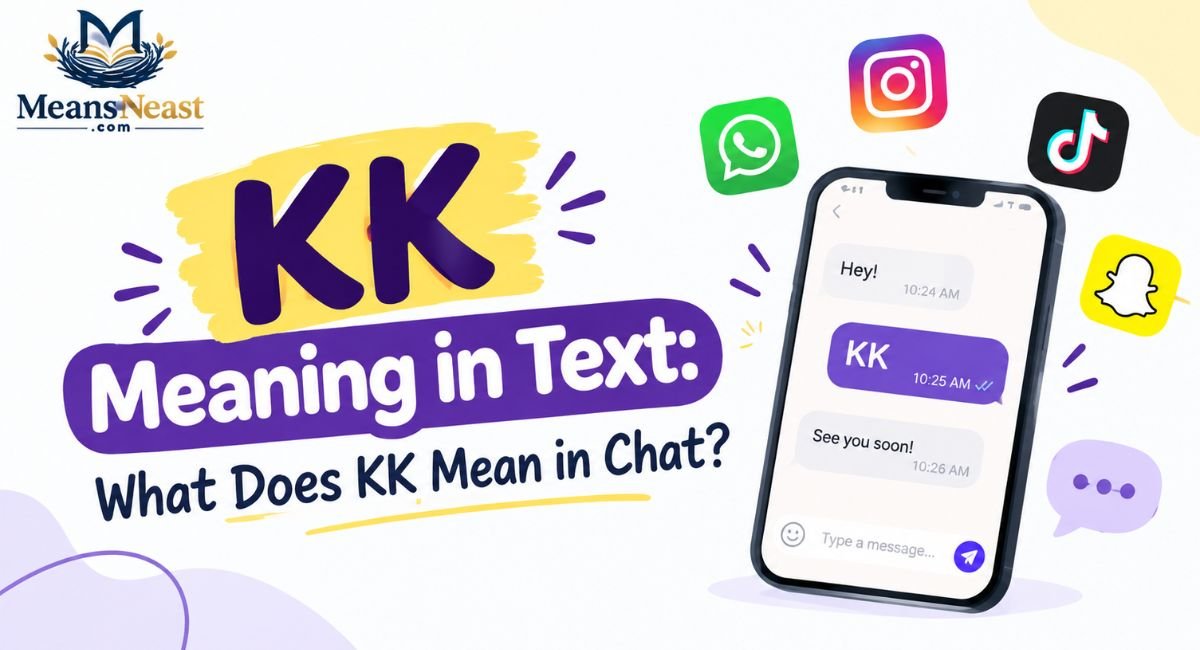
You send a quick message, and the reply comes back as just “kk.” Two letters, no extra words. Now you’re left wondering what it really meant.
If you’ve ever asked what “KK” means in text, you’re not alone. This tiny texting abbreviation appears in almost every chat app, from WhatsApp to Instagram.
Most of the time it simply means okay, but tone matters in digital communication. The meaning of “kk” in chat can change with the sender, the topic, and the mood.
It might sound friendly, or you may wonder, is KK rude? In this guide, you’ll learn why people use it and how to read KK in casual texting.
What Does KK Mean in Text?
KK means “okay.” It’s a texting abbreviation, a quicker way to type “OK.”
People send it as a casual response to confirm they saw your message. It works as a simple acknowledgment.
It’s part of everyday texting slang. You’ll see it in a text message, an online chat, or a comment under a post.
The double K is just a small twist on the single “K.” It has been around since the early days of internet slang and instant messaging.
What Does KK Mean in Simple Words?
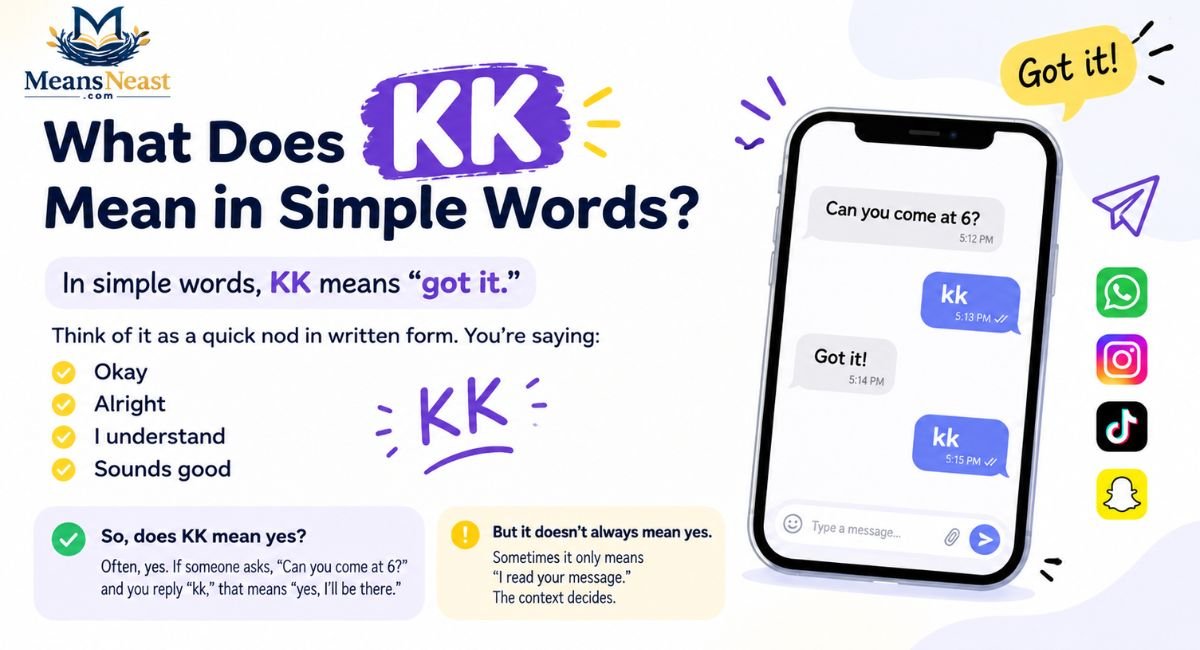
In simple words, KK means “got it.”
Think of it as a quick nod in written form. You’re saying:
- Okay
- Alright
- I understand
- Sounds good
So, does KK mean yes? Often, yes. If someone asks, “Can you come at 6?” and you reply “kk,” that means “yes, I’ll be there.”
But it doesn’t always mean yes. Sometimes it only means “I read your message.” The context decides.
Why Do People Use KK in Text Messages?
Why do people say KK? Mostly, it’s about speed.
Texting is built for quick replies. Typing “kk” takes less than a second, and it keeps the conversation moving.
Here’s why people use KK instead of OK:
- It’s faster. Two taps beat typing “okay.”
- It feels softer than “K.” A single “k” can feel blunt. The extra letter adds a little warmth.
- It’s a habit. Many people picked it up from friends and never dropped it.
- It fits casual texting. It matches a relaxed conversational tone.
- It’s playful. Some people just like how it looks.
Read More: IRL Meaning in Text: What Does IRL Mean in Chat?
Messaging apps reward short replies. KK is one of the easiest ways to give one.
What Does KK Mean in Different Contexts?
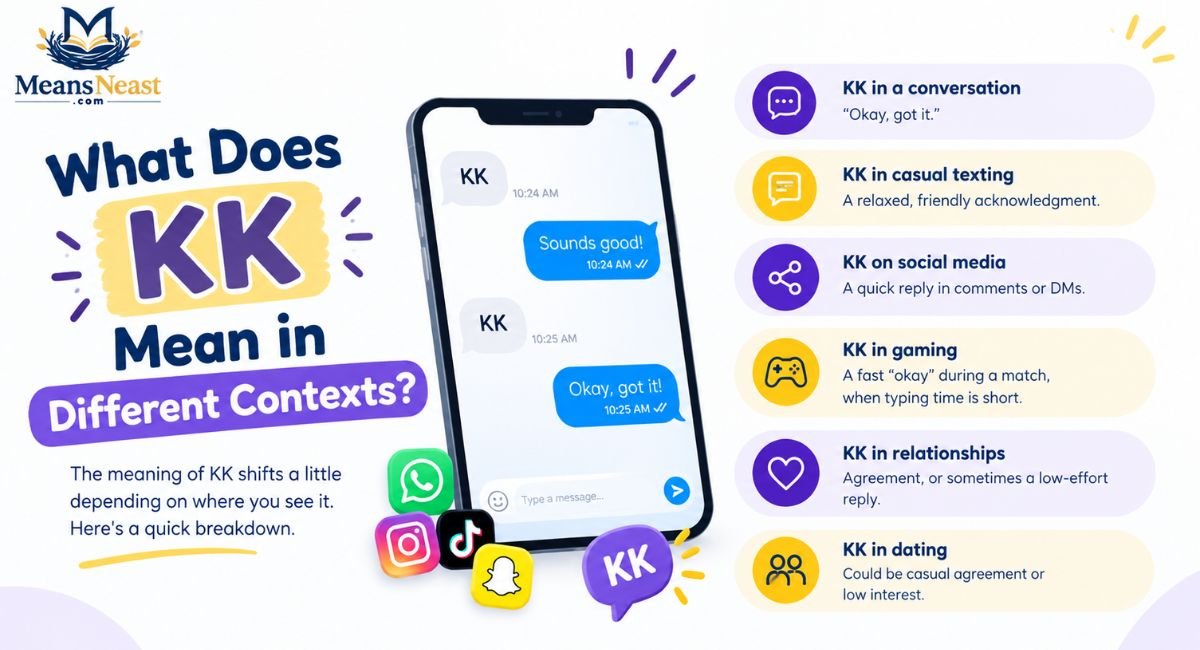
The meaning of KK shifts a little depending on where you see it. Here’s a quick breakdown.
| Context | What KK Usually Means |
| KK in a conversation | “Okay, got it.” |
| KK in casual texting | A relaxed, friendly acknowledgment |
| KK on social media | A quick reply in comments or DMs |
| KK in gaming | A fast “okay” during a match, when typing time is short |
| KK in relationships | Agreement, or sometimes a low-effort reply |
| KK in dating | Could be casual agreement or low interest |
A few more points worth knowing:
In gaming, players type fast during matches. “Kk” is a quick way to confirm a plan without losing focus.
On social media: It’s a light, low-pressure reply. Nobody reads much into it.
Other languages: In Korean chat, “kk” (from ㅋㅋ) often stands for laughter. In Brazil, “kkk” means laughing too. So if the sender uses a different language online, “kk” might mean “haha” instead of “okay.”
Always check who’s sending it and where.
Is KK rude, cold, or passive-aggressive?
Usually, no. Does KK sound rude? Most of the time, it doesn’t.
Compare it with a plain “K.” That one can feel cold. KK is generally friendlier because it reads like a casual “okay.”
Still, tone in texting is tricky. A short reply can feel off in certain situations.
KK may feel cold or passive-aggressive when:
- You just sent a long, heartfelt message and got “kk” back
- The conversation was already tense
- The person usually writes long replies but suddenly shortens them
- It follows an argument or a disagreement
Read More: FG Meaning in Text: What Does FG Mean in Chat & Social Media?
So, is KK a good response? For simple plans and quick confirmations, yes. For emotional topics, it can fall flat.
Don’t panic when you get one. Look at the whole conversation first.
KK vs K vs OK vs Okay vs Okk
These all mean roughly the same thing. The difference is in the feel.
| Reply | Tone | Best Used For |
| K | Short can seem cold | Very quick, neutral replies |
| KK | Casual, friendly | Friends, quick confirmations |
| OK | Neutral | Everyday use, work chats |
| Okay. | Polite, complete | Formal or serious conversations |
| Okk | Warm, a bit playful | Friends and close chats |
A few quick comparisons:
KK vs K: KK is warmer. K can sound dismissive.
KK vs OK: OK is more neutral and safer in any setting. KK is more casual.
KK vs okay: “Okay” is the full, polite version. It feels more thoughtful.
KK vs Okk: Okk adds extra enthusiasm. It often shows up with friends or someone you’re comfortable with.
Think of them as volume levels. K is low, KK is medium, and Okk is a bit more cheerful.
KK Texting Examples in Real Conversations
Seeing it in action helps. Here are a few simple examples.
1: Making plans
“Dinner at 8?”
“See you there.”
Here, KK means yes. Easy.
2: Quick acknowledgment
“I’ll send the file in ten minutes.”
“kk”
The person is simply saying, “Got it.”
3: A cold-feeling reply
“I felt really bad about what happened yesterday. Can we talk?”
“kk”
Same word, different feeling. This one can seem distant.
Read More: IDC Meaning in Text: What Does IDC Mean in Chat & Social Media?
4: In gaming
“Rush the left side.”
“kk”
Fast, clear, no fuss.
5: Playful friend chat
“Don’t forget to bring snacks!”
“Kkkk, got you.”
Here the extra letters add energy.
What Does KK Mean From a Guy or Girl?
The meaning of “kk” from a guy or a girl is basically the same: okay. Gender doesn’t change the word.
What changes is the person, their habits, and the relationship.
KK from a guy: Many guys use short replies as a normal texting style. It often means they’re busy or keeping things simple, not that something’s wrong.
KK from a girl: It can be casual and friendly, especially among friends. But if she normally sends longer messages, a sudden “kk” might signal she’s distracted or upset.
KK in dating: Early in a talking stage, a lot of “kk” replies might suggest low effort. But one or two doesn’t mean much.
The best approach is to compare it with their usual style. If a person always texts short, “kk” is just who they are.
When Should You Use or Avoid KK?
Knowing when to use KK saves you from awkward moments.
Use KK when:
- You’re texting friends or family
- You’re confirming plans quickly
- The conversation is light and casual
- You want a short reply without sounding harsh
Avoid KK when:
- You’re writing to a boss, client, or teacher
- The topic is serious or emotional
- Someone is upset or sharing bad news
- You want to show real interest or care
Read More: STFU Meaning in Text: What It Means, How It’s Used & Examples
So, when not to use KK? Anytime the moment needs more effort.
A simple fix: add a few words. “Kk, sounds good!” or “Okay, thanks for telling me” feels much warmer.
Common Misunderstandings About KK
A lot of confusion comes from reading too much into two letters. Here are the most common mistakes.
“KK always means the person is annoyed.” Not true. Most people use it casually, with no hidden message.
“KK is the same as K.” Close, but not quite. KK usually feels friendlier.
“KK means yes.” Sometimes it only means “I saw this. “It doesn’t always mean agreement.
“KK means the same everywhere.” Not always. In some online communities, it means laughter.
“A short reply means they don’t care.” People text short for many reasons: they’re busy, driving, at work, or just prefer brevity.
Before you decide it’s rude, consider the person, the timing, and the topic.
❓ Frequently Asked Questions (FAQs)
What does “KK” mean in chat?
It means “okay.” It’s a quick, casual way to acknowledge a message.
What does “kk” mean?
“kk” is a texting abbreviation for “okay” or “got it.” In some Korean and Brazilian chats, it can also mean laughter.
How to reply to KK?
Keep it simple and match their tone, like “cool 👍” or “great, see you then.” If the topic is serious, add a few more words.
What does KK mean from a boy?
It usually just means “okay.” Many boys text short, so it often means they’re busy or keeping it simple.
Why do girls say KK?
Mostly to sound casual and friendly, since it feels softer than a plain “K.” Sometimes it can also mean they’re busy or distracted.
Conclusion
So, what does KK mean in text? In most cases, it’s just a quick, casual “okay.”
It’s one of the most common examples of texting slang. People use it to save time, keep conversations moving, and stay relaxed.
It isn’t rude by default. But tone matters, and context is everything. A “kk” in a friendly plan feels normal. A “kk” after a heartfelt message can sting.
Next time you see it, look at the full conversation before judging. And if you want to be safe, add a few extra words. That small effort makes your message feel warmer.
Now you know the KK meaning in text and how to use it with confidence.

Hi, I’m Kaif Ali, creator of MeansNest. I’m an SEO professional passionate about helping people understand the meanings of words, text slang, and online expressions through clear, accurate, and easy-to-read content. I create SEO-friendly guides that deliver real value while making learning simple for everyone.