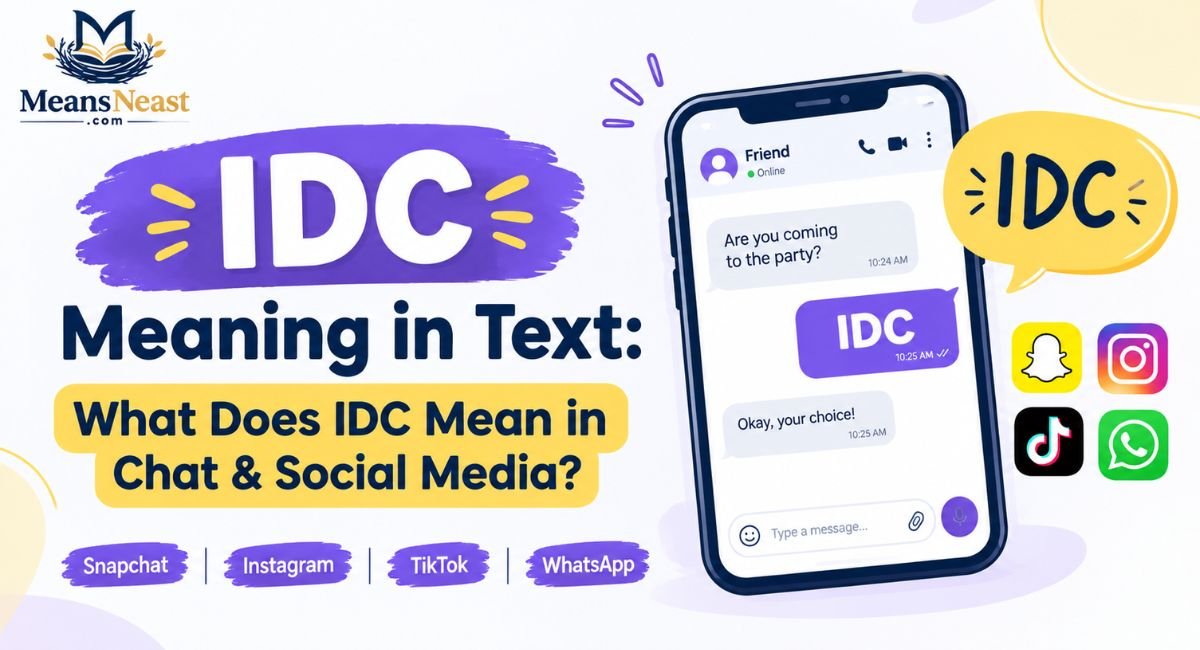
If you’ve seen IDC in a text message, chat, or social media post, you may wonder what it means. In most casual conversations, IDC means “I Don’t Care.” It is a common texting abbreviation used to show that someone is not concerned, interested, or bothered about a particular topic or situation.
The tone can change depending on the context, relationship, and wording, ranging from casual indifference to sounding dismissive or rude. Understanding the IDC meaning in text can help you interpret messages more accurately.
In this guide, we’ll explain what IDC stands for, how it is used in chats, provide examples, and explore its meaning on popular social media platforms.
What Does IDC Mean in Text?
IDC stands for “I Don’t Care.” It is one of the most common internet abbreviations used in casual texting and online communication.
When someone types “IDC,” they generally mean that something does not matter to them, they have no preference, or they are not interested in discussing it further.
For example:
- “IDC what movie we watch.”
- “IDC if you go without me.”
- “IDC about the argument anymore.”
- “IDC, you can choose.”
The IDC definition is simple, but the meaning can depend heavily on context and tone.
If a friend says, “IDC, pick whichever restaurant you want,” they may simply mean they have no preference.
However, “IDC about your opinion” can sound much more dismissive.
IDC Full Form
The IDC full form is
IDC = I Don’t Care
In everyday texting, the abbreviation is usually written in capital letters, but “idc” is also extremely common.
What Does IDC Mean in Chat and Text Messages?
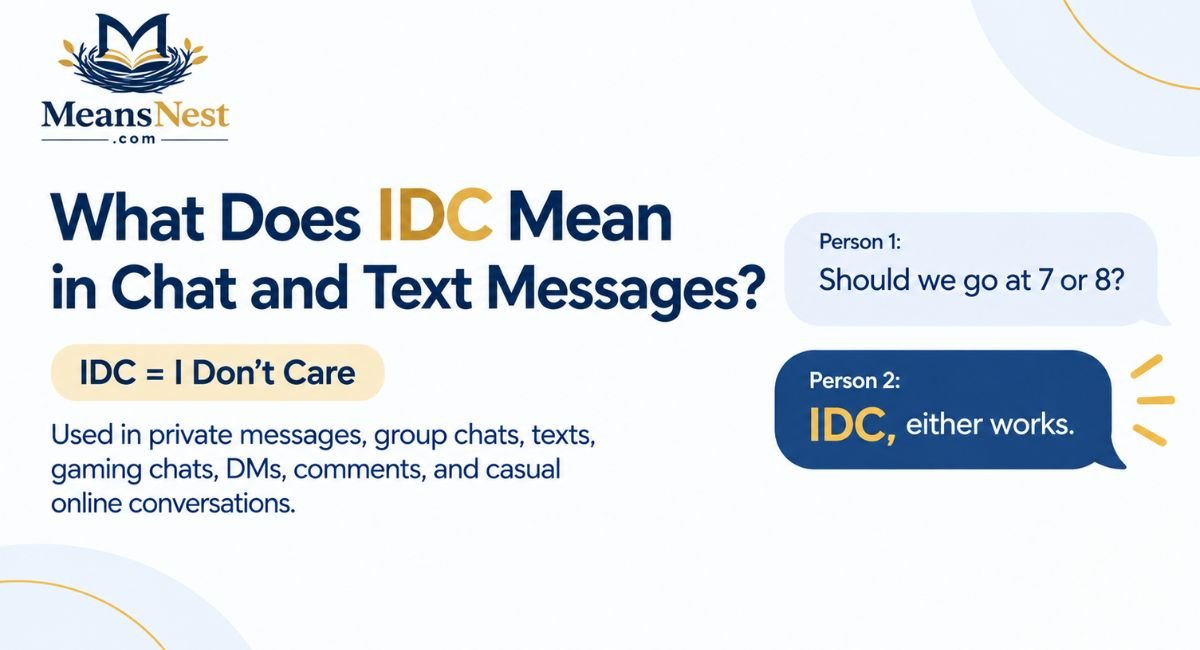
The IDC meaning in chat is generally “I Don’t Care.” People use it to make messages shorter and faster, especially during informal conversations.
You may see IDC in:
- Private messages
- Group chats
- Text messages
- Gaming chats
- Social media DMs
- Comments
- Casual online conversations
For example:
Person 1: “Should we go at 7 or 8?”
Person 2: “IDC either works.”
Here, IDC simply means the person has no preference.
But consider this example:
Person 1: “Are you upset about what happened?”
Person 2: “IDC anymore.”
This can suggest that the person is frustrated, emotionally tired, or trying to move past the issue.
Therefore, IDC in text messages does not always communicate exactly the same emotion. The surrounding words provide important clues.
Why Do People Use IDC in Texting?
People use IDC because it is quick, familiar, and easy to understand.
Texting often favors short expressions instead of complete sentences. This is why casual texting terms such as IDC have become common in everyday digital communication.
Here are some common reasons people use IDC:
- To say they do not care about a particular choice.
- To show they have no preference.
- To end an unimportant discussion.
- To express frustration.
- To show emotional distance.
- To keep a message short.
- To sound casual with friends.
Read More: STFU Meaning in Text: What It Means, How It’s Used & Examples
For example, someone might text:
“IDC where we eat.”
This does not necessarily mean they are angry. They could simply be saying, “You choose.”
However, if someone repeatedly responds with “IDC” during a serious conversation, the phrase may sound cold or dismissive.
The meaning of the IDC expression depends on the relationship between the people, the topic, and the rest of the conversation.
IDC Meaning on WhatsApp, Instagram, Snapchat & TikTok
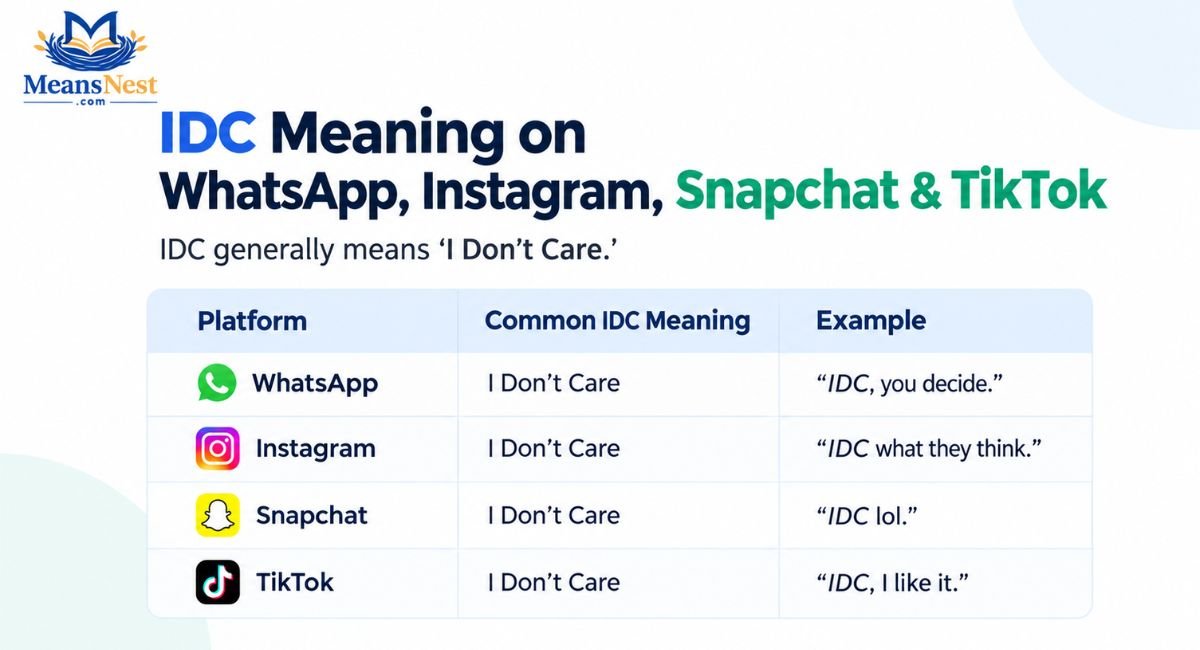
The IDC meaning on WhatsApp, Instagram, Snapchat, and TikTok is generally the same: “I Don’t Care.”
The platform does not normally change the basic definition. However, the way IDC is used can vary depending on the type of conversation.
| Platform | Common IDC Meaning | Example |
| I Don’t Care | “IDC, you decide.” | |
| I Don’t Care | “IDC what they think.” | |
| Snapchat | I Don’t Care | “IDC lol.” |
| TikTok | I Don’t Care | “IDC, I like it.” |
IDC in DMs
In DMs, IDC can be used between friends, followers, or acquaintances.
For example:
“IDC if you post it.”
Depending on the conversation, this could mean the person genuinely has no objection or is showing a slightly dismissive attitude.
IDC in Group Chats
In group chats, IDC is often used when someone does not want to choose between different options.
For example:
“Pizza or burgers?”
“IDC 😭”
Here, the sender may simply be leaving the decision to everyone else.
Is IDC Rude, Negative, or Sarcastic?
The answer depends on the IDC tone and context.
IDC is not automatically rude or negative. Among close friends, it can be completely casual.
For example:
“Which color should I buy?”
“IDC, both look good.”
This sounds neutral.
But consider:
“IDC what you think.”
That sentence can sound rude because it directly dismisses another person’s opinion.
Is IDC Positive or Negative?
IDC is usually neutral to negative, depending on how it is used.
It is neutral when someone is simply expressing a lack of preference.
It can become negative when it dismisses another person, topic, or concern.
Read More: SMFH Meaning in Text: Full Form, Uses, Examples & More
IDC Sarcastic Meaning
Sometimes IDC is used sarcastically.
For example:
“IDC, I totally love waiting two hours 🙄.”
The words say “I don’t care,” but the context and emoji suggest the opposite. The person may actually be annoyed.
This is why understanding IDC’s sarcastic meaning requires looking at the entire message instead of focusing only on the abbreviation.
Is IDC Rude or Not?
Ask yourself:
- Who sent the message?
- What were you discussing?
- What words came before or after IDC?
- Was an emoji used?
- Is the person normally casual in their texting style?
These details can help you understand whether IDC is friendly, neutral, irritated, or dismissive.
Real-Life Examples of IDC in Text
Here are several IDC examples showing how the expression can be used in different situations.
1: No Preference
Friend: “Do you want pizza or burgers?”
You: “IDC, you choose.”
Meaning: You are happy with either option.
2: Not Interested
Friend: “Did you see what he posted?”
You: “IDC about his posts.”
Meaning: You are not interested in the topic.
3: Ending an Argument
Person 1: “You should have listened to me.”
Person 2: “IDC anymore.”
Meaning: The person does not want to continue arguing.
4: Casual Conversation
Friend: “Should we watch a comedy or horror movie?”
You: “IDC 😂.”
Meaning: You do not mind either choice.
5: Dismissive Tone
Person 1: “Everyone thinks you’re wrong.”
Person 2: “IDC what everyone thinks.”
Meaning: The person is rejecting or dismissing those opinions.
6: Sarcastic Use
Friend: “We have to wait another hour.”
You: “IDC 😒.”
The emoji may suggest that the person actually does care and is annoyed.
These IDC text examples show why context matters when interpreting internet slang.
When Should You Use IDC, and When Should You Avoid It?
Knowing how to use IDC is important because the abbreviation can sound different depending on who receives it.
When to Use IDC
IDC is generally suitable for informal conversations with people who understand your texting style.
You can use it when:
- You genuinely have no preference.
- You are chatting casually with friends.
- The topic is not serious.
- You want to keep your message short.
- You are comfortable with informal texting slang.
For example:
“IDC which game we play.”
This is a natural casual use.
Read More: TSTS Meaning in Text: What It Means, How to Use It & Reply
When Not to Use IDC
You may want to avoid IDC in professional or sensitive conversations.
For example, sending:
“IDC about the deadline.”
to a manager or teacher could sound disrespectful or careless.
You should also avoid IDC when someone is sharing a serious personal concern. A short “IDC” can make the other person feel ignored.
In formal situations, phrases such as “I don’t have a preference” or “Either option works for me” are usually clearer.
IDC vs Similar Texting Acronyms and Phrases
There are several similar texting acronyms that can appear close to IDC, but they do not always communicate exactly the same thing.
| Acronym/Phrase | Meaning | Main Difference |
| IDC | I Don’t Care | Shows lack of concern or preference |
| IDK | I Don’t Know | Shows uncertainty or lack of knowledge |
| IDGAF | I Don’t Give A Fuck | Much stronger and more aggressive |
| NVM | Never mind. | Indicates that something can be ignored or dropped |
| Whatever | No strong preference / dismissal | Meaning depends strongly on tone. |
| I’m fine with either | No preference | More polite and clear |
For example, IDK means you do not know the answer, while IDC means the answer or issue does not matter to you.
Compare:
“IDK where he went.”
= I don’t know where he went.
“IDC where he goes.”
= I don’t care where he goes.
This difference is important when interpreting internet slang.
Other Meanings of IDC Outside Texting
Although IDC slang meaning is usually “I don’t care” in casual conversations, IDC can have other meanings outside texting.
The meaning depends on the industry or subject.
Read More: What Does GL Mean in Text? Meaning, Examples & How to Use It
For example, IDC can refer to International Data Corporation, a technology market research and intelligence company.
In other professional or technical contexts, the same three letters may represent a different term.
Therefore, if you see IDC in a business document, technical discussion, academic material, or professional setting, do not automatically assume it means “I Don’t Care.”
Context determines the correct IDC online meaning or professional meaning.
How to Respond When Someone Says IDC
Your IDC response should depend on what the person means.
If they are simply saying they have no preference, you can make the decision yourself.
Them: “IDC, you choose.”
You: “Okay, let’s go with pizza.”
If they seem annoyed, it may be better to avoid escalating the conversation.
Them: “IDC anymore.”
You: “Okay, we can leave it there.”
If you are unsure whether they are being serious, ask a simple question:
“Do you mean you don’t mind, or are you upset?”
This can prevent misunderstandings.
How to Respond to IDC Casually
For a relaxed conversation, you could say:
- “Fair enough 😂”
- “Okay, you choose then.”
- “No worries.”
- “Got it.”
- “Alright, your call.”
The best response depends on the person’s IDC tone and the situation.
❓ Frequently Asked Questions (FAQs)
What does IDC mean in chat?
IDC means “I Don’t Care.” It shows that someone is not concerned or has no preference.
What is IDC in Gen Z slang?
In Gen Z texting slang, IDC means “I Don’t Care” and is commonly used in casual chats and social media.
What is an IDC person?
An “IDC person” generally describes someone who seems unconcerned, indifferent, or not bothered about something.
Is IDC a rude word?
IDC is not automatically rude, but it can sound dismissive or insensitive depending on the context and tone.
What is IDC in WhatsApp?
On WhatsApp, IDC usually means “I Don’t Care” and is used in casual messages or group chats.
Conclusion
The IDC Mean in Text is most commonly “I Don’t Care.” It is a popular texting abbreviation used in messages, DMs, group chats, and social media conversations.
The basic IDC meaning in chat is straightforward, but its tone can change significantly depending on the situation.
IDC can show that someone has no preference, is uninterested, feels annoyed, or wants to end a discussion.
It is common on WhatsApp, Instagram, Snapchat, and TikTok, especially in casual conversations. However, it may sound rude or dismissive in serious or professional situations.
When you see IDC, look at the surrounding words and context before deciding what the sender means.

Hi, I’m Kaif Ali, creator of MeansNest. I’m an SEO professional passionate about helping people understand the meanings of words, text slang, and online expressions through clear, accurate, and easy-to-read content. I create SEO-friendly guides that deliver real value while making learning simple for everyone.