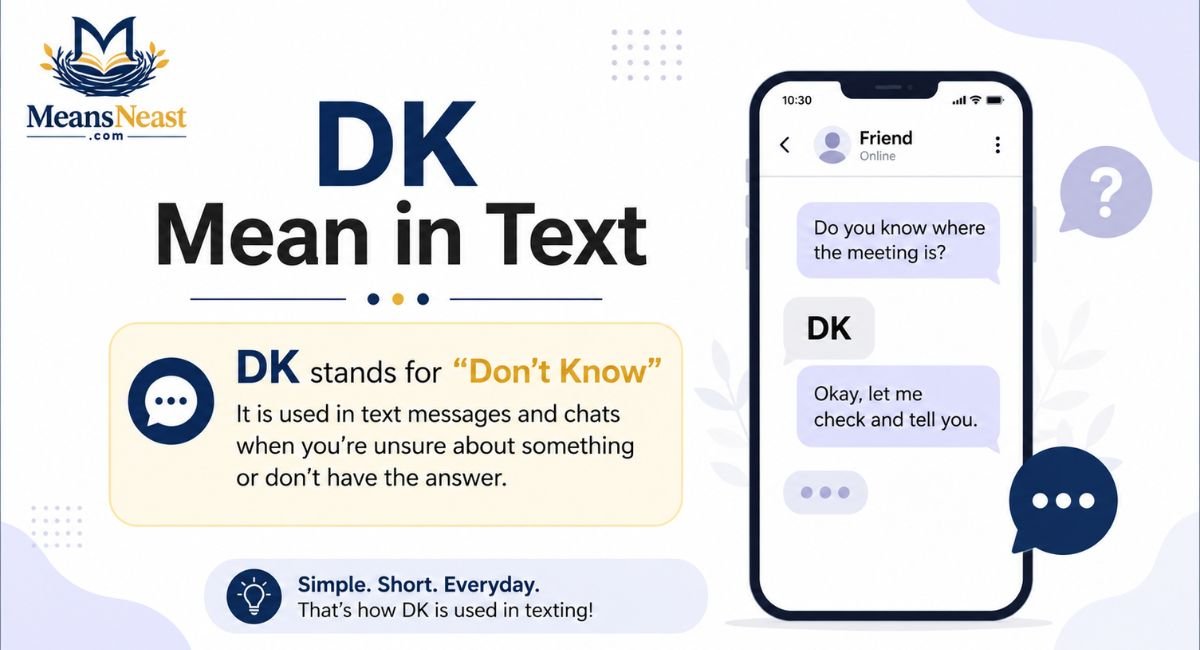
“DK” in text usually means “don’t know” and is commonly used in texting abbreviations and casual online conversations.
People use this short form when they are unsure about something, do not have an answer, or simply want to reply quickly.
You may see chat abbreviations like DK in WhatsApp messages, social media comments, group chats, and private conversations.
The internet slang term is informal, so it works best when talking with friends or people who understand casual messaging language.
The exact meaning can sometimes depend on the context, but in everyday online communication, DK most often means “don’t know.”
Understanding this simple text message language can make conversations easier to follow and help you respond naturally.
What Does DK Mean in Text?
In most texting situations, DK means “don’t know.”
It is a simple text abbreviation used when someone does not know the answer to a question or is uncertain about something.
For example:
Person A: “Do you know where Sarah is?”
Person B: “DK.”
Here, DK simply means “I don’t know.”
Another example:
Person A: “What time does the movie start?”
Person B: “DK, maybe 8?”
The first part shows uncertainty, while the second part gives a possible guess.
Quick Meaning
| Term | Meaning |
| DK | Don’t know |
| DK in texting | Don’t know |
| “DK” meaning in chat: | Don’t know |
| DK in messages | Usually “don’t know” |
| DK abbreviation | A short form of “don’t know” |
The DK text meaning is usually straightforward. Still, you should look at the surrounding words before deciding what the abbreviation means.
What Does DK Mean in Chat and Social Media?
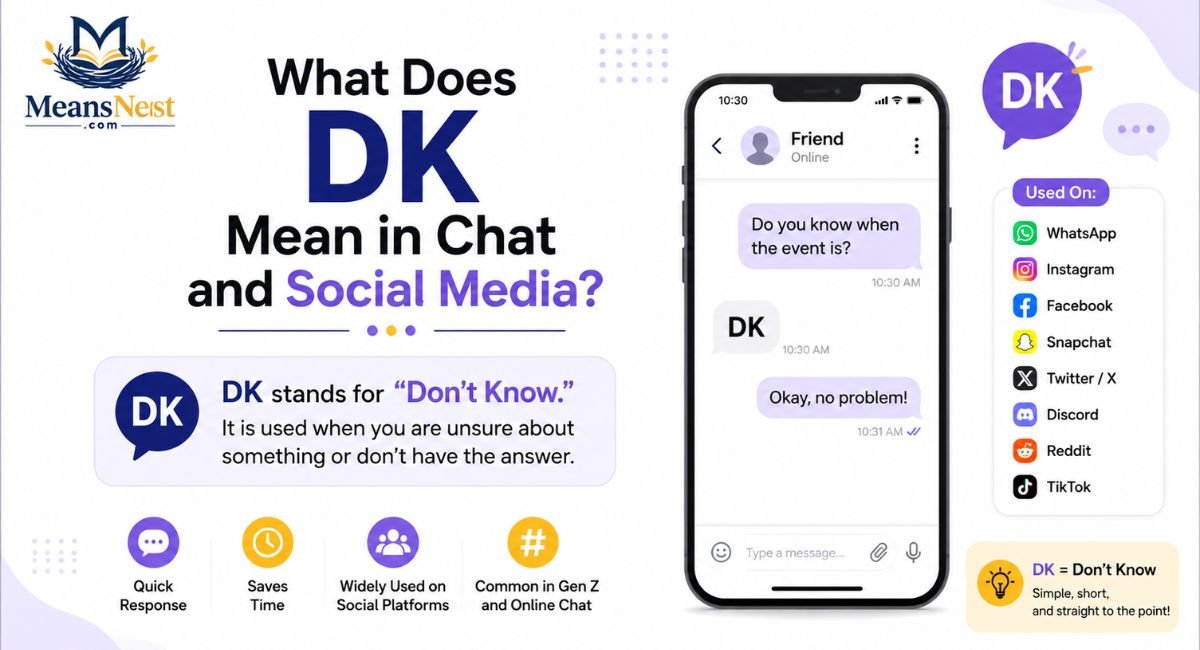
The DK meaning in chat is generally “don’t know.” People use it because typing two letters is faster than writing the complete phrase.
It can appear in private messages, group conversations, comments, and social platforms.
For example:
WhatsApp: “DK what happened.”
Instagram: “DK, I wasn’t there.”
TikTok: “DK why everyone likes it 😂”
Snapchat: “DK, ask him.”
This makes DK in chat a practical example of modern chat abbreviations.
On different platforms, the meaning usually stays the same. The DK WhatsApp meaning, DK Instagram meaning, DK TikTok meaning, and DK Snapchat meaning are normally “don’t know” when used in ordinary conversation.
It is also common to see DK alongside other internet slang and texting abbreviations.
For example:
“IDK, DK what to say.”
Although people normally use “IDK” more frequently for “I don’t know,” DK can still appear as a shortened version in casual communication.
What Does DK Mean From a Guy or Girl?
If you receive “DK” from a guy or girl, it normally means “don’t know.”
The abbreviation itself does not automatically carry a romantic or secret meaning.
For example:
You: “Are you going to the party?”
Them: “DK yet.”
This means the person has not decided.
DK From a Guy
When a guy says DK, the meaning depends on the conversation.
For example:
“DK what I’m doing tonight.”
This simply means he is unsure about his plans.
See Also: What Does KMSL Mean in Text? Meaning, Usage & Examples
DK From a Girl
The same applies when a girl uses DK.
For example:
“DK, maybe I’ll go tomorrow.”
She is saying that she is uncertain.
DK Meaning in Dating
In dating app slang and private messages, DK can still mean “don’t know.”
For example:
You: “Want to meet this weekend?”
Them: “DK, I might be busy.”
This does not necessarily mean yes or no. It indicates uncertainty.
If you are trying to understand DK from a guy or DK from a girl, focus on the complete message, previous conversation, and tone rather than the abbreviation alone.
How Is DK Used in Text Messages?
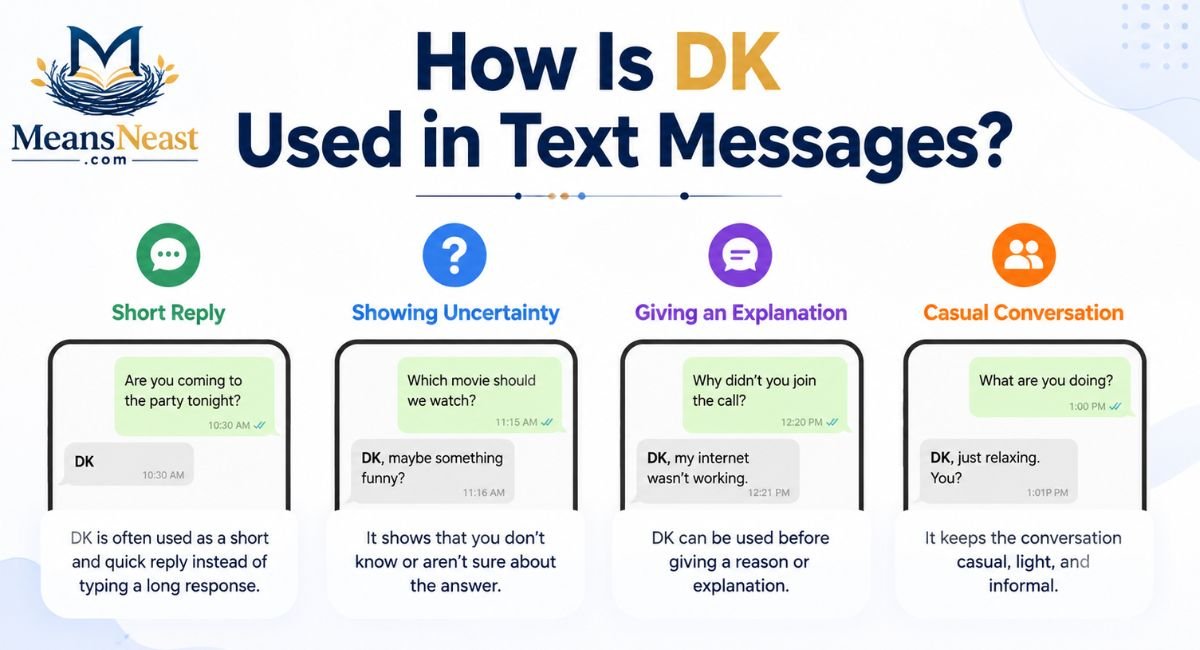
DK is usually used as a short response or as part of a sentence.
People often use it when they want to communicate quickly.
Common patterns include:
- “DK.”
- “DK yet.”
- “DK why.”
- “DK what happened.”
- “DK what to say.”
- “DK if I can.”
- “DK where he went.”
Short Reply
“Where is Mike?”
“DK.”
This is the shortest form.
Showing Uncertainty
“Are you coming?”
“DK yet.”
This tells the other person that the decision has not been made.
Giving an Explanation
“Why did she leave?”
“DK why she left.”
Here, DK is used inside a longer sentence.
Casual Conversation
In DK casual conversation, the abbreviation can make a message feel quick and informal.
It works best with people who already understand common short forms in texting.
For professional communication, however, writing “I don’t know” is usually clearer.
DK Meaning in Different Contexts
The meaning of DK can change depending on the context.
In ordinary texting, it usually means “don’t know.” But context is important because DK is also an acronym with other meanings outside casual messaging.
| Context | Possible DK Meaning |
| Texting | Don’t know |
| Chat | Don’t know |
| Social media | Don’t know |
| Dating | Usually don’t know |
| Gaming | Often don’t know, but may have another meaning |
| Work/business | May refer to a specific organization or term |
| Education | Could be an abbreviation for a subject or name |
| Country-related context | “DK” can refer to Denmark in some settings |
DK in Messages
When someone writes:
“DK what you mean.”
The meaning is almost certainly “don’t know.”
But if “DK” appears in a technical document, username, product name, or organization name, it may have a completely different definition.
That is why DK context matters.
See Also: What Does “Etc.” Mean in Text? Meaning and Usage
DK Meaning in Conversation
In spoken or written conversation, DK can represent uncertainty.
For example:
“I don’t know if that’s true.”
The intended meaning is “I don’t know if that’s true.”
The writing style is informal, so it is more suitable for online communication, texting, and casual conversations.
Other Meanings of DK You Should Know
Although “don’t know” is the most relevant interpretation in casual messaging, DK is also used as a general acronym.
Its meaning can vary by industry, country, platform, or community.
For example, DK can be associated with Denmark in some international contexts. You may also see it used as an abbreviation for names, organizations, gaming terms, brands, or technical expressions.
This is why it is not always safe to assume that every DK acronym means “don’t know.”
The best approach is to check the surrounding information.
Consider these examples:
“DK what happened.”
→ Most likely “don’t know.”
“DK is the country code.”
→ Could refer to Denmark.
“DK character unlocked.”
→ Could refer to a game-specific term.
The difference comes from context rather than the two letters themselves.
This is an important part of understanding abbreviation meanings and internet abbreviations.
DK Texting Examples and Sample Conversations
Seeing DK texting examples makes the meaning easier to understand.
1: Asking About Plans
Alex: “Are you coming tonight?”
Sam: “DK yet.”
Alex: “Let me know later.”
Here, DK means “don’t know.”
2: Asking About Someone
Mia: “Where is John?”
Lena: “DK.”
The reply means “I don’t know.”
3: School Conversation
Tom: “Do we have homework today?”
Jake: “DK, check the group chat.”
The speaker is unsure.
4: Social Media Conversation
A: “Why did he delete the video?”
B: “DK 😂”
The response is casual and brief.
See Also: What Does HBU Mean in Text? Meaning, Uses & Examples
5: Dating Conversation
A: “Are you free Saturday?”
B: “DK. I may have plans.”
Here, the person is uncertain rather than rejecting the invitation.
Group Chat
A: “Who is bringing snacks?”
B: “DK.”
C: “I can bring some.”
This shows how DK can work as a quick response in group messaging.
DK Sentence Examples
Here are some simple DK sentence examples:
- “DK what happened.”
- “DK where she went.”
- “DK if I can come.”
- “DK yet.”
- “DK why he did that.”
- “DK, ask Emma.”
- “DK what time it starts.”
These examples show the normal DK usage in informal communication.
DK Conversation Examples
Conversation 1
You: “What time are they arriving?”
Friend: “DK.”
Conversation 2
You: “Do you like this song?”
Friend: “DK, it’s okay.”
Conversation 3
You: “Are you ordering food?”
Friend: “DK yet.”
The meaning remains connected to uncertainty.
DK vs Similar Texting Abbreviations
DK is related to several common texting terms, but they are not always interchangeable.
| Abbreviation | Meaning | Typical Use |
| DK | Don’t know | Casual uncertainty |
| IDK | I don’t know | Very common uncertainty |
| IDC | I don’t care | Showing lack of concern |
| IMO | In my opinion | Giving an opinion |
| TBH | To be honest | Honest statement |
| WDYT | What do you think? | Asking for an opinion |
| WBU | What about you? | Returning a question |
DK vs IDK
The closest comparison is DK vs IDK.
“IDK” means “I don’t know” and is much more established as a common texting abbreviation.
For example:
“IDK what happened.”
DK can communicate a similar idea:
“DK what happened.”
Both can express uncertainty, but IDK is generally more recognizable.
DK vs IDC
These two should not be confused.
DK = Don’t know
IDC = I don’t care
For example:
“DK where he is.”
means the person does not know.
“IDC where he is.”
means the person does not care where he is.
That difference can completely change the tone of a message.
Understanding these common texting terms can prevent unnecessary confusion.
Is DK Rude, Confusing, or Appropriate to Use?
DK is not automatically rude.
However, a very short answer can sometimes sound cold or uninterested.
For example:
“Do you know where my keys are?”
“DK.”
This is probably neutral.
But:
“Can you help me with this?”
“DK.”
Depending on the situation, the response might sound dismissive because it does not explain anything.
The tone depends on the relationship and conversation.
When DK Is Appropriate
DK works well in:
- Friendly texts
- Group chats
- Casual messaging
- Social media conversations
- Gaming chats
- Informal communication
- Quick replies
See Also: What Does X Mean in Text? Complete Guide to X Meaning
When to Avoid DK
It may be better to avoid DK in
- Job applications
- Formal emails
- Academic writing
- Customer support
- Professional communication
- Important business messages
In these situations, complete sentences are usually clearer.
Instead of:
“DK.”
Write:
“I’m not sure.”
or:
“I don’t know, but I can check.”
This creates more helpful online communication and avoids ambiguity.
How to Reply When Someone Says DK?
The best DK response depends on what you asked.
If someone simply says “DK,” you can ask a follow-up question.
For example:
You: “Do you know when the store closes?”
Them: “DK.”
You: “No problem. I’ll check.”
You can also encourage them to find the answer.
Them: “DK where she is.”
You: “Maybe ask Mark.”
If You Need More Information
You can say:
- “Can you find out?”
- “No worries.”
- “Okay, thanks.”
- “Do you want me to check?”
- “Any idea?”
- “Maybe ask someone else.”
If DK Sounds Unclear,
If the answer could be interpreted in several ways, simply ask:
“Do you mean you’re not sure?”
This is especially useful in online conversations where tone can be difficult to read.
How to Use DK in a Text
If you want to use DK yourself, keep it for situations where the meaning is obvious.
For example:
“Not yet, I’ll let you know.”
This is more informative than simply saying “DK.”
Using a little extra context can make DK communication clearer without making the message unnecessarily long.
❓ Frequently Asked Questions (FAQs)
What does DK mean in chat?
DK usually means “don’t know” in casual chats and messages.
What is DK when texting?
DK is a short form of “don’t know,” used for quick informal replies.
What does “DK” mean from a girl?
From a girl, DK usually means “don’t know” and does not have a special hidden meaning.
What does DK mean?
DK most commonly means “don’t know” in texting and online communication.
What does DK mean in Snap?
On Snapchat, DK usually means “don’t know” when used in casual messages.
Conclusion
The most common DK mean in text is “don’t know.” It is a short and informal way to express uncertainty in messages, chats, and social media conversations.
You may see DK in WhatsApp slang, Instagram slang, TikTok slang, Snapchat abbreviations, group chats, and everyday online communication. Its meaning is usually easy to identify from the sentence around it.
Still, context matters because DK can have other meanings outside casual texting. If you are unsure, look at the topic and surrounding words before interpreting the abbreviation.
For everyday messaging, DK is useful when you want a quick answer. When clarity matters, however, writing “I don’t know” or “I’m not sure” is often the better choice.

Hi, I’m Kaif Ali, creator of MeansNest. I’m an SEO professional passionate about helping people understand the meanings of words, text slang, and online expressions through clear, accurate, and easy-to-read content. I create SEO-friendly guides that deliver real value while making learning simple for everyone.