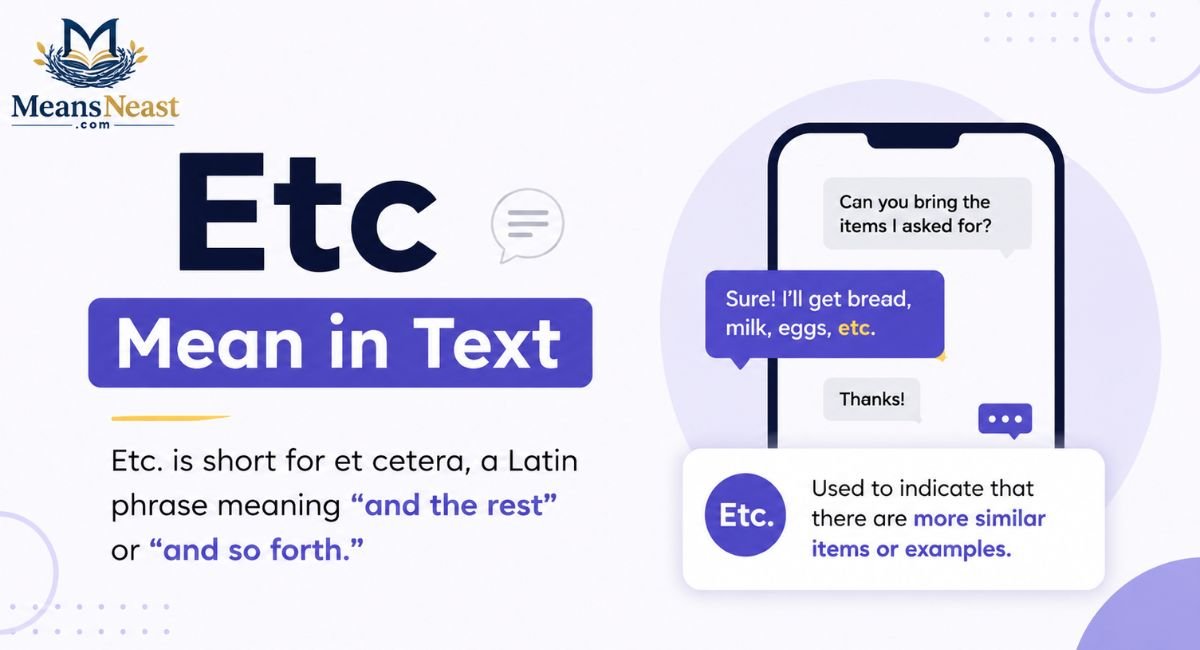
“Etc.” is a common abbreviation used in text messages, social media, and everyday writing. It comes from the Latin phrase et cetera, meaning “and so on” or “and other things.”
People use it when they want to mention several examples without listing every item. For example, “Bring snacks, drinks, plates, etc.” means there are other similar items to bring.
The “etc.” meaning in chat is generally the same as in formal writing, although it is especially convenient in casual texting and online conversations.
Understanding the meaning of “et cetera” and proper punctuation can help you use this common abbreviation naturally and correctly in messages.
What Does “Etc.” Mean in Text?
In text messages, “etc.” usually means “and so on,” “and so forth,” or “and other similar things.” It tells the reader that the writer has mentioned only some examples from a larger group.
For example:
“I need to buy notebooks, pens, folders, etc.”
The writer does not mean only notebooks, pens, and folders. They are also referring to other related school supplies.
The definition of “etc.” is therefore connected to an incomplete list. It provides a list continuation without requiring the writer to mention every item.
Quick meaning
| Term | Meaning |
| Etc. | And so on |
| Et cetera | And other things |
| “Etc.” in texting | The list continues |
| “Etc.” in conversation | Similar things are included |
| “Etc.” on social media | More related examples exist |
The meaning normally stays the same whether you see “etc.” in a text, email, comment, or social media post.
What Does Et Cetera (Etc.) Mean?
Et cetera is a Latin phrase that literally refers to “and the rest” or “and other things.” In modern English, it is commonly understood as “and so on” or “and so forth.”
“Etc.” is simply the shortened form.
The “et cetera” spelling is
et cetera
The common abbreviation is:
etc.
The period after “etc.” is important because it shows that the word has been abbreviated.
For example:
- Correct: “Bring shoes, socks, jackets, etc.”
- Incorrect: “Bring shoes, socks, jackets, etc.”
In American English, the period after “etc.” is normally retained because “etc.” is an abbreviation.
See Also: What Does HBU Mean in Text? Meaning, Uses & Examples
How to pronounce et cetera
“Et cetera” is commonly pronounced approximately as et-SET-er-uh.
The abbreviation “etc.” is usually read aloud as “et cetera,” rather than saying each letter separately.
Knowing the pronunciation helps when moving between spoken and written communication.
How Is “Etc.” Used in Text Messages and Chat?
The “etc.” abbreviation in texting is used to shorten a list. It is especially useful when the writer has already provided enough examples for the reader to understand the category.
For example:
“We talked about school, exams, teachers, etc.”
The message suggests that the conversation included other school-related topics too.
In online conversation, “etc.” can make a message more concise without changing its main meaning.
You may see it in:
- text messages
- WhatsApp messages
- Instagram messages
- TikTok comments
- social media posts
- emails
- group chats
- everyday conversation written online
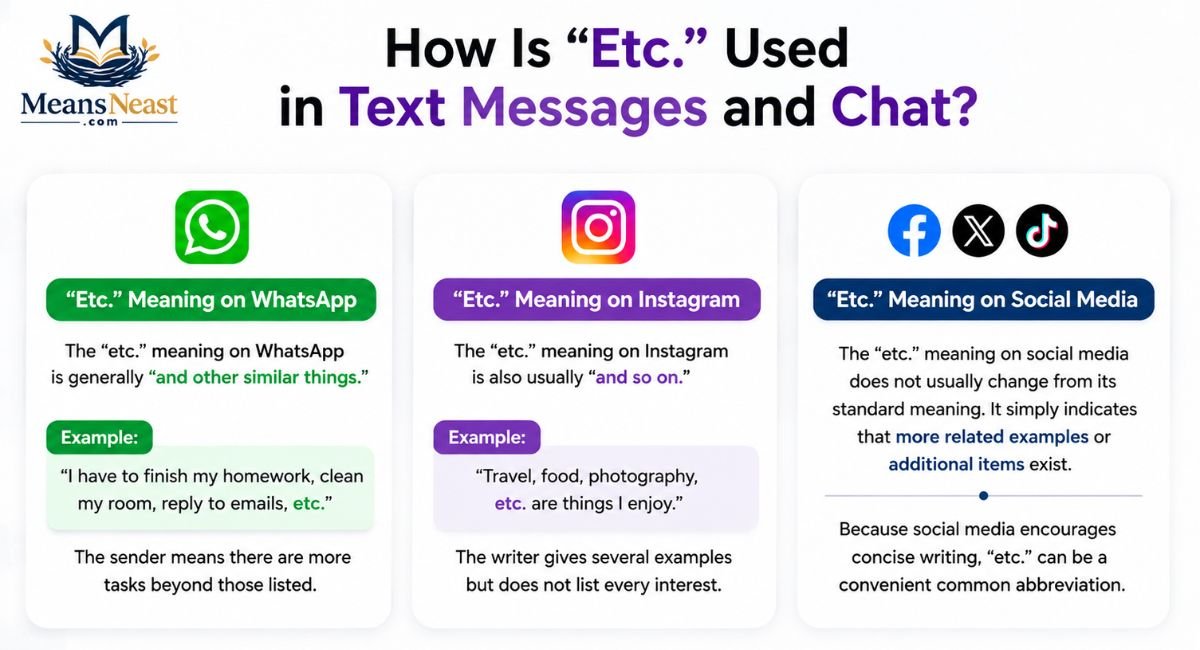
“Etc.” meaning on WhatsApp
The “etc.” meaning on WhatsApp is generally “and other similar things.”
Example:
“I have to finish my homework, clean my room, reply to emails, etc.”
The sender means there are more tasks beyond those listed.
“Etc.” meaning on Instagram
The “etc.” meaning on Instagram is also usually “and so on.”
Example:
“Travel, food, photography, etc. are things I enjoy.”
The writer gives several examples but does not list every interest.
“Etc.” meaning on social media
The “etc.” meaning on social media does not usually change from its standard meaning. It simply indicates that more related examples or additional items exist.
Because social media encourages concise writing, “etc.” can be a convenient common abbreviation.
When Should You Use “Etc.”
You should use “etc.” when you have already provided enough examples and the remaining items are similar or obvious.
It works best when the reader can reasonably understand what the missing items would be.
1. When listing similar things
“I bought apples, bananas, oranges, etc.”
The reader understands that other fruits may also be included.
2. When saving space
“The store sells clothes, shoes, bags, accessories, etc.”
Listing every product would make the sentence unnecessarily long.
3. In casual texting
“Bring your charger, headphones, laptop, etc.”
This is natural in informal communication.
4. In everyday conversation
“We discussed movies, music, sports, etc.”
The writer is giving a list of examples, not a complete inventory.
5. In concise writing
“Etc.” can be useful when concise writing is more important than providing an exhaustive list.
However, the reader should still be able to understand what category the omitted items belong to.
When Should You Avoid Using “Etc.”?
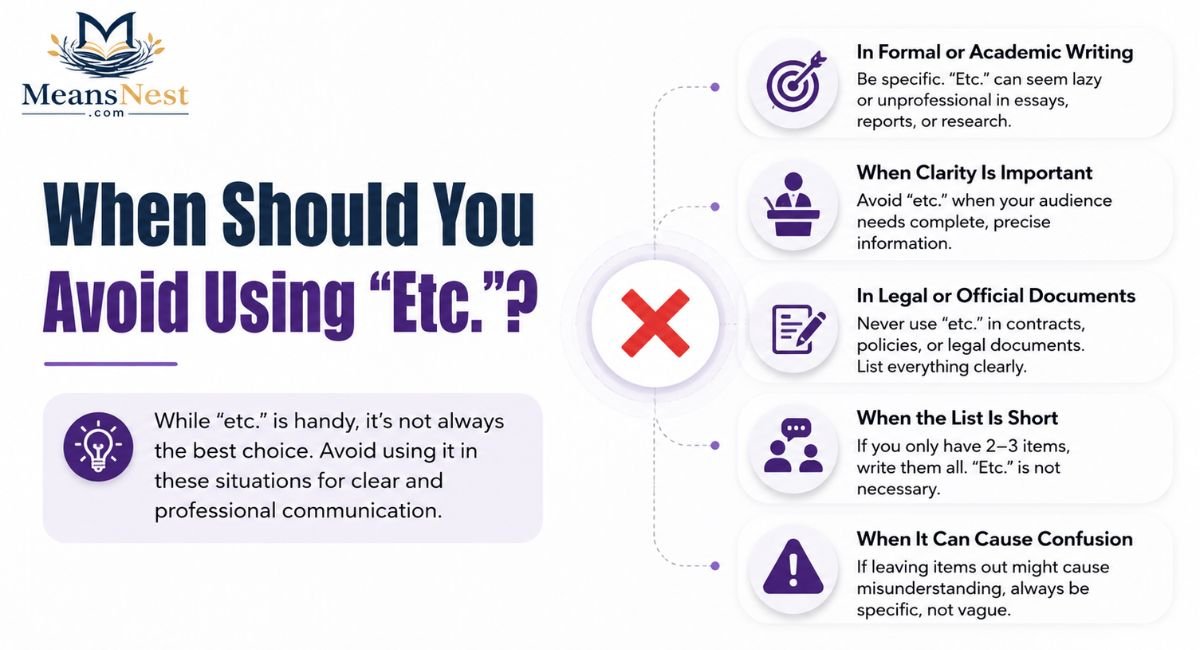
Although “etc.” is useful, it is not appropriate in every situation.
Avoid it when the reader needs a complete and exact list.
For example, in a legal document, safety instruction, technical specification, or official procedure, vague wording can create confusion.
Instead of:
“Submit your ID, passport, documents, etc.”
A formal instruction may need to identify exactly which documents are required.
You should also avoid “etc.” when the list is already unclear.
For example:
“I like cars, books, computers, etc.”
What does “etc.” include? The categories are too broad and unrelated.
Another common problem is using “etc.” after only one example.
Weak:
“I like pizza, etc.”
The reader does not know what other things are being included.
Better:
“I like pizza, burgers, pasta, etc.”
The examples establish a clearer category.
See Also: What Does X Mean in Text? Complete Guide to X Meaning
When not to use, etc.
Avoid “etc.” when:
- every item needs to be specified
- the list contains unrelated things
- the missing information could cause confusion
- the document requires precise instructions
- you have provided only one unclear example
- “etc.” would hide important information
This is especially important in formal writing, where precision often matters more than brevity.
How to Use “Etc.” Correctly in a Sentence
The correct way to write, etc., depends on punctuation, sentence structure, and the type of list.
The most common pattern is
“We bought bread, milk, eggs, etc.”
A comma before “etc.” is commonly used when “etc.” follows a series of items.
Correct examples
- “Bring pens, pencils, notebooks, etc.”
- “She enjoys reading, writing, painting, etc.”
- “We visited parks, museums, markets, etc.”
- “The course covers grammar, vocabulary, pronunciation, etc.”
Punctuation rules
The main, etc., punctuation rules are simple.
1. Use a period after “etc.”
“Books, magazines, newspapers, etc.”
2. Usually place a comma before “etc.”
“I need paper, envelopes, stamps, etc.”
3. Avoid unnecessary repetition
Do not write:
“etc.”
“Etc.” already carries the idea of continuation, so “and etc.” is generally redundant.
4. Do not combine “etc.” with “and so on.”
For example:
“Bring pens, pencils, paper, etc. and so on.”
This is repetitive. Choose one.
What about “etc.” at the end of a sentence?
If “etc.” ends the sentence, its existing period also serves as the sentence-ending period.
Correct:
“We discussed movies, music, books, etc.”
You do not normally need another period.
If the sentence requires another punctuation mark, the situation can vary depending on the punctuation.
“Etc.” Examples in Different Contexts
The best way to understand et cetera examples in sentences is to see how the abbreviation works in different situations, etc.
Casual texting
“I need to finish my work, clean the kitchen, do laundry, etc.”
Meaning: There are other chores too.
School
“Bring your notebook, textbook, calculator, etc.”
Meaning: Bring these and other relevant school supplies.
Work
“Please review the reports, emails, invoices, etc.”
Meaning: Review those documents and other similar materials.
Shopping
“We need milk, bread, eggs, fruit, etc.”
Meaning: These are examples of the groceries needed.
See Also: What Does IK Mean in Text? Complete Guide to IK Meaning and Usage
Travel
“Pack clothes, toiletries, chargers, documents, etc.”
Meaning: Pack these things along with other travel essentials.
Social media
“I love taking photos of food, places, people, sunsets, etc.”
Meaning: These are examples of subjects the person enjoys photographing.
Friends chatting
“We talked about college, jobs, movies, relationships, etc.”
Meaning: The conversation covered these and other topics.
Formal communication
“The report includes information about sales, expenses, revenue, etc.”
Here, “etc.” can work if the omitted items are clear and the document does not require an exhaustive list.
| Context | Example | Meaning |
| Text message | “Bring snacks, drinks, etc.” | Bring these and similar things |
| School | “Pens, books, folders, etc.” | Other school supplies too |
| Work | “Reports, invoices, emails, etc.” | Other related documents |
| “Movies, music, games, etc.” | Other similar interests | |
| “Travel, food, photos, etc.” | More related topics | |
| Everyday conversation | “Sports, movies, books, etc.” | Other similar subjects |
These examples show why “etc.” is useful for list abbreviations and quick communication.
Etc. vs. Similar Terms and Alternatives
“Etc.” has several close alternatives, but they are not always interchangeable.
Etc. vs. et cetera
There is no major difference in meaning.
- et cetera = full phrase
- etc. = abbreviation
Example:
“Bring books, pens, notebooks, et cetera.”
“Bring books, pens, notebooks, etc.”
The second version is shorter.
This explains “etc.” vs. “et cetera”: they communicate the same basic idea.
“Etc.” vs. “and so on”
“Etc.” vs. “and so on” is mostly a difference in style.
“We discussed sports, movies, music, etc.”
“We discussed sports, movies, music, and so on.”
Both indicate that the list continues.
“And so on” can sound slightly more conversational, while “etc.” is compact and common in writing.
“Etc.” vs. “and so forth
The difference between “etc.” and “and so forth” is also small.
“She likes reading, writing, drawing, etc.”
“She likes reading, writing, drawing, and so forth.”
Both suggest similar additional examples.
Etc. vs. e.g.
This distinction is important.
e.g. means “for example.” It introduces examples rather than saying that the list continues.
For example:
“You can use fruit, e.g., apples or oranges.”
This means apples and oranges are examples.
By contrast:
“You can use apples, oranges, bananas, etc.”
This means the list continues with other similar fruits.
Therefore, “etc.” vs. “e.g.” should not be confused.
| Term | Basic meaning | Main purpose |
| etc. | And so on | Continue the list. |
| et cetera | And other things | Full form of etc. |
| and so on | More similar things | Continue the list. |
| and so forth | More similar things | Continue the list. |
| e.g. | For example, | Introduce examples |
Alternatives to “etc.”
Depending on the context, possible alternatives to “etc.” include the following:
- and so on
- and so forth
- and other similar things
- among other things
- and more
- including others
The best choice depends on the sentence and the level of formality.
Common Mistakes and Misconceptions About “Etc.”
There are several common mistakes with “etc.” that are easy to avoid.
1: Writing “ect.”
A frequent spelling error is
“etc.”
The correct spelling is:
“etc.”
The abbreviation comes from “et cetera,” so the letters are “etc.,” not “ect.”
2: Writing “etc.” without a period
In standard writing, the abbreviation is normally written:
“etc.”
The period represents the abbreviated form.
3: You and singing “and etc.”
For example:
“Bring books, pens, etc.”
This is incorrect or unnecessarily repetitive.
Use:
“Bring books, pens, etc.”
See Also: What Does LCR Mean in Text? Meanings, Uses, and Examples
4: Using “etc.” after an incomplete idea
Consider:
“I like sports, etc.”
This gives the reader little information.
A better sentence would provide several clear examples first.
5: Confusing “etc.” with “e.g.”
Remember:
- e.g. = for example
- etc. = and so on
They perform different jobs.
6: Assuming “etc.” means anything
“Etc.” should normally refer to things that are similar to the examples already given.
If you write:
“I bought apples, shoes, a laptop, etc.”
The category is unclear.
The reader cannot easily determine what the remaining items are supposed to be.
7: Overusing “etc.”
Using “etc.” in every list can make writing vague.
If the exact information matters, write the complete list instead.
These rules help maintain proper usage, correct spelling, and clear punctuation.
How to Reply When Someone Uses “Etc.” in a Text
How you respond depends on the meaning and context of the message.
If the person uses “etc.” after a clear list, you may not need to ask anything.
For example:
Friend: “I need to buy groceries—milk, bread, eggs, etc.”
You could reply:
“Got it. Do you need anything else?”
If you want clarification, ask what additional items they mean.
“What else should I bring?”
Or:
“What do you mean by etc.?”
For casual conversations, a simple response is usually enough.
conversation 1
A: “Bring snacks, drinks, plates, etc.”
B: “Sure. Anything specific?”
conversation 2
A: “We talked about school, exams, teachers, etc.”
B: “Sounds like you covered a lot.”
conversation 3
A: “I enjoy movies, music, games, etc.”
B: “Nice! What kind of movies do you like?”
The key is to understand that “etc.” normally signals remaining items that the writer has chosen not to list.
❓ Frequently Asked Questions (FAQs)
What does “etc.” mean in chat?
“Etc.” means “and so on” or “and other similar things.”
What does “etc.” mean?
“Etc.” is short for et cetera, meaning “and other things.”
How to use “etc.” in a text?
Use “etc.” at the end of a list when you do not want to mention every similar item, e.g., “Bring snacks, drinks, plates, etc.”
What is the full form of etc.?
The full form of “etc.” is et cetera, a Latin phrase meaning “and so on.”
What does ECT mean in text?
“ECT” can have different meanings depending on context, but it is not the standard spelling of “etc.” “Etc.” means “and so on.”
Conclusion
The “etc.” meaning in text is simple: it usually means “and so on,” “and so forth,” or “and other similar things.” It comes from the Latin phrase “et cetera” and is widely used in text messages, social media, emails, and other forms of written communication.
Using “etc.” correctly can make writing more concise, especially when a list contains many similar items. However, it should not replace important details or be used when the reader needs a complete list.
Remember the basics: use the correct “et cetera” spelling, write “etc.” with a period, use appropriate punctuation, and make sure the examples before “etc.” clearly establish the category. Whether you see the “etc.” meaning on WhatsApp, Instagram, TikTok, or in formal writing, the core meaning remains the same: the list continues.

Hi, I’m Kaif Ali, creator of MeansNest. I’m an SEO professional passionate about helping people understand the meanings of words, text slang, and online expressions through clear, accurate, and easy-to-read content. I create SEO-friendly guides that deliver real value while making learning simple for everyone.