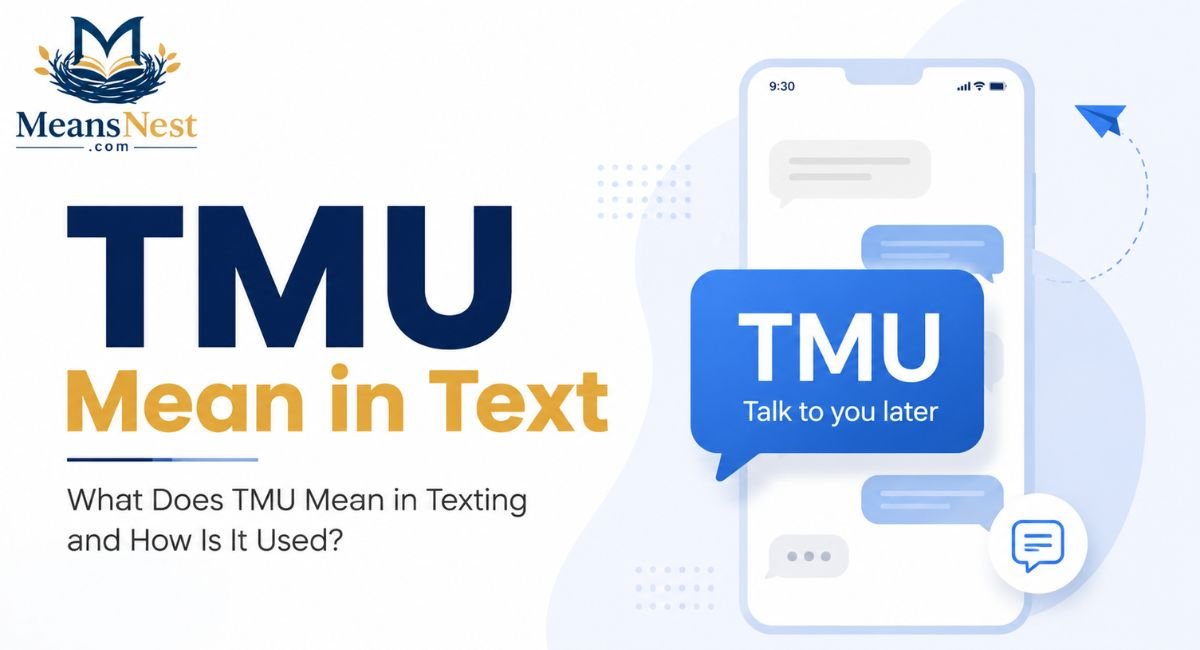
“TMU” means “talk to me, usually” in text and can be confusing when you first see it in a message, comment, or DM.
Unlike some common texting abbreviations, TMU can have different meanings depending on the conversation and the person using it.
In casual online communication, it may be used as a short way to ask someone to continue messaging or contact them later.
However, its exact meaning can change with the context, making it important to read the full message before replying.
This guide explains the TMU slang, possible meanings, and real chat abbreviation examples you may encounter on WhatsApp, Instagram, TikTok, and Snapchat. You’ll also learn how to respond naturally when someone sends “TMU.”
What Does TMU Mean in Text and Chat?
TMU is an informal chat abbreviation that can have different interpretations depending on the context.
One common interpretation is “Text Me Up,” meaning that someone wants you to message or contact them. For example:
“I have to go now. TMU later.”
Here, the sender is essentially asking the other person to text them later.
Another interpretation can be “Tell Me U” or a similar context-based phrase where the sender wants the other person to share information or respond. Because TMU is not a universally standardized texting abbreviation, you should look at the complete message before deciding what it means.
Quick Meaning of TMU
| TMU use | Possible meaning | Typical purpose |
| TMU | Text me up. | Asking someone to message |
| TMU | Tell Me U | Asking someone to share or respond |
| TMU | Context-specific phrase | Meaning depends on the conversation |
So, if someone asks what “TMU” means in text, the safest answer is: TMU is an informal abbreviation whose meaning depends on context, with “Text Me Up” being one common interpretation.
This is important because internet slang changes quickly. A phrase that makes sense in one friend group may mean something different in another.
What Does TMU Stand For? Different Meanings Explained
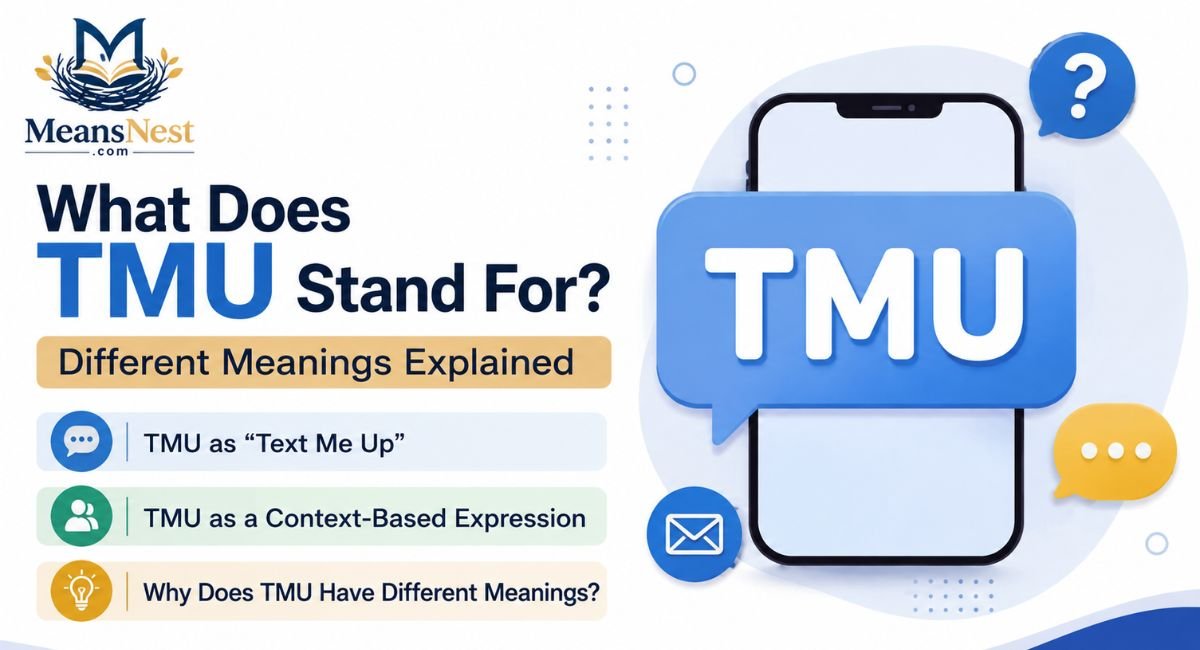
The TMU full form is not universally agreed upon in texting. Unlike formal acronyms, modern messaging shorthand can be created or adapted by individual online communities.
TMU as “Text Me Up”
“Text Me Up” is one interpretation used in casual conversations. It generally asks someone to contact the sender through a message.
Example:
“I’m busy right now, TMU tonight.”
The intended idea is that the person should message later.
TMU as a Context-Based Expression
Sometimes people use TMU as a shortened expression without following a formal acronym structure. The sender may expect the other person to understand the phrase from the surrounding conversation.
For example:
“I told you my side, TMU?”
The exact interpretation depends on what the two people were discussing.
Why Does TMU Have Different Meanings?
There are several reasons:
- Texting slang is often informal.
- People create their own slang expressions.
- Social platforms encourage short messages.
- Different online communities develop different terminology.
- A few letters can represent different phrases.
Therefore, the TMU definition should always be interpreted with context rather than treated as one universal rule.
How Is TMU Used in Text Conversations?
The TMU usage is generally casual. People may use it when they want to keep a conversation going or encourage someone to contact them.
For example:
“I’m heading home now. TMU later.”
The abbreviation makes the message shorter without changing its basic purpose.
Another example is:
“Got something funny to tell you. TMU.”
Here, the sender is encouraging the recipient to message them.
See Also: PH Meaning in Text: Full Form, Slang & Examples
TMU in a Friendly Conversation
A: “I have to leave for class.”
B: “Okay, TMU after!”
The phrase can make a simple request feel relaxed and conversational.
TMU in a Personal Conversation
“I’m going offline for a while. TMU when you’re free.”
This use suggests that the sender wants to continue talking later.
TMU in Casual Online Communication
Short forms such as TMU are part of modern digital communication. They are especially useful when people are typing quickly on phones.
However, TMU is not as universally understood as common online acronyms. If the recipient does not know the abbreviation, the message may create confusion.
TMU Meaning on WhatsApp, Instagram, TikTok & Snapchat
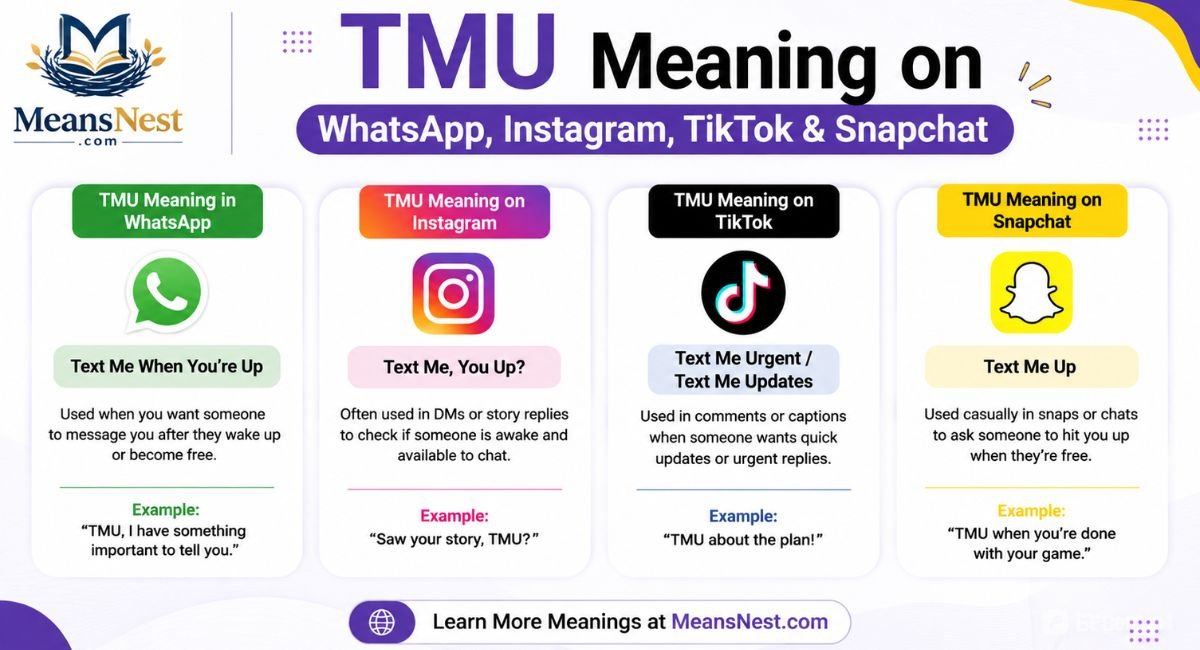
The TMU meaning on social media generally depends more on context than on the platform itself.
TMU Meaning in WhatsApp
The TMU meaning in WhatsApp is usually understood through the surrounding chat.
Example:
“I’m going to dinner. TMU after 9.”
The sender likely wants the recipient to message later.
Since WhatsApp conversations are often personal, TMU may appear between friends, relatives, couples, or other contacts.
TMU Meaning on Instagram
The TMU meaning on Instagram can appear in DMs, comments, or story replies.
For example:
“Nice pic 😂 TMU later.”
Here, the phrase can function as a casual invitation to continue chatting.
TMU Meaning on TikTok
The TMU meaning on TikTok may depend strongly on the comment or caption where it appears.
TikTok has many forms of social media slang, so an abbreviation can sometimes have a community-specific meaning.
If someone comments only “TMU,” check the creator’s caption and surrounding comments before interpreting it.
TMU Meaning on Snapchat
The TMU meaning on Snapchat is also context-dependent. Snapchat conversations are usually quick and informal, so abbreviations and messaging shorthand are common.
For example:
“Can’t talk rn, TMU later.”
The intended meaning is likely a request to continue messaging later.
TMU Texting Examples in Different Situations
Looking at TMU text examples is one of the easiest ways to understand how the abbreviation may work.
1: Talking to a Friend
Alex: “I’m going out for a bit.”
Sam: “Okay, TMU later.”
Here, TMU is being used as a casual request to message later.
2: Making Plans
A: “I’ll know my schedule tonight.”
B: “Cool, TMU when you know.”
The abbreviation keeps the conversation short.
3: Continuing a Conversation
A: “I have more to tell you 😂”
B: “Wait, what happened?”
A: “TMU later and I’ll explain.”
This creates a natural reason to continue the conversation.
See Also: What Does DHZ Mean in Text? Meaning, Uses & Examples
4: Flirty Conversation
A: “You’re leaving already?”
B: “Yeah, unfortunately.”
A: “TMU later.” 😉
The meaning may be friendly or slightly flirty depending on the relationship and emoji.
5: Social Media DM
“Your story was hilarious 😂 TMU sometime.”
Here, the sender is showing interest in continuing communication.
6: Group Chat
Friend 1: “Who is coming tonight?”
Friend 2: “Not sure yet.”
Friend 1: “TMU when you decide.”
Again, the exact interpretation comes from the surrounding words.
These TMU chat examples show why context is important. The abbreviation itself is short, but the sentence around it gives the reader the real clue.
How to Reply When Someone Says “TMU”
Knowing how to respond to TMU depends on what the sender appears to mean.
If they are asking you to message later, you can simply agree.
Casual Replies
- “Sure, I will.”
- “Okay, sounds good.”
- “Yep, I’ll text you later.”
- “Got it 😂”
- “No problem.”
If You Are Unsure
The safest response is to ask the following:
“What do you mean by TMU?”
There is nothing wrong with asking for clarification. Since TMU is not one of the most standardized popular texting terms, the sender may have a personal meaning in mind.
If the Conversation Is Flirty
You can match the tone without overthinking it:
“I will.” 😉
or:
“Definitely.”
Your response should fit the relationship and the rest of the conversation rather than the abbreviation alone.
Is TMU slang, rude, flirty, or appropriate?
TMU is generally informal texting slang, but its tone can change depending on who uses it and how it appears.
Is TMU slang?
Yes. In casual messaging, TMU can function as internet slang or an informal abbreviation.
It belongs to the broader world of modern texting terms, where people shorten phrases to communicate faster.
Is TMU rude?
Not necessarily.
The abbreviation itself is not inherently rude. A message such as:
“TMU when you get home.”
can sound completely normal between friends.
However, a very short message can sometimes seem cold or demanding if there is no other context.
See Also: HWY Mean in Text: Meaning, Uses & Examples
Is TMU Flirty?
TMU is not automatically flirty.
A flirty interpretation may occur when it appears in a romantic conversation, especially with emojis or affectionate language.
For example:
“Had fun talking to you. TMU later 😉.”
The flirtatious feeling comes from the overall message, not simply from the letters TMU.
Is TMU Appropriate at Work?
It is better to avoid TMU in formal emails, professional documents, or important workplace communication.
Use clear language instead:
“Please message me when you are available.”
Clear wording is preferable when there is a possibility of misunderstanding.
TMU in Other Fields and Contexts
TMU is not limited to text message abbreviations. Three-letter acronyms can have completely different meanings in education, technology, business, engineering, organizations, and other fields.
For example, “TMU” can refer to a Time Measurement Unit in technical contexts. It can also appear as an abbreviation for names of institutions or organizations.
This creates an important distinction:
TMU in a text message → likely informal slang or messaging shorthand.
TMU in a technical document → potentially a specialized acronym.
Therefore, do not assume that every occurrence of TMU has a social-media meaning.
If you see TMU in a workplace report, textbook, research paper, or technical document, read the surrounding material before interpreting it.
TMU vs Similar Texting Abbreviations
TMU can sometimes be confused with other texting abbreviations because many online expressions have similar purposes.
| Abbreviation | Common meaning | Main purpose |
| TMU | Text Me Up / context-based meaning | Encourages contact or conversation |
| HMU | Hit Me Up | Asks someone to contact you |
| DM | Direct Message | Refers to private messaging |
| LMK | Let Me Know | Requests information or an update |
| TTYL | Talk to you later. | Ends or pauses a conversation |
| BRB | Be Right Back | Indicates a temporary absence |
Among these, HMU is especially easy to confuse with TMU because both can appear when someone wants another person to make contact.
See Also: “Lonk” Meaning in Text: Definition, Uses & Examples
For example:
“HMU when you’re free.”
is a familiar way of saying
“Contact me when you’re free.”
If someone uses TMU in a similar situation, context can help determine the intended meaning.
Understanding these common chat acronyms makes online conversations easier to follow.
Common Misunderstandings About TMU
TMU creates confusion mainly because it does not have one universally accepted meaning in casual online communication.
1: Assuming There Is Only One Full Form
People sometimes search for one definitive TMU full form. In reality, informal abbreviations can vary between communities.
2: Treating Every TMU as Slang
TMU may have technical, organizational, or industry-specific meanings outside social conversations.
3: Assuming It Is Flirty
A person using TMU is not automatically flirting. The relationship, wording, emojis, and conversation history matter.
4: Assuming It Is Rude
A short abbreviation may look blunt, but that does not mean the sender intends to be rude.
5: Ignoring the Sentence Around It
The words before and after “TMU” are often the biggest clue to the TMU conversation’s meaning.
When you are unsure, simply ask the sender what they meant. That is usually better than making an incorrect assumption.
❓ Frequently Asked Questions (FAQs)
What does TMU slang mean?
TMU usually means “Tell Me Up” in slang, asking someone to keep you informed or updated.
What does TMU mean in messages?
TMU can mean “Tell Me Up,” depending on the conversation.
What does TMU mean?
TMU most commonly means “Tell Me Up” in texting and slang.
What does TMU mean in Snap?
On Snapchat, TMU can mean “Tell Me Up” or ask someone to update you.
What does “TMU” mean on Instagram?
On Instagram, TMU can mean “Tell Me Up,” especially when asking for an update.
Conclusion
The TMU meaning in text can be confusing because the abbreviation does not have one universally fixed meaning.
In casual messaging, one common interpretation is “Text Me Up,” while other context-based meanings may appear in different conversations or online communities.
The safest way to understand TMU is to look at the complete message, tone, relationship, and platform.
Whether you encounter TMU in WhatsApp, Instagram, TikTok, Snapchat, or another form of digital communication, context is the key.
If the meaning is still unclear, asking the sender is the simplest way to avoid misunderstanding.

Hi, I’m Kaif Ali, creator of MeansNest. I’m an SEO professional passionate about helping people understand the meanings of words, text slang, and online expressions through clear, accurate, and easy-to-read content. I create SEO-friendly guides that deliver real value while making learning simple for everyone.