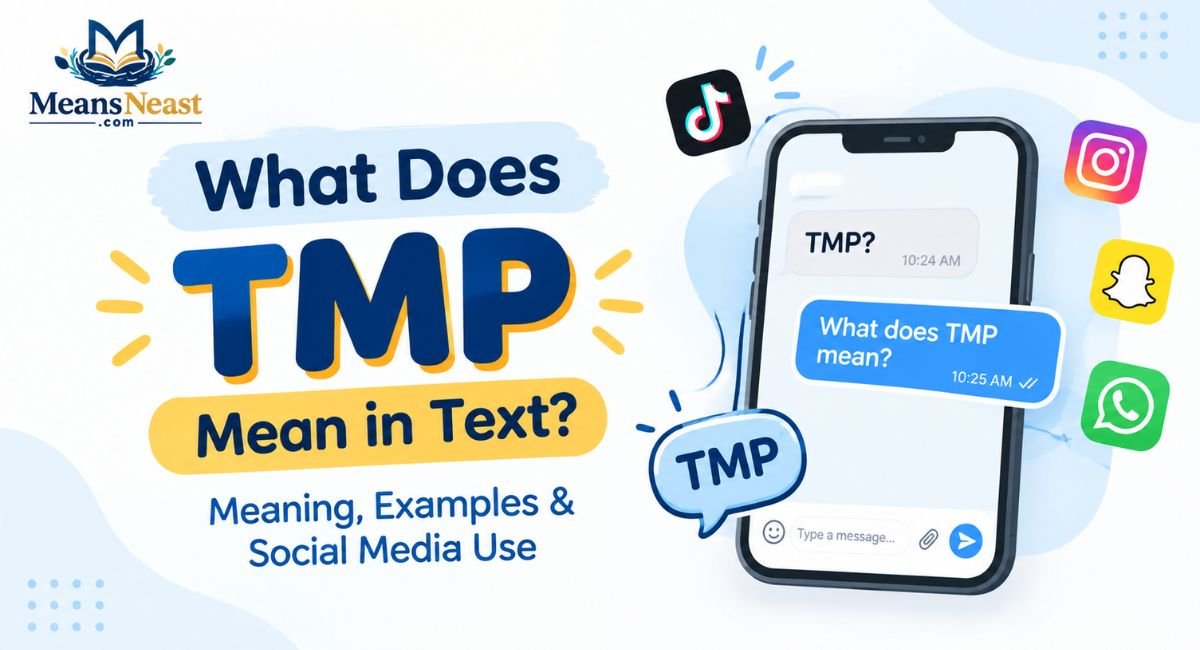
TMP is a texting abbreviation that can mean “tomorrow” in casual conversations, depending on the message context.
People may use this short form when discussing plans, appointments, school, work, or something happening the next day.
You might come across TMP in chat while texting friends or communicating on WhatsApp, Instagram, Snapchat, or TikTok.
Since TMP is less standardized than abbreviations such as TMR or TMRW, its meaning can sometimes be unclear without the surrounding conversation.
In this guide, we’ll explain the TMP text message meaning, show realistic examples, compare TMP with similar abbreviations, and explain how to reply when someone uses TMP in a casual message.
What Does TMP Mean in Text?
In casual texting, TMP can mean “tomorrow.” It is used as a shortened form when someone wants to refer to the following day without typing the complete word.
For example:
“Are you free, TMP?”
This generally means:
“Are you free tomorrow?”
TMP is a text abbreviation or short form rather than a formal English word. It is more likely to appear in quick messages between friends, classmates, coworkers, or people who regularly communicate through instant messaging.
Because TMP is not one of the most standardized common texting terms, you should always consider the surrounding message before deciding what it means.
For example:
“Can you send it TMP?”
If the conversation is about a deadline, TMP may mean the sender wants it sent tomorrow.
The conversation context makes the intended meaning clearer.
TMP Full Form and Meaning in Texting
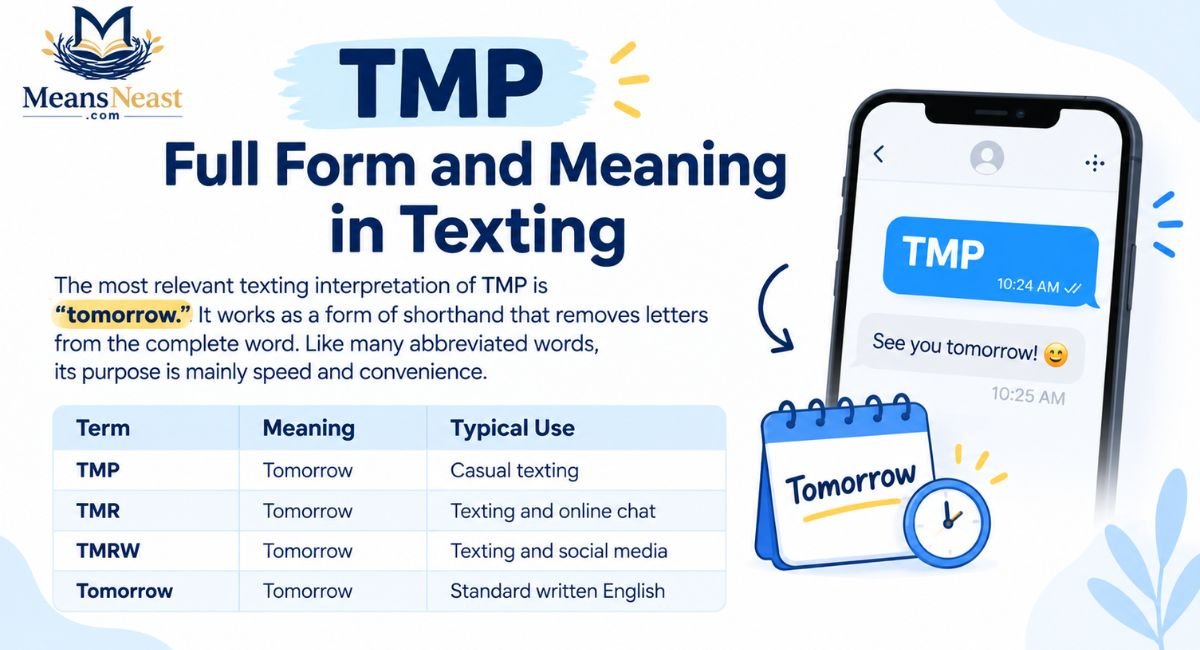
The most relevant texting interpretation of TMP is “tomorrow.”
It works as a form of shorthand that removes letters from the complete word. Like many abbreviated words, its purpose is mainly speed and convenience.
| Term | Meaning | Typical Use |
| TMP | Tomorrow | Casual texting |
| TMR | Tomorrow | Texting and online chat |
| TMRW | Tomorrow | Texting and social media |
| Tomorrow | Tomorrow | Standard written English |
The important point is that TMP is not a universally fixed abbreviation. Different communities may use the same three letters differently.
Therefore, if someone sends “TMP” and the meaning is unclear, look at the rest of the conversation before assuming it means tomorrow.
For example:
“Let’s meet TMP after class.”
Here, TMP naturally refers to tomorrow because the sentence discusses a future meeting.
This makes TMP useful in informal communication, especially when the people chatting already understand each other’s texting style.
What Does TMP Mean on WhatsApp, Instagram, Snapchat & TikTok?
The meaning of TMP can remain the same across different platforms when it is being used as a shortened form of “tomorrow.”
TMP on WhatsApp
TMP on WhatsApp may be used in personal chats when someone wants to save time while discussing plans.
Example:
“I’ll call you TMP.”
Meaning:
“I’ll call you tomorrow.”
WhatsApp conversations are often informal, so shortened words can naturally appear in quick messages.
TMP on Instagram
TMP on Instagram may appear in DMs, comments, or casual conversations.
For example:
“Are you coming, TMP?”
The sender may be asking whether you are coming tomorrow.
The exact meaning still depends on the message context.
Read More: What Does WTM Mean in Text? Meaning, Examples & How to Use It
TMP on Snapchat
TMP on Snapchat can be used as a quick chat abbreviation when talking about plans or upcoming activities.
Example:
“Snap me TMP.”
Depending on the conversation, this could mean “Snap me tomorrow.”
TMP on TikTok
On TikTok, TMP on TikTok may appear in comments, direct messages, or conversations between users.
However, social media abbreviations can vary between communities. If TMP does not clearly fit the sentence, ask the sender what they mean.
| Platform | Possible TMP Meaning | Example |
| Tomorrow | “Talk TMP.” | |
| Tomorrow | “See you, TMP.” | |
| Snapchat | Tomorrow | “Call me TMP.” |
| TikTok | Tomorrow | “Are you free, TMP?” |
So, whether you see TMP on WhatsApp, Instagram, Snapchat, or TikTok, context remains the safest way to interpret it.
How Is TMP Used in Text Messages?
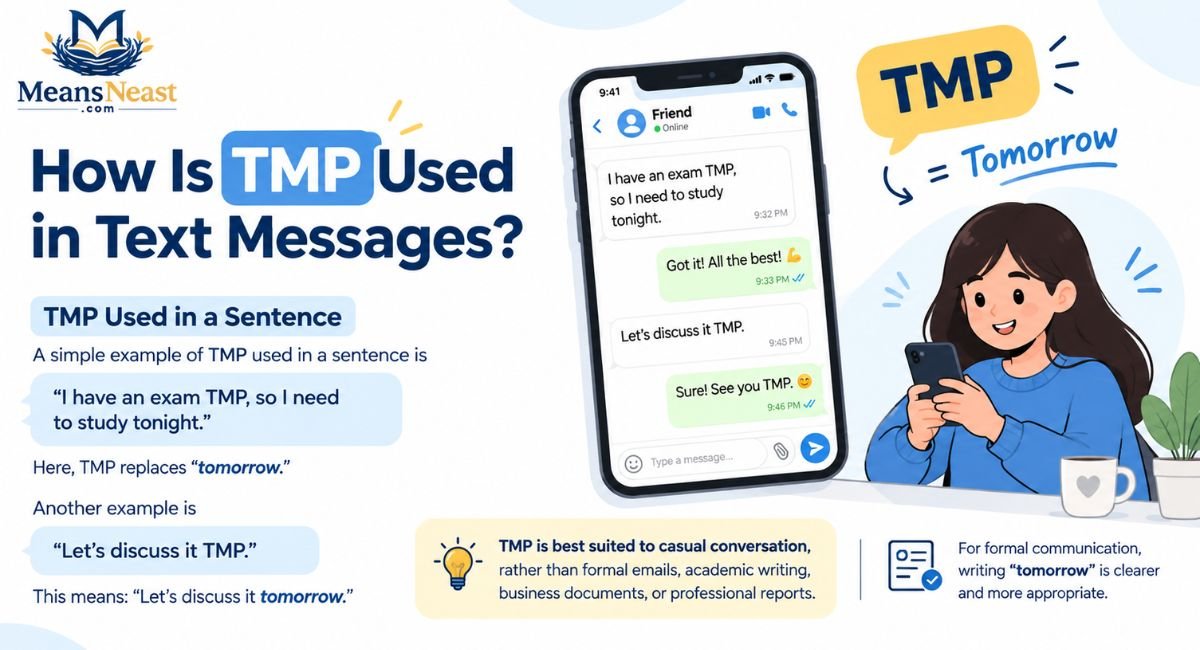
TMP is mainly useful when people want to keep their messages short.
It can appear in conversations about plans, schedules, appointments, school, work, or social activities.
Here are some natural ways to understand how to use TMP in text:
- “What are you doing, TMP?”
- “Can we talk TMP?”
- “I’ll send it TMP.”
- “Are you coming TMP?”
- “Let’s finish this TMP.”
In each example, TMP is being used as shorthand for tomorrow.
TMP Used in a Sentence
A simple example of TMP used in a sentence is
“I have an exam TMP, so I need to study tonight.”
Here, TMP replaces “tomorrow.”
Another example is
“Let’s discuss it TMP.”
This means:
“Let’s discuss it tomorrow.”
TMP is best suited to casual conversation, rather than formal emails, academic writing, business documents, or professional reports.
For formal communication, writing “tomorrow” is clearer and more appropriate.
TMP Texting Examples and Conversations
The easiest way to understand TMP texting examples is to see how the abbreviation works in realistic conversations.
1: Making Plans
Alex: Are you free, TMP?
Sam: Yeah, after 6 PM.
Here, TMP means tomorrow.
2: School
Alex: Did you finish the project?
Sam: Not yet. I’ll do it TMP.
The sender means they will complete it tomorrow.
Read More: BD Meaning in Text: What Does BD Mean in Chat & Social Media?
3: Work
Alex: Can you send me the document?
Sam: Sure, I’ll send it TMP.
The message indicates that the document will be sent tomorrow.
4: Friends
Alex: Want to hang out TMP?
Sam: Definitely. What time?
Again, TMP refers to tomorrow.
5: Online Conversation
Alex: When should we continue this discussion?
Sam: TMP works for me.
The person is agreeing to continue the conversation tomorrow.
These examples show why message context is important. A short abbreviation can sometimes have more than one interpretation, particularly when it is less standardized than other common texting abbreviations.
Does TMP Have Different Meanings in Other Contexts?
Yes. TMP does not have one universal meaning across every situation.
In casual texting slang, TMP can be interpreted as “tomorrow.” But the same three letters may represent something different in another field, workplace, organization, technical system, or online community.
That is why TMP abbreviation meaning should not automatically be assumed from the letters alone.
Consider these two situations:
“See you, TMP!”
This strongly suggests a casual reference to tomorrow.
Read More: CTFU Meaning: What It Means in Text, Chat & Social Media
But:
“Upload the TMP file.”
This could refer to a file, technical term, project name, or another abbreviation rather than “tomorrow.”
The difference comes from the conversation context.
If you encounter TMP in internet slang, texting, or a casual chat about plans, “tomorrow” may make sense. If the topic is technical, professional, academic, or industry-specific, another meaning may be intended.
When unsure, simply ask:
“What do you mean by TMP?”
That is often the fastest way to avoid misunderstanding.
TMP vs TMR vs TMRW: What’s the Difference?
TMP, TMR, and TMRW can all be encountered as shortened forms associated with tomorrow, but they are not equally common or standardized.
| Abbreviation | Meaning | General Use |
| TMP | Tomorrow | Casual or less-standard texting |
| TMR | Tomorrow | Common texting shorthand |
| TMRW | Tomorrow | Common online and texting abbreviation |
| Tomorrow | Tomorrow | Standard English |
TMP vs TMR
TMP vs TMR mainly comes down to familiarity and usage.
If someone writes:
“See you TMR.”
The meaning is usually easy to understand as “See you tomorrow.”
TMP may communicate the same idea, but it can be less immediately recognizable to some readers.
TMP vs TMRW
TMP vs TMRW is similar.
TMRW visually resembles the word “tomorrow” more closely, making its intended meaning easier for many readers to recognize.
For example:
“Talk TMRW.”
Most readers will understand this as
“Talk tomorrow.”
TMR Meaning in Text
TMR, meaning “in text,” is commonly understood as “tomorrow.”
Example:
“I’ll call you TMR.”
TMRW Meaning in Text
TMRW, meaning “in text,” is also “tomorrow.”
Example:
“See you TMRW!”
If your goal is maximum clarity, writing “tomorrow” is always the safest choice.
Is TMP Slang, Rude, or Flirty?
TMP can be considered a form of texting slang or informal shorthand when it is used to mean “tomorrow.”
Is TMP Slang?
If you are asking about TMP slang, the answer depends on how it is being used.
When TMP means “tomorrow” in casual messages, it functions like a social media or texting abbreviation. It is not formal English.
Is TMP Rude?
Is TMP rude? Usually, no.
The abbreviation itself is not inherently rude or offensive. Tone depends more on the complete message and the relationship between the people communicating.
For example:
“Can you call me TMP?”
Sounds like a normal request.
But:
“Do it TMP. I don’t want to hear excuses.”
could sound demanding because of the wording around TMP.
Read More: What Does DC Mean in Text? Meanings, Uses & Examples
TMP Meaning From a Girl
The TMP meaning from a girl is not automatically different from its general meaning.
If she says:
“Can we talk TMP?”
TMP may simply mean tomorrow.
You should not assume romantic interest based on the abbreviation alone.
TMP Meaning From a Guy
Likewise, the TMP meaning from a guy generally depends on the conversation.
For example:
“Let’s meet TMP.”
could simply mean “Let’s meet tomorrow.”
The sender’s gender does not give TMP a separate standard definition.
TMP Flirty Meaning
There is no universal TMP flirty meaning.
If TMP appears in a romantic conversation, the surrounding words, emojis, previous messages, and relationship between the people may provide additional context.
For example:
“Can’t wait to see you, TMP ❤️.”
may feel affectionate because of the entire message, not because TMP itself is a flirty abbreviation.
How to Reply to TMP in a Text
If someone sends TMP and clearly means “tomorrow,” your reply can simply address the plan.
For example:
“Sure, what time?”
Or:
“Yeah, I’m free tomorrow.”
You can also respond with:
- “Sounds good!”
- “Sure, see you then.”
- “What time works for you?”
- “I can’t tomorrow. How about Friday?”
- “Yes, that works for me.”
If you are not sure what the sender means, ask directly:
“Do you mean tomorrow?”
This is especially useful because TMP is not as universally recognized as some other texting abbreviations.
The best way to reply to a TMP response depends on what the sender is actually asking.
| Message | Possible Reply |
| “Are you free, TMP?” | “Yes, after 5.” |
| “Call me TMP.” | “Sure, what time?” |
| “See you, TMP!” | “See you then!” |
| “Can we talk TMP?” | “Of course.” |
| “Let’s meet TMP.” | “Where should we meet?” |
The goal of digital communication is clarity. If an abbreviation creates confusion, a short clarification is better than guessing.
❓ Frequently Asked Questions (FAQs)
What do you mean by TMP?
TMP can mean “tomorrow” in casual texting, depending on the conversation context.
What is TMP in messages?
TMP is sometimes used as a short form of “tomorrow” in informal messages.
What does TMP mean on Snap?
On Snapchat, TMP can mean “tomorrow” when talking about plans or future activities.
What does “TMP” mean on IG?
On Instagram, TMP may be used as shorthand for “tomorrow” in DMs or casual conversations.
What is TMP used for?
TMP is used as a quick texting abbreviation to refer to tomorrow in informal communication.
Conclusion
TMP in text is commonly understood as a shortened form of “tomorrow” in some casual conversations. It can appear in messages about plans, appointments, school, work, or other future activities.
You may encounter it as TMP on WhatsApp, Instagram, Snapchat, or TikTok, although its exact meaning always depends on the context.
Unlike more familiar abbreviations such as TMR and TMRW, TMP may not be immediately understood by everyone.
If a message is unclear, asking the sender is the simplest solution. In short, TMP can work as informal shorthand for tomorrow, but “tomorrow” remains the clearest choice in formal communication.

Hi, I’m Kaif Ali, creator of MeansNest. I’m an SEO professional passionate about helping people understand the meanings of words, text slang, and online expressions through clear, accurate, and easy-to-read content. I create SEO-friendly guides that deliver real value while making learning simple for everyone.