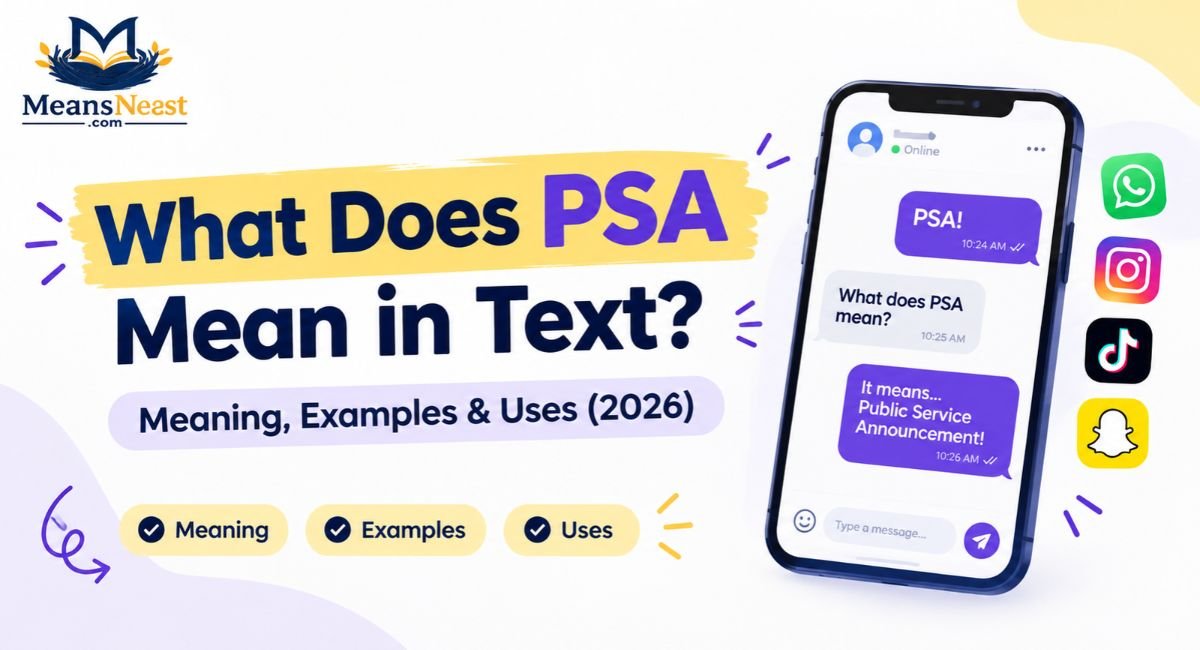
If you have seen PSA in a text message, group chat, or social media post, you might wonder what it means.
PSA Mean in Text usually refers to “Public Service Announcement,” a phrase people use to share important information, helpful advice, or reminders.
In everyday conversations, PSA can introduce a serious warning or a funny announcement between friends.
You may notice it on Instagram, TikTok, Snapchat, or WhatsApp when someone wants others to pay attention. Understanding this texting acronym makes online communication easier and helps you recognize its meaning from context.
In this guide, you’ll explore PSA examples, common uses, and related terms like FYI and Heads Up.
What Does PSA Mean in Text?
PSA means Public Service Announcement. In texting, it introduces information that the sender believes other people should know. It draws attention to a message, reminder, warning, or useful tip.
Originally, a public service announcement was a message intended to inform the public about an important issue. Today, the abbreviation is also common in casual texting language and social media posts.
For example:
“PSA: Bring a jacket tomorrow. It’s going to be cold!”
In this message, PSA tells readers to pay attention to the reminder.
People do not always use PSA for serious matters. It can introduce a joke, a personal opinion, or a playful announcement among friends.
Quick meaning: PSA = Public Service Announcement, or a way to introduce information people should notice.
What Does PSA Mean in Chat and Social Media?
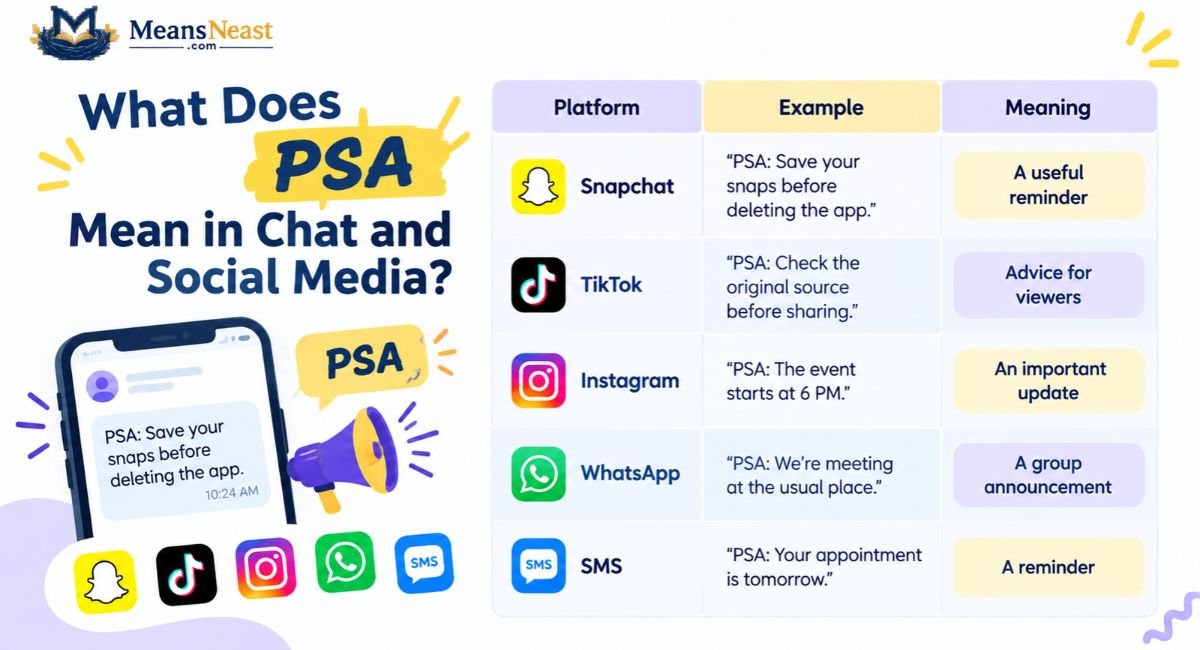
The PSA social media meaning is generally the same across messaging apps and online platforms. It introduces a message that the sender wants others to read or remember.
However, the topic and tone can change depending on the platform and conversation.
People often use PSA in text messages, comments, captions, and online conversations because it makes an announcement stand out.
Read More: What Does “DP” Mean in Text? Meaning, Origin, Examples & Usage Guide
- PSA in group chats: Someone might remind everyone about a plan or share an update.
- PSA in comments: A user might correct misinformation or offer a helpful tip.
- PSA online posts: A creator might share advice, an important update, or a public warning.
- PSA in text messages: A friend might use it to announce a change of plans.
Here is how PSA may appear on different platforms.
| Platform | Example | Meaning |
| Snapchat | “PSA: Save your snaps before deleting the app.” | A useful reminder |
| TikTok | “PSA: Check the original source before sharing.” | Advice for viewers |
| “PSA: The event starts at 6 PM.” | An important update | |
| “PSA: We’re meeting at the usual place.” | A group announcement | |
| SMS | “PSA: Your appointment is tomorrow.” | A reminder |
The abbreviation itself does not have a different meaning on each platform. The surrounding message helps you understand what the sender wants to communicate.
Why Do People Use PSA in Texts and Online Posts?
People use PSA to make information easier to notice. Instead of starting with a long explanation, they can place PSA at the beginning of a message to signal that something deserves attention.
Here are the most common reasons.
1. Sharing helpful information
Someone might share a tip that could save others time, money, or effort.
Example: “PSA: You can turn on dark mode in the app settings.”
2. Giving warnings
PSA can introduce a warning about a problem, a possible scam, or a change people should know about.
Example: “PSA: That account is pretending to be the official page. Be careful.”
3. Offering advice
People use PSA to share practical suggestions with friends, followers, or online communities.
Example: “PSA: Read the return policy before ordering clothes online.”
4. Giving an important reminder
A PSA important reminder can help a group remember a deadline, event, or change of plans.
Example: “PSA: Our assignment is due on Friday.”
5. Making funny announcements
PSA internet slang is not always serious. People sometimes use it to make ordinary opinions sound like official announcements.
Example: “PSA: Fries taste better when you steal one from your friend’s plate.”
6. Raising general awareness
A person may use PSA to bring attention to an issue, such as online safety, public health, or responsible social media use.
In all these situations, PSA communication helps signal that the following information is worth noticing.
Real Chat Examples of PSA in Text Messages
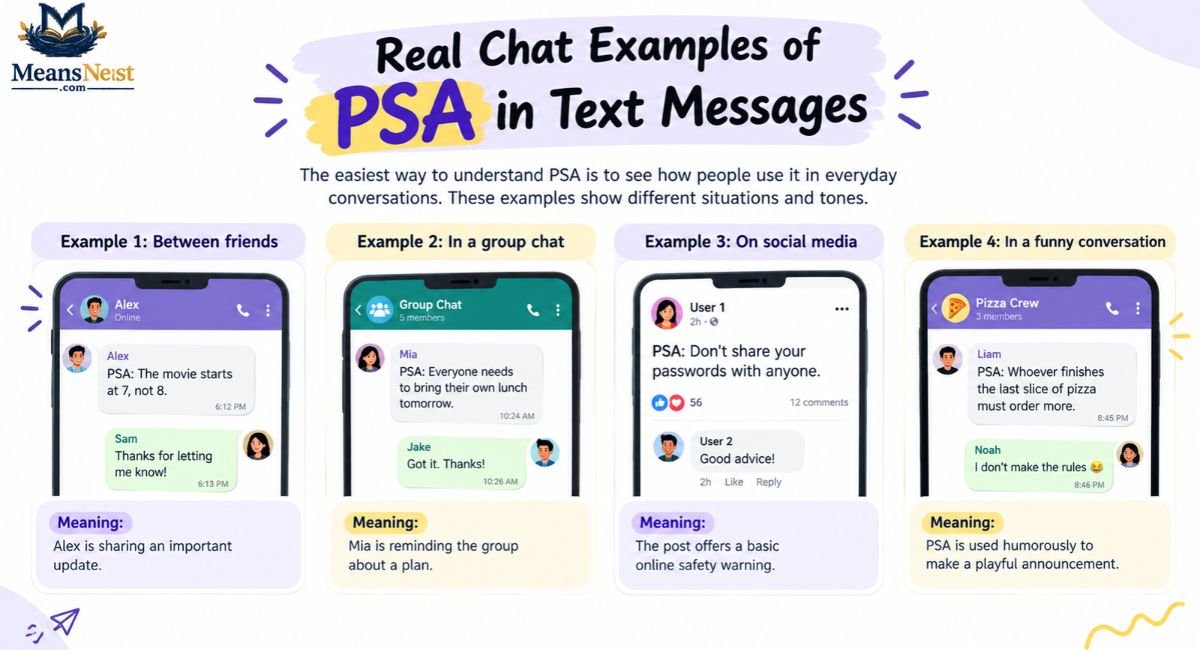
The easiest way to understand PSA is to see how people use it in everyday conversations. These examples show different situations and tones.
Example 1: Between friends
Alex: “PSA: The movie starts at 7, not 8.”
Sam: “Thanks for letting me know!”
Meaning: Alex is sharing an important update.
Example 2: In a group chat
Mia: “PSA: Everyone needs to bring their own lunch tomorrow.”
Jake: “Got it. Thanks!”
Meaning: Mia is reminding the group about a plan.
Example 3: On social media
User 1: “PSA: Don’t share your passwords with anyone.”
User 2: “Good advice!”
Meaning: The post offers a basic online safety warning.
Example 4: In a funny conversation
Liam: “PSA: Whoever finishes the last slice of pizza must order more.”
Noah: “I don’t make the rules 😂”
Meaning: PSA is used humorously to make a playful announcement.
Read More: PFP Meaning in Text: What It Means in Chats & Online Slang (2026 Guide)
Example 5: In an Instagram comment
User 1: “PSA: The discount code expires tonight.”
User 2: “Thanks! I almost missed it.”
Meaning: The comment highlights useful information.
Example 6: In a school chat
Sara: “PSA: Our science test has moved to Monday.”
Aisha: “I’m glad you told us!”
Meaning: Sara is announcing a schedule change.
Example 7: Giving a helpful tip
Chris: “PSA: You can recover deleted files from the recycle bin.”
Taylor: “I didn’t know that!”
Meaning: Chris is sharing information that may help others.
Example 8: Sharing an opinion
Emma: “PSA: Comfortable shoes are always worth it.”
Olivia: “Absolutely!”
Meaning: Emma is using PSA to emphasize a personal opinion.
These examples show that the PSA acronym can introduce serious information, casual reminders, useful tips, or jokes. The sentence after PSA explains the actual message.
How to Reply When Someone Says PSA
How you reply to PSA depends on the information being shared. You do not need a special response just because someone uses the abbreviation.
A simple acknowledgment is usually enough.
Casual and neutral replies
Use these when someone shares an update or reminder.
- “Thanks for the heads-up!”
- “Good to know.”
- “Got it, thanks!”
- “Thanks for letting me know.”
- “I’ll keep that in mind.”
Funny replies
If the message is clearly a joke, you can respond playfully.
- “PSA received 😂”
- “Important news of the day!”
- “Why is this so accurate?”
- “Someone had to say it!”
- “Finally, some useful information 😂”
Serious replies
When the message contains a warning or important information, acknowledge it clearly.
- “Thanks for the warning.”
- “I’ll be careful.”
- “I appreciate the information.”
- “I’ll share this with the others.”
- “Thanks for bringing this to our attention.”
When you need more information
If the announcement is unclear, ask a direct question.
For example:
Friend: “PSA: The location has changed.”
You: “Thanks! What’s the new location?”
The best reply depends on the situation. Focus on the information itself rather than the abbreviation.
What Does PSA Mean in Different Contexts?
Although “public service announcement” is the common expansion of PSA, its exact meaning can depend on the subject being discussed.
In texting and online messaging, it usually introduces information. In professional, medical, or public communication, it may refer to a more specific concept.
| Context | PSA meaning | Example |
| Texting | Public Service Announcement | “PSA: The deadline is tomorrow.” |
| Social media | An attention-grabbing announcement | “PSA: Check your privacy settings.” |
| Public awareness | Public Service Announcement | A campaign encouraging road safety |
| Healthcare | Prostate-specific antigen | A PSA blood test |
| Business | Usually public service announcements when discussing public messaging | A company shares a safety announcement. |
PSA in healthcare
In medicine, PSA can stand for prostate-specific antigen, a protein measured through a blood test. This is different from the texting meaning and is usually discussed in a medical context.
Read More: WFH Meaning: What Does WFH Stand For in Text, Work, and Job Postings?
PSA in public announcements
A traditional public service announcement shares information intended to benefit or inform the public. Examples include campaigns about road safety, emergency preparedness, and health awareness.
PSA in business communication
A business might use PSA when discussing a public awareness campaign or an announcement intended for a wider audience. In ordinary workplace messages, the surrounding sentence helps clarify the intended meaning.
Do not assume that every occurrence of PSA refers to texting slang. Look at the topic and surrounding words before deciding what it means.
Is PSA Formal, Informal, Rude, or Sarcastic?
PSA can be used in both formal and informal communication. Its tone depends on the message, audience, and situation.
In casual conversations, it is often friendly, direct, or humorous. In public announcements, it may introduce serious or important information.
Is PSA slang?
PSA is an acronym rather than a slang word by itself. However, its casual use in online conversations has made it familiar in social media slang and everyday messaging.
Is PSA rude?
No, PSA is not inherently rude or offensive. A message such as “PSA: Please clean up after yourself” may sound firm, but the wording and context determine how it comes across.
Can PSA be sarcastic?
Yes. People sometimes use PSA to introduce exaggerated opinions or playful complaints.
Example: “PSA: Mondays should be cancelled permanently.”
This is a humorous opinion, not an official announcement.
Is PSA formal or informal?
PSA works in casual posts, group chats, and some professional communications. For a formal business message, consider whether “announcement,” “important update,” or “please note” would sound more appropriate.
Can you use PSA at school or work?
Yes, when it suits the situation. It can introduce a class reminder, a schedule change, or a workplace update. For important official instructions, follow the communication style expected by your school or organization.
PSA vs FYI vs Heads Up: What’s the Difference?
PSA, FYI, and Heads Up are common chat abbreviations and expressions used to share information. They are related, but they do not communicate exactly the same thing.
The main difference is the purpose of the message.
| Term | Full form or meaning | Main purpose | Example |
| PSA | Public Service Announcement | Draw attention to an announcement or useful information | “PSA: The library closes early today.” |
| FYI | For Your Information | Share information someone may need to know. | “FYI, the library closes at 5.” |
| Heads Up | A warning or advance notice | Prepare someone for something that may happen | “Heads up, the library closes in 10 minutes.” |
PSA vs FYI
The FYI meaning in text is “For Your Information.” It introduces information that may be useful to the recipient.
PSA often sounds more like an announcement intended to attract attention, sometimes for a wider group.
Example:
- PSA: “PSA: Remember to back up your files.”
- FYI: “FYI, I backed up the files yesterday.”
Both share information, but the emphasis is different.
PSA vs Heads Up
“Heads up” means an advance warning or notice. It is particularly useful when someone needs time to prepare.
Example:
- PSA: “PSA: The parking lot will close on Sunday.”
- Heads Up: “Heads up, you may need to move your car before Sunday.”
The first announces information, while the second directly prepares someone for a possible inconvenience.
PSA vs Announcement
An announcement is a general message that communicates news or information. PSA is a specific acronym that stands for Public Service Announcement and is often used to highlight information people should notice.
In casual online messaging, the terms can overlap. Choose the expression that best matches your purpose and audience.
How to Use PSA Correctly in a Sentence
Using PSA is simple. Place it at the beginning of a message when you want to highlight an announcement, warning, reminder, or useful tip.
A colon often follows PSA to separate the abbreviation from the message.
For example:
- “PSA: The registration deadline is tomorrow.”
- “PSA: Never share your login details with strangers.”
- “PSA: Our group project meeting starts at 3 PM.”
- “PSA: Save your work before restarting your computer.”
- “PSA: The café is offering free coffee today.”
These examples show how PSA works in everyday online communication.
When should you use PSA?
Use PSA when you want to:
- Share information with a group of people.
- Highlight an important reminder.
- Give a helpful warning.
- Draw attention to advice or a public awareness message.
- Make a playful announcement among friends.
When should you avoid using PSA?
Avoid it when a direct message would be clearer, when the information is private and intended for one person, or when the abbreviation feels too casual for the situation.
For instance, an official email may be better with “Important Update” as the heading. A personal message may simply begin, “Just letting you know…”
Common mistakes to avoid
- Assuming PSA always refers to a serious warning.
- Treating PSA as a different acronym on every social media platform.
- Using it without explaining the information that follows.
- Confusing PSA with FYI or heads-up in every situation.
- Assuming its medical meaning applies to casual texting.
The key is to use PSA when you want readers to pay attention to the information that follows.
❓ Frequently Asked Questions (FAQs)
What does “PSA” mean in chat?
PSA stands for “Public Service Announcement.” In chat, it introduces important information, helpful advice, or a reminder.
What does “PSA” mean in slang?
In slang, PSA is used to grab attention before sharing a tip, warning, opinion, or funny announcement.
What does PSA mean in Gen Z?
Gen Z often uses PSA on social media and in chats to highlight something important, relatable, or humorous.
What is a PSA message?
A PSA message is an announcement that shares useful information, raises awareness, or warns people about something they should know.
What is a PSA on social media?
A PSA on social media is a post, caption, or comment that draws attention to advice, news, reminders, or public awareness.
Conclusion
Understanding PSA meaning in text is simple once you know its main purpose. PSA stands for Public Service Announcement and is commonly used in chats, comments, captions, and social media posts to highlight information people should notice.
It can introduce a helpful tip, warning, reminder, serious announcement, or even a joke. Unlike FYI, which simply shares information, PSA often gives the message more emphasis. Heads Up is more focused on warning someone in advance.
When you see PSA in an online conversation, read the words that follow it to understand the sender’s intention. Using it naturally can make your messages clearer and easier to understand.

Hi, I’m Kaif Ali, creator of MeansNest. I’m an SEO professional passionate about helping people understand the meanings of words, text slang, and online expressions through clear, accurate, and easy-to-read content. I create SEO-friendly guides that deliver real value while making learning simple for everyone.