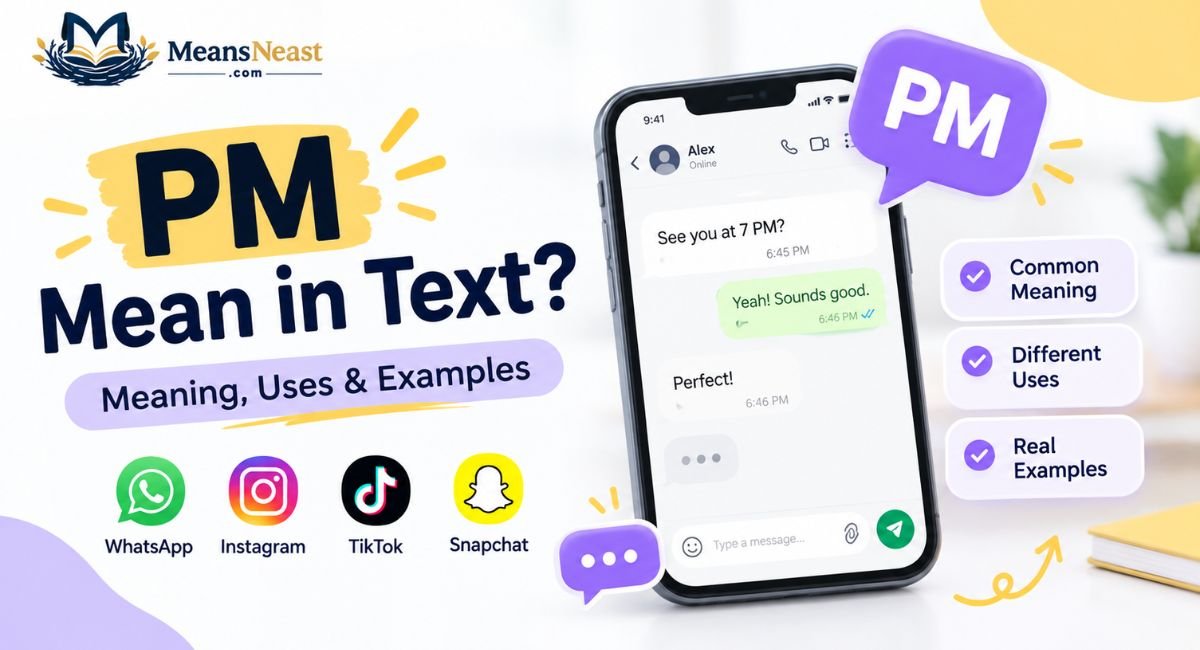
When someone uses “PM” in a chat, social media post, or text message, its meaning can depend on the context.
Most commonly, PM means private message, telling someone to communicate with you privately rather than in a public conversation.
You may see phrases like “PM me,” “send me a PM,” or “I’ll PM you later.” The term is common across online communities and messaging platforms, although some apps use “DM” more often.
Understanding the PM meaning on social media can help you follow conversations without confusion. In this guide, we’ll explain what PM means, how PM is used on different platforms, the difference between PM and DM, and other possible meanings of PM.
What Does PM Mean in Text?
In texting and online conversations, PM usually means “private message” or “personal message.”
It refers to a message sent privately to another person rather than being shared publicly.
For example:
“PM me the details.”
This means:
“Send me the details in a private message.”
PM is a common chat abbreviation used in texting, forums, social media, and other forms of online communication.
It is especially common when someone does not want to share personal information in a public comment.
Common meanings of PM
| PM Meaning | Explanation |
| Private message | A message sent privately to another user |
| Personal message | A private conversation between people |
| PM me. | Send me a private message |
| Send a PM. | Contact someone privately. |
| I’ll PM you. | I will message you privately |
The meaning is usually easy to understand from the surrounding conversation.
For example, if someone comments, “I have the information. PM me,” they are asking you to contact them privately.
In casual conversations, PM is an informal abbreviation rather than a formal expression.
What Does “PM Me” Mean?
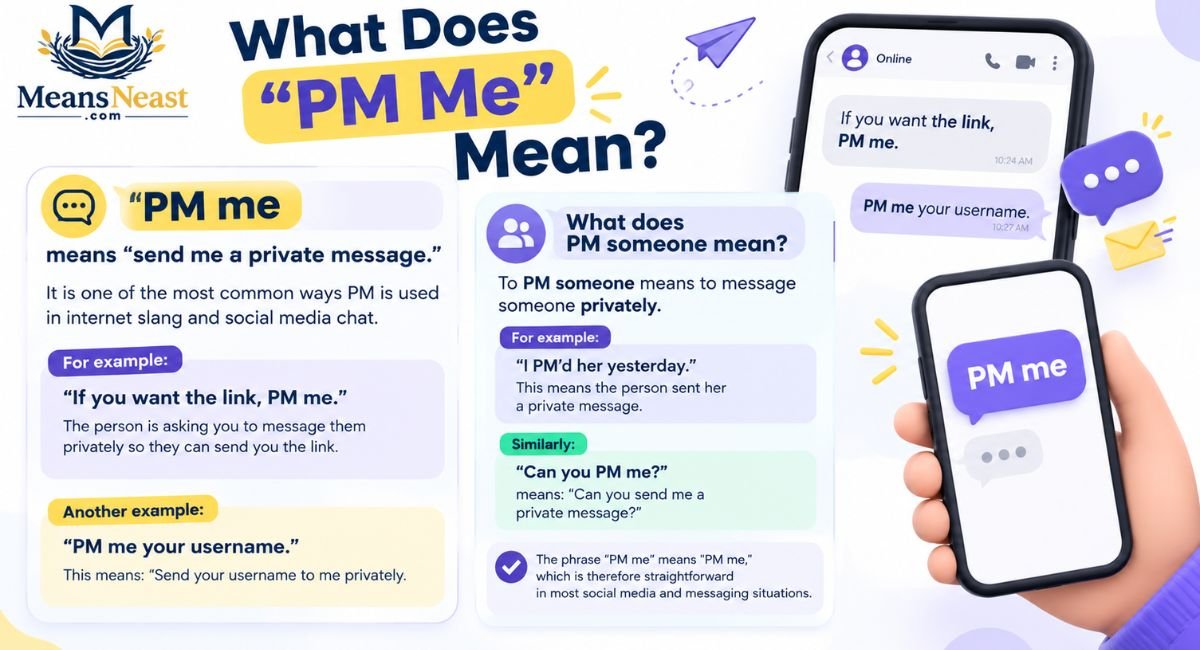
“PM me” means “send me a private message.”
It is one of the most common ways PM is used in internet slang and social media chat.
For example:
“If you want the link, PM me.”
The person is asking you to message them privately so they can send you the link.
Another example is
“PM me your username.”
This means:
“Send your username to me privately.”
Read More: What Does DPWM Mean in Text? Meaning, Uses & Examples (2026)
What does PM someone mean?
To PM someone means to message someone privately.
For example:
“I PM’d her yesterday.”
This means the person sent her a private message.
Similarly:
“Can you PM me?”
means:
“Can you send me a private message?”
The phrase “PM me” means “PM me,” which is therefore straightforward in most social media and messaging situations.
PM Meaning on Social Media and Messaging Apps
The PM meaning on social media is generally connected with private communication.
However, different platforms may use different terms for private messages.
| Platform | How PM May Be Used |
| Snapchat | Private chat or message |
| Private message, usually called a DM | |
| Private conversation through Messenger | |
| Private one-to-one or group chat | |
| TikTok | Private message through direct messaging |
| Online forums | Private message between users |
PM meaning on Snapchat
The PM meaning on Snapchat generally refers to contacting someone privately.
If someone says, “PM me,” they may simply be asking you to continue the conversation through a private chat.
PM meaning on Instagram
On Instagram, people normally say DM rather than PM.
Still, someone may use PM to mean a private message.
For example:
“PM me the details.”
The intended meaning is likely “send me a private message.”
PM meaning on Facebook
On Facebook, PM can refer to a private conversation through Messenger.
For example:
“PM me your address.”
This means the person does not want the address posted publicly.
PM meaning on WhatsApp
WhatsApp is already based heavily on private messaging, so people do not need to use PM as often.
However, someone may still use the abbreviation when talking about contacting them privately.
PM meaning on TikTok
TikTok users may use PM to refer generally to a private message.
However, “DM” is also common when referring to private social media communication.
So, the platform can provide context, but the surrounding conversation is usually more important than the platform itself.
PM vs DM: What’s the Difference?
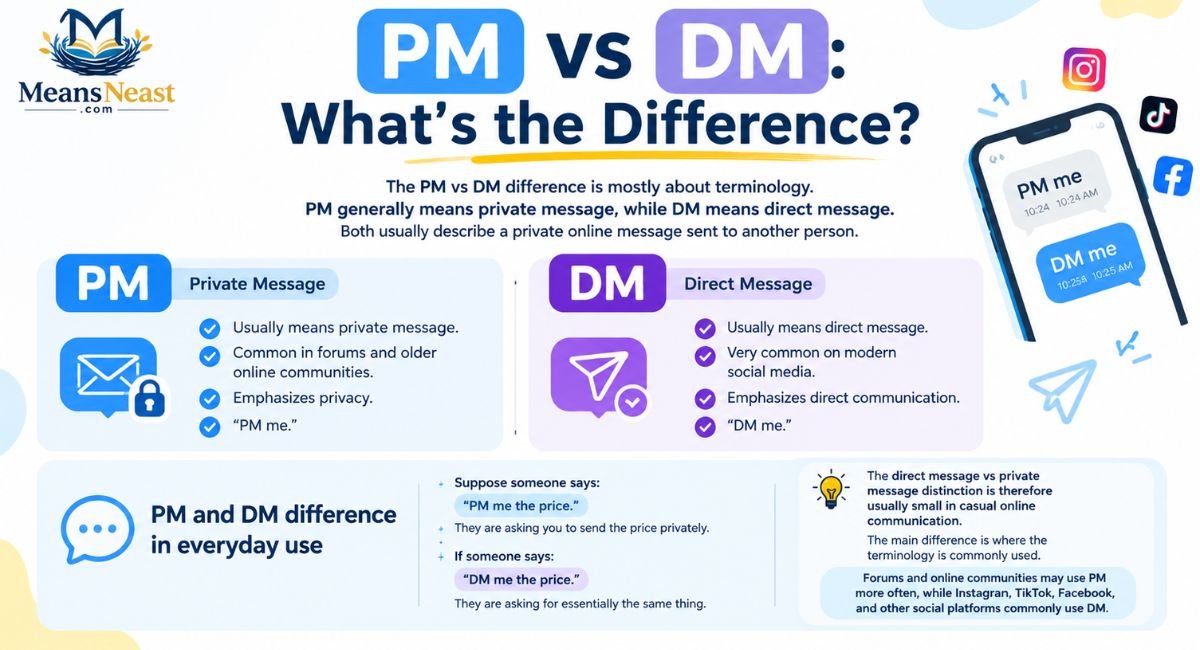
The PM vs DM difference is mostly about terminology.
PM generally means private message, while DM means direct message.
Both usually describe a private online message sent to another person.
| PM | DM |
| Usually means private message. | Usually means direct message |
| Common in forums and older online communities | Very common on modern social media |
| Emphasizes privacy | Emphasizes direct communication |
| “PM me.” | “DM me.” |
| Same general purpose | Same general purpose |
PM and DM difference in everyday use
Suppose someone says:
“PM me the price.”
They are asking you to send the price privately.
Read More: What Does CC Mean in Text? Meaning, Slang, Uses & Examples
If someone says:
“DM me the price.”
They are asking for essentially the same thing.
The direct message vs private message distinction is therefore usually small in casual online communication.
The main difference is where the terminology is commonly used.
Forums and online communities may use PM more often, while Instagram, TikTok, Facebook, and other social platforms commonly use DM.
How PM Is Used in Different Conversations
PM can appear in many types of online conversations.
The meaning usually stays the same, but the reason for sending a private message can change.
Buying and selling
“Interested? PM me for the price.”
Here, the seller wants the buyer to contact them privately.
Social conversations
“PM me when you’re free.”
This means the person wants to continue talking privately.
Sharing information
“I have the details. PM me.”
The person wants to share the information privately.
Asking for help
“If you need help setting it up, PM me.”
This invites the other person into a private conversation.
Online communities
“PM me if you want to join.”
The person may want to discuss membership privately.
Dating or personal conversations
“PM me if you want to talk.”
Here, PM may indicate a desire for a more private conversation.
The tone depends on the relationship between the people involved.
PM Meaning From a Girl or Guy
The PM meaning from a girl or the PM meaning from a guy is usually not different.
If a girl says,
“PM me later.”
She most likely means:
“Message me privately later.”
If a guy says:
“PM me the details.”
He most likely means:
“Send me the details in a private message.”
The gender of the person does not automatically change the meaning of PM.
Read More: BBW Meaning in Text: What Does BBW Stand For?
PM meaning in texting from a girl
When someone asks about PM meaning in texting from a girl, context matters more than gender.
For example:
“PM me when you get home.”
This could simply be a friendly request to continue chatting privately.
But:
“PM me 😉”
could have a more playful or personal tone depending on the conversation.
The abbreviation itself does not prove romantic interest.
PM meaning in texting from a guy
Likewise, the PM meaning in texting from a guy is generally “private message” or “personal message.”
For example:
“PM me your number.”
simply means that he wants you to send the information privately.
To understand the intention, look at the words around PM and the overall relationship.
PM as a Time: What Does PM Mean?
PM can also have a completely different meaning when it is written after a time.
In this context, PM means “post meridiem.”
It describes the period from 12:00 noon until 11:59 at night in the 12-hour clock system.
For example:
- 1:00 PM = afternoon
- 3:30 PM = afternoon
- 7:00 PM = evening
- 10:00 PM = night
This meaning has nothing to do with private messaging.
PM as a time vs PM in texting
Context makes the difference clear.
“I’ll PM you tonight.”
Here, PM means private message.
But:
“The meeting starts at 4 PM.”
Here, PM refers to the time of day.
| Example | Meaning of PM |
| “PM me.” | Private message |
| “Send me a PM.” | Private message |
| “The meeting is at 5 PM.” | Post meridiem |
| “I’ll PM you later.” | Private message |
So, when you see PM, check what words or numbers appear around it.
How to Know Which PM Someone Means
The easiest way to understand PM is to look at the context.
Ask yourself whether the word is connected to messaging or time.
If PM appears with words such as
- me
- message
- chat
- send
- contact
- reply
It probably means private message.
Read More: What Does Hyy Mean in Text? Meaning, Tone & Examples
For example:
“PM me the information.”
Clearly refers to a private message.
If PM appears after a number, it probably refers to time.
For example:
“I’ll arrive at 8 PM.”
Here, PM means the evening/night part of the 12-hour clock.
Quick context check
| Context | Likely Meaning |
| “PM me.” | Private message |
| “Send a PM” | Private message |
| “PM someone.” | Message someone privately. |
| “6 PM” | Time |
| “PM tonight” | Usually private message if used as a verb |
| “PM meeting” | Could require more context |
When the meaning is unclear, read the entire sentence rather than focusing on the abbreviation alone.
How to Reply When Someone Says “PM Me”
When someone says “PM me,” they are asking you to contact them privately.
Your response depends on whether you want to continue the conversation.
You can simply send them a private message.
For example:
“Sure, I’ll PM you.”
Or:
“Okay, sending you a PM now.”
If you are not sure what they want, you can ask:
“Sure. What would you like to discuss?”
If you do not want to message privately
You can politely say:
“Can you share it here?”
Or:
“Is it okay to discuss this in the comments?”
There is no requirement to send a private message just because someone asks.
If you want to reply casually
You could say:
“Sure 👍”
“Got it, I’ll message you.”
“Okay, PMing you now.”
The best reply depends on the relationship and tone of the conversation.
PM Texting Examples and Common Mistakes
Understanding examples makes the PM abbreviation easier to recognize.
Example 1
“PM me your address.”
Meaning: Send your address privately.
Example 2
“I’ll PM you after work.”
Meaning: I will send you a private message after work.
Example 3
“PM me if you’re interested.”
Meaning: Contact me privately if you are interested.
Example 4
“Can you PM me the details?”
Meaning: Can you send me the details privately?
Example 5
“The event starts at 7 PM.”
Meaning: The event starts at 7 in the evening.
Common mistakes
One common mistake is assuming PM always means private message.
That is incorrect because “PM” can also mean “post meridiem” when used with a time.
Another mistake is assuming PM and DM are completely different forms of communication.
In many situations, PM vs DM is mostly a difference in terminology.
A third mistake is assuming “PM me” automatically has a romantic meaning.
It usually does not.
The phrase simply asks someone to communicate privately.
Is PM Formal or Informal?
PM is generally an informal abbreviation.
It is common in casual conversations, online communities, forums, social media messages, and messaging apps.
For example:
“PM me when you get a chance.”
sounds natural in an online conversation.
In formal writing, it is usually better to write the meaning more clearly.
Instead of:
“Please PM me the documents.”
A formal message might say:
“Please send me the documents privately.”
However, the level of formality depends on the environment.
Some workplaces and professional online communities commonly use PM, especially when discussing internal messages.
So, PM is not necessarily unprofessional, but it is more casual than writing “private message.”
Other Meanings of PM
Although “private message” is one of the most common meanings of “PM” in online communication, the abbreviation can have other meanings.
Post meridiem
This is the time-related meaning discussed earlier.
Example:
“The appointment is at 2 PM.”
Prime Minister
In news, politics, and government-related conversations, “PM” can mean “Prime Minister.”
Example:
“The PM gave a speech today.”
The exact meaning depends on the country and context.
Project Manager
In workplace communication, PM may sometimes mean Project Manager.
Example:
“Ask the PM about the deadline.”
Personal Message
Some platforms and communities use PM to mean personal message rather than private message.
The practical meaning is usually the same: a message intended for a specific person rather than a public audience.
Why context matters
The same two letters can have different meanings in different situations.
| PM Usage | Meaning |
| “PM me.” | Private message |
| “Send a PM” | Private/personal message |
| “8 PM” | Post meridiem |
| “The PM spoke today.” | Prime Minister |
| “Ask the PM about the project.” | Project Manager, depending on context |
This is why you should always consider the sentence, platform, and subject before deciding what PM means.
❓ Frequently Asked Questions (FAQs)
What does “PM” mean in chat?
PM usually means “private message” or “personal message,” referring to a message sent privately.
What does PM slang mean?
In texting slang, PM commonly means “private message” or “message me privately.”
Is it PM or DM?
Both are used for private messaging; PM means “private message,” while DM means “direct message.”
What is PM on Snapchat?
On Snapchat, PM generally means sending someone a private message or chat.
What does PM mean in TXT?
In text messages, PM usually means “private message,” especially when someone says “PM me.”
Conclusion
The most common PM mean in text is “private message” or “personal message.” When someone says “PM me,” they are asking you to contact them privately rather than continuing the conversation publicly.
PM is widely understood in online communication, although many modern social platforms use the term DM more often.
The PM vs DM difference is usually small, as both describe private communication. Remember that “PM” can also mean “post meridiem” when used with a time or other terms such as “prime minister” or “project manager” in different contexts.
When you see PM in a chat, always consider the surrounding words to identify the intended meaning.

Hi, I’m Kaif Ali, creator of MeansNest. I’m an SEO professional passionate about helping people understand the meanings of words, text slang, and online expressions through clear, accurate, and easy-to-read content. I create SEO-friendly guides that deliver real value while making learning simple for everyone.