If you’ve come across “ion” in a text message or social media comment, you might be wondering what it means. The phrase “ion mean” in text has become increasingly popular across Snapchat, TikTok, Instagram, and other messaging platforms.
In most cases, “ion” is simply a shortened version of “I don’t,” making conversations quicker and more casual. As part of modern **texting abbreviations and **internet slang, it’s widely used by Gen Z and active social media users.
However, its meaning can change depending on the context. This guide explains the ion meaning, where it’s used, real chat examples, and how to respond confidently in everyday online conversations using **online chat language and **digital communication.
What Does “ion” Mean in Text?
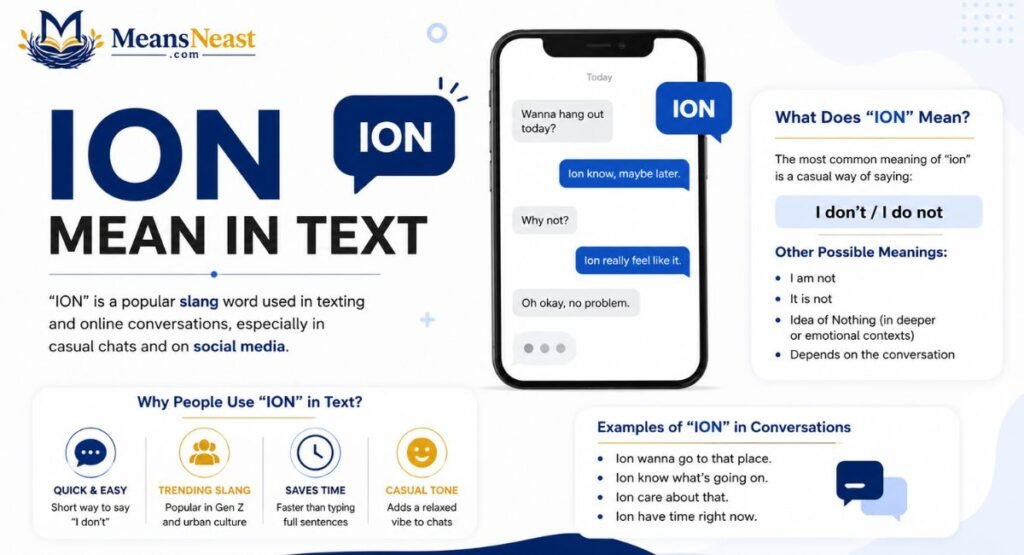
The most common “ion” meaning in text is “I don’t.”
People remove the space and apostrophe from “I don’t” and simply type “ion.” It saves time and matches the fast style of modern digital communication.
Quick Answer
| Term | Meaning |
| ion | I don’t |
| Usage | Casual texting and social media |
| Tone | Informal |
| Common Platforms | Snapchat, TikTok, Instagram, WhatsApp, Discord |
For example:
Friend: Ion know what happened.
Meaning: I don’t know what happened.
Another example:
Text: Ion think that’s a good idea.
Meaning: I don’t think that’s a good idea.
This texting abbreviation is especially popular among younger users who prefer short and simple messages. It has become part of everyday internet slang and is commonly seen in chats, comments, and direct messages.
Why Do People Use “Ion”?
People use “ion” slang because it is
- Faster to type
- Easy to understand
- Common in Gen Z slang
- Popular across social media
- Natural in casual conversations
Instead of writing:
I don’t want to go.
Many people simply write:
Ion wanna go.
Both sentences mean the same thing, but the second sounds more relaxed and conversational.
Is “Ion” Always Correct?
Not always.
Since “ion” is informal text message slang, it should only be used when chatting with friends or posting casually online. It isn’t suitable for:
- School assignments
- Business emails
- Professional messages
- Formal writing
Using the right word for the right situation helps avoid confusion.
See Also: What Does “MB” Mean in Text? Uses, Meaning & Examples
Different Meanings of “Ion Mean” in Text
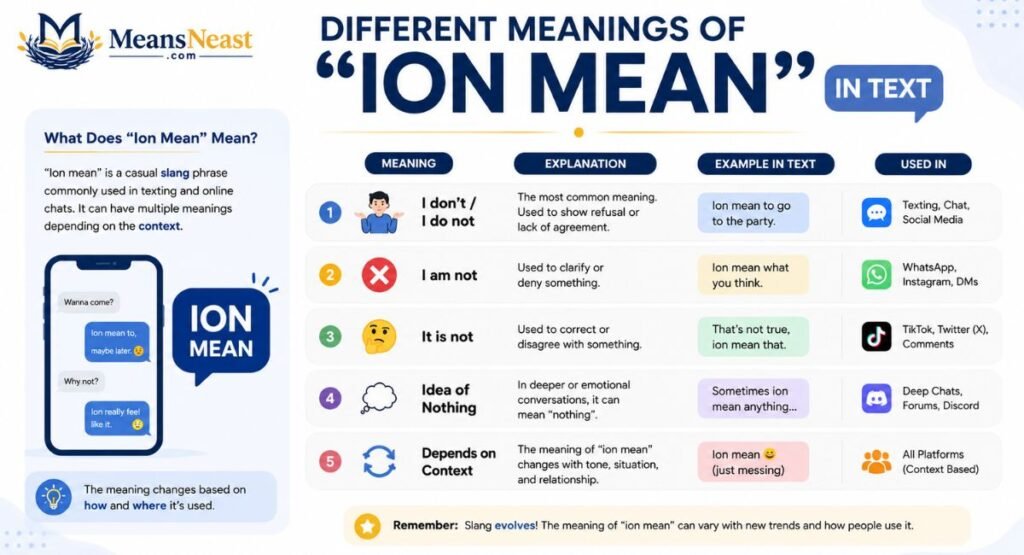
Although “ion” = “I don’t” is the most common meaning, the word can have different meanings depending on the conversation. Understanding the context-based meaning helps you interpret messages correctly.
| Meaning | Where It’s Used | Example |
| I don’t | Texting and social media | Ion like that movie. |
| Ion (science) | Chemistry discussions | An ion has an electric charge. |
| Name or username | Games and online platforms | Ion joined the match. |
1. “Ion” Means “I Don’t”
This is the most popular “ion” slang meaning.
Examples:
- Ion remember.
- Ion care.
- Ion see anything.
- Ion think he’s coming.
In these examples, the abbreviation “ion” replaces “I don’t,” making the message shorter.
2. Ion in Science
Outside online conversations, “ion” has a completely different meaning.
In chemistry, an ion is an atom or molecule that carries an electric charge because it has gained or lost electrons.
Example:
Sodium becomes a positive ion after losing an electron.
This scientific meaning has nothing to do with social media slang. The topic of the conversation usually makes the difference obvious.
3. Ion as a Name or Username
Sometimes Ion is simply someone’s first name or gaming username.
Example:
Ion invited everyone to the Discord server.
Here, Ion refers to a person rather than the slang expression.
How to Know Which Meaning Is Correct
The easiest way is to look at the surrounding words.
| Sentence | Meaning |
| Ion know the answer. | I don’t |
| The atom became an ion. | Chemistry |
| Ion sent me a message. | Person’s name |
In almost every casual texting situation, “ion” means “I don’t.” Only scientific discussions or names use the other meanings.
Understanding these alternate meanings of “ion” helps prevent misunderstandings and makes it easier to follow conversations across different platforms.
How is “ion mean” in text used on social media?
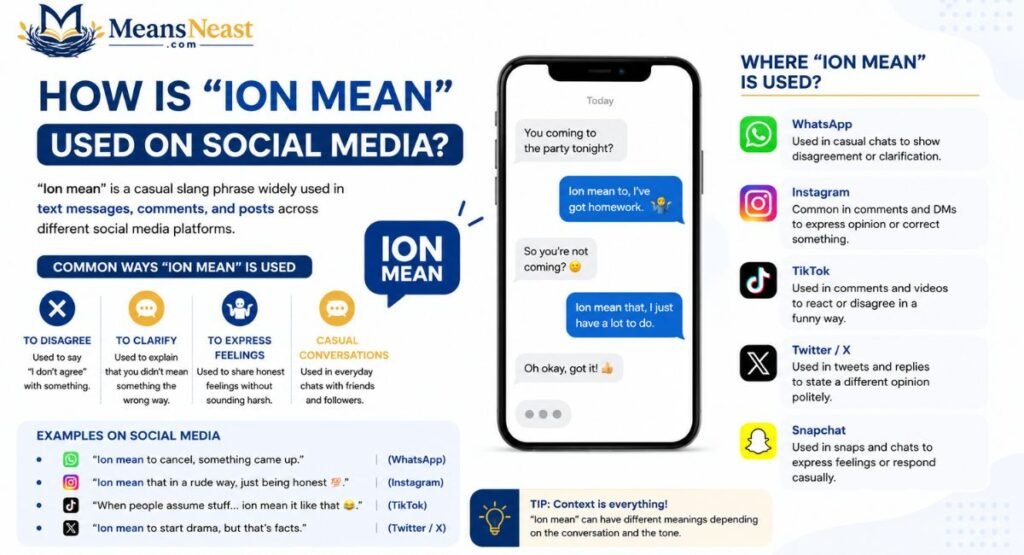
The “I’m mean” text trend is especially popular on social media. People use it to make messages shorter and sound more natural. Instead of typing “I don’t,” they simply write “ion.” It is commonly seen in social media communication, comments, captions, and private chats.
Here is how it is used on different platforms.
| Platform | How “ion” Is Used | Example |
| Snapchat | Quick replies | Ion saw your snap. |
| TikTok | Video comments | Ion think that’s true. |
| DMs and comments | Ion like this filter. | |
| Daily chats | Ion have time today. | |
| Facebook Messenger | Casual messages | Ion remember that. |
| Discord | Gaming chats | Ion play that game anymore. |
| X (Twitter) | Short posts | Ion agree with this opinion. |
Snapchat
“Ion” is common in Snapchat slang because users prefer short messages.
Example:
Alex: Did you watch my story?
Sam: Ion get the chance yet.
TikTok
In TikTok slang, people often write “ion” in video comments or replies.
Example:
Ion think this trend will last long.
The word keeps comments short and matches today’s texting culture.
You’ll often see “ion” in Instagram messages, comment sections, and DM conversations.
Example:
I don’t know where you bought that hoodie.
See Also: What Does a White Heart Mean in Text? Full Meaning Guide
WhatsApp and Facebook Messenger
Friends use “ion” in WhatsApp chats and Facebook Messenger during everyday conversations.
Example:
Ion feel like going out tonight.
Discord
Gamers frequently use “ion” in Discord chat while talking with teammates.
Example:
Ion have enough coins for that upgrade.
X (Twitter)
Short posts work well with abbreviations, so “ion” appears regularly in X (Twitter) posts and online comments.
Example:
Ion believe that news.
Why Is “Ion” So Popular?
People like using Ion because it is
- Easy to type
- Faster than writing “I don’t”
- Common in viral slang
- Perfect for casual chats
- Easy for younger users to understand
As long as you’re chatting with friends, using “ion” sounds natural and fits today’s online communication style.
Real Chat Examples
The easiest way to understand what “ion” means in text is by looking at real conversations. These real texting examples show how people naturally use the slang in everyday messages.
Example 1: Friends Chat
Emma: Are you coming tonight?
Jake: Ion think I can.
Meaning: I don’t think I can.
Example 2: Snapchat
Lily: Did you open my Snap?
Noah: Ion see it yet.
Meaning: I don’t see it yet.
Example 3: TikTok Comment
Comment:
Ion understand why everyone is arguing.
This is a common example found in social media comments.
Example 4: Instagram DM
Sarah: Do you know that person?
Mia: Ion know them.
Meaning: I don’t know them.
Example 5: WhatsApp Chat
Friend: Want to order pizza?
You: Ion have any money today.
Example 6: Discord Conversation
Player 1: Ready for another match?
Player 2: Ion have enough time.
More Daily Chat Examples
Here are some short sample messages you may see online.
| Text | Meaning |
| Ion care. | I don’t care. |
| Ion remember. | I don’t remember. |
| Ion agree. | I don’t agree. |
| Ion want that. | I don’t want that. |
| Ion know. | I don’t know. |
| Ion like it. | I don’t like it. |
Why These Examples Matter
These text conversation samples show that “ion” almost always replaces “I don’t.” Once you recognize this pattern, understanding chats becomes much easier.
Whether you’re reading online chat, replying in a group, or scrolling through social media, you’ll quickly recognize the meaning from the sentence around it.
These message examples, texting scenarios, and daily chat examples reflect how millions of people communicate online today using short, informal expressions.
When Should You Use “ion mean” in text?
You should use “ion” to mean “in text” only in informal texting and relaxed online conversations. Since “ion” means “I don’t,” it fits naturally in messages with friends, family, or people you know well.
It is commonly used in casual conversations, social media chats, and online messaging where short replies are normal.
Examples
Friend: Want to watch a movie?
You: Ion have time tonight.
Friend: Did you finish the game?
You: Ion play it anymore.
These examples sound natural because they’re part of everyday texting between friends.
When You Should Avoid It
Don’t use “ion” in professional or formal situations.
For example, avoid writing the following:
Ion understand your email.
Instead, write:
I don’t understand your email.
Following good texting etiquette helps you know when slang is appropriate and when full words are better.
Quick Tips
- Use it with close friends.
- Keep it for friendly conversations.
- Avoid it in formal writing.
- Make sure the other person understands internet slang.
- Use it naturally instead of forcing it into every sentence.
“ion” meaning in text vs. similar slang
Many texting abbreviations look similar, but they have different meanings. Understanding the difference helps you avoid confusion during conversations.
| Slang | Meaning | Example |
| ion | I don’t | Ion know. |
| idk | I don’t know | IDK what happened. |
| fr | For real | That’s funny fr. |
| ngl | Not gonna lie | NGL, I liked it. |
| imo | In my opinion | IMO it’s better. |
| ik | I know | I know what you mean. |
“ion” vs. “idk”
Many people confuse “ion” vs. “idk,” but they aren’t the same.
- “Ion” means “I don’t” and can be followed by many words.
- IDK specifically means I don’t know.
Examples:
- Ion like that song.
- IDK the answer.
ion vs fr
The comparison between ION vs. FR is simple.
- Ion expresses disagreement or something you don’t do.
- FR means for real and shows agreement or surprise.
Example:
- Ion believe it.
- That’s crazy, fr.
See Also: What Does YFM Mean in Text? A Complete Guide with Real Examples
ion vs ngl
In “ion” vs. “ngl,” both are common Gen Z expressions, but they serve different purposes.
- Ion = I don’t
- NGL = Not gonna lie
Example:
- Ion think he’s right.
- NGL, that’s impressive.
ION vs. IMO
The difference between “ion” vs. “imo” is also clear.
- Ion talks about what you don’t do or think.
- IMO shares your opinion.
Example:
- Ion agree.
- IMO, this movie was better.
ion vs ik
People also compare “ion” vs. “ik.”
- Ion = I don’t
- IK = I know
These two expressions are almost opposites.
Which One Should You Use?
Choose the slang based on what you want to say.
- Use “I don’t” when saying “I don’t.”
- Use IDK when you don’t know something.
- Use FR to say “for real.”
- Use NGL before giving an honest opinion.
- Use IMO when sharing your thoughts.
- Use IK when you already know something.
Learning these chat acronyms, internet abbreviations, and texting abbreviations makes online conversations much easier to understand.
Common Mistakes
Although ions are easy to use, many people misunderstand them. Knowing these common mistakes will help you avoid slang confusion.
1. Thinking “Ion” Always Means Science
One of the biggest common misconceptions is believing every use of “ion” refers to chemistry.
Wrong assumption:
Ion know.
This has nothing to do with science.
Correct meaning:
I don’t know.
Always remember that context matters.
2. Using It in Formal Writing
Some people use “ion” in emails or work messages.
Ion can attend the meeting.
I don’t think I can attend the meeting.
This is one of the most common texting mistakes.
3. Confusing It With “IDK”
Another misunderstood abbreviation is treating “ion” and “IDK” as the same.
- Ion = I don’t
- IDK = I don’t know
They are related but not interchangeable in every sentence.
4. Capitalizing It Incorrectly
When Ion appears at the beginning of a sentence, some readers may think it’s a person’s name.
Example:
- Ion invited me yesterday.
In this case, Ion is a name, not slang.
5. Using It With People Who Don’t Know Slang
Not everyone understands internet abbreviations.
If you’re talking to teachers, clients, or older relatives, writing “I don’t” is usually a better choice.
See Also: Why People Use SH Mean in Text Messages and Social Media
How to Avoid These Mistakes
- Read the whole sentence before deciding the meaning.
- Remember that context matters.
- Avoid slang in formal situations.
- Learn the difference between similar abbreviations.
- Keep an eye out for casual conversations.
By avoiding these internet slang mistakes, you’ll communicate more clearly and reduce texting errors in everyday chats.
How to Reply When Someone Says “ion mean in text”
If someone uses “ion” in a message, your reply depends on the conversation. Since “ion” usually means “I don’t,” you can respond naturally just as you would if the person had written the full phrase.
Here are some simple texting replies and reply examples you can use.
Casual Responses
| They Say | You can reply. |
| Ion know. | No worries! |
| Ion think so. | That’s okay. |
| Ion remember. | It’s all good. |
| Ion want to go. | Maybe next time. |
| Ion saw your message. | No problem! |
These casual responses work well when chatting with friends or classmates.
Friendly Replies
If you want to keep the conversation going, try these friendly replies.
- That’s fine. Let me know later.
- No worries, I understand.
- Thanks for telling me.
- We’ll figure it out together.
- Maybe another day.
These replies help create natural conversation starters and keep the chat flowing.
Funny Replies
Want to make the conversation more entertaining? Try these funny replies.
- Ion? Sounds like you’re speaking another language! 😂
- Fair enough, I won’t argue.
- Haha, I figured you’d say that.
- That’s the shortest “I don’t” I’ve ever seen!
Use humor only when it matches the tone of the conversation.
Quick Message Reply Ideas
| Situation | Message Reply |
| My friend says, “I don’t care.” | Haha, fair enough! |
| My friend says, “I don’t know.” | Let’s find out together. |
| My friend says, “I don’t agree.” | That’s okay, everyone has different opinions. |
| My friend says, “I don’t remember.” | I’ll remind you. |
The best chat response is one that matches the person’s mood and the context of the conversation. Whether you’re replying in a text, group chat, or social media reply, keeping your response simple and friendly usually works best.
❓ Frequently Asked Questions (FAQs)
What does ion mean in slang text?
In slang texting, ion usually means “I don’t.” It’s a casual abbreviation commonly used in chats and on social media.
What is “ion” in Gen Z slang?
In Gen Z slang, ion is a shortened way of saying “I don’t,” making conversations faster and more informal.
Is “ion” used in text messages?
Yes, “ion” is widely used in text messages, Snapchat, TikTok, Instagram, WhatsApp, and other social media platforms.
Is ion slang for “I don’t”?
Yes. In most online conversations, ion is slang for “I don’t,” such as “Ion know,” meaning “I don’t know.”
What does “ion” mean to a girl?
When a girl texts “ion,” it usually has the same meaning as anyone else—it simply means “I don’t.” The meaning depends on the context of the conversation.
Conclusion
Now you know exactly what “ion” means in text and why it has become so popular in online conversations. In most cases, “ion” is simply a shorter way of saying “I don’t,” making it perfect for casual texting, social media posts, and chats with friends. However, the meaning always depends on the context, especially when the word appears in science or as a person’s name.
By understanding where and when to use “ion,” recognizing similar slang, avoiding common mistakes, and learning how to reply naturally, you’ll feel more confident in modern digital conversations. The next time you see “ion” in a message, you’ll know exactly what it means and how to respond.

Hi, I’m Kaif Ali, creator of MeansNest. I’m an SEO professional passionate about helping people understand the meanings of words, text slang, and online expressions through clear, accurate, and easy-to-read content. I create SEO-friendly guides that deliver real value while making learning simple for everyone.