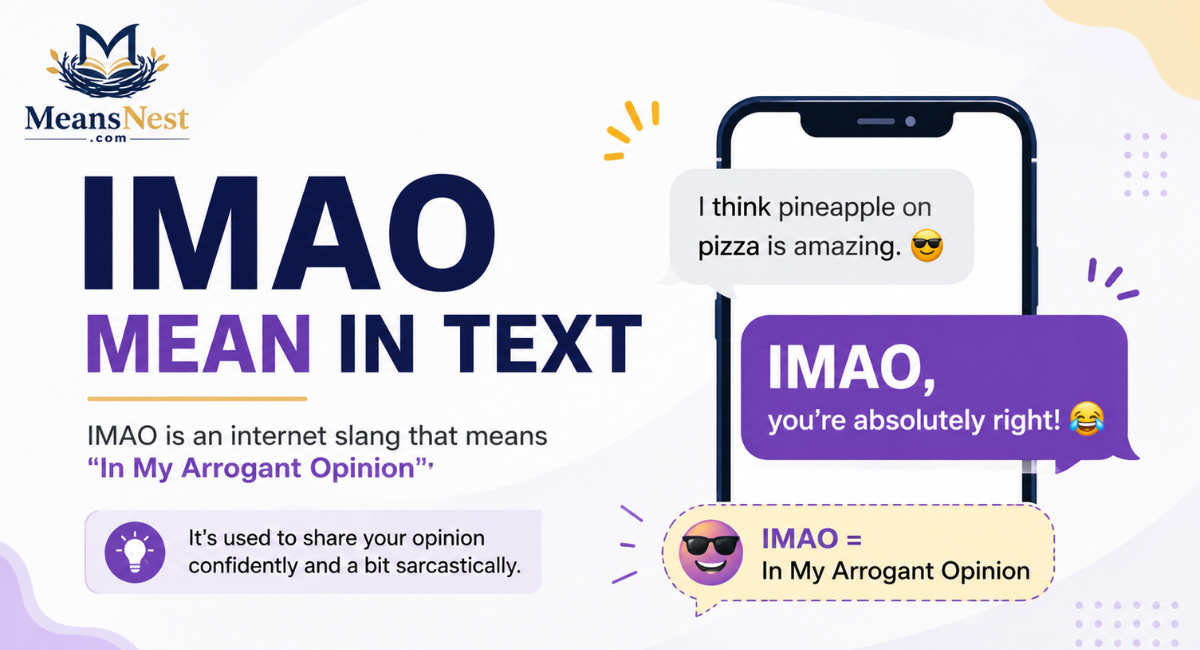
If you’ve come across IMAO in a text message or social media post, you might be wondering what it means. The IMAO meaning in text is “In My Arrogant Opinion,” a playful expression used to share a bold or humorous opinion without sounding too serious.
While it looks similar to IMHO or LOL, its tone is usually more sarcastic and lighthearted. In this guide, you’ll learn the meaning of IMAO, how it’s used in chats and online conversations, when to use it, and how it compares with other popular internet slang terms.
You’ll also discover real examples, texting tips, and why this phrase remains part of modern texting slang and social media abbreviations.
What Does IMAO Mean in Text?
IMAO stands for “In My Arrogant Opinion.”
It is an IMAO acronym used when someone wants to express an opinion while sounding funny, sarcastic, or intentionally overconfident. Most people don’t actually mean they are arrogant. Instead, they use the phrase as a joke to make their opinion sound more entertaining.
Example 1
Alex: Which superhero is the strongest?
Ryan: IMAO, Superman still wins.
Example 2
Emma: Pineapple belongs on pizza.
Lily: IMAO, that’s the best pizza topping ever!
In both examples, the speaker is sharing a personal opinion with a lighthearted tone.
Key Points
- IMAO means In My Arrogant Opinion.
- It is popular IMO in texting expression.
- It usually adds humor or sarcasm.
- It is mostly used in casual communication.
- Avoid using it in formal emails or professional messages.
What Does IMAO Mean on Social Media?
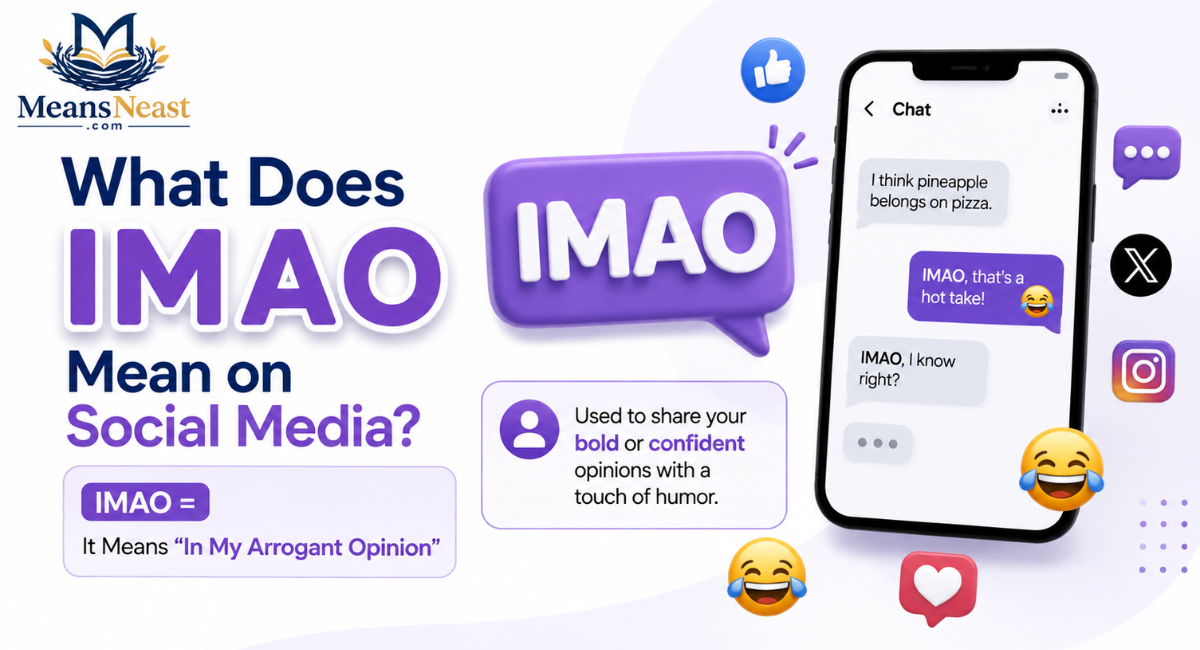
The IMAO meaning on social media is the same as in texting. People use it to share opinions, react to posts, or join discussions in a fun and informal way.
You’ll often find IMAO online slang on platforms like
- TikTok
- X (Twitter)
- Snapchat
For example:
“IMAO, this is the funniest video I’ve seen today.”
Or:
“IMAO, this movie deserved more awards.”
Because social media is full of online conversation and social media slang, IMAO fits naturally into comments, captions, and replies.
Why People Use IMAO Online
- To make opinions sound humorous.
- To soften a bold statement.
- To join friendly debates.
- To react to memes or trending topics.
- To add personality to digital communication.
How and When Is IMAO Used?
People use IMAO in messages when they want to share an opinion without sounding too serious. The expression often signals that the speaker knows their view may not be shared by everyone.
Here are common situations where how to use IMAO becomes clear.
During Friendly Debates
When discussing movies, games, music, or sports.
Example
“IMAO, that was the best Marvel movie.”
While Joking With Friends
Friends often use IMAO to exaggerate their opinions.
Example
“IMAO, I’m the best cook in this family.”
See Also: What Does IMSG Mean in Text? Meaning, Uses & Real Examples
Replying to Social Media Posts
It works well in comments and replies.
Example
“IMAO, this meme deserves a million likes.”
Giving Honest Reactions
Sometimes people use it to express an immediate reaction.
Example
“IMAO, the update actually made the app better.”
When You Should Avoid IMAO
Don’t use IANAL in:
- Business emails
- School assignments
- Job applications
- Professional presentations
- Formal customer communication
Since it is part of texting abbreviations and chat abbreviations, it is best reserved for informal conversations.
IMAO Meaning and Tone in Different Contexts
The meaning of IMAO stays the same, but its tone changes depending on the conversation.
| Context | Tone | Example |
| Friends chatting | Funny | “IMAO, you’re the slowest gamer ever.” |
| Family group chat | Playful | “IMAO, Mom makes the best biryani.” |
| Social media comments | Casual | “IMAO, this trend won’t last long.” |
| Gaming chat | Competitive | “IMAO, our team carried the match.” |
| Meme discussions | Sarcastic | “IMAO, this meme is internet gold.” |
Always consider the audience before using IMAO. Some people may not recognize the joke and could misunderstand the IMAO tone.
In most cases, IMAO works best among friends who understand modern texting language and online expressions.
IMAO vs IMHO, LMAO, and LOL: What’s the Difference?
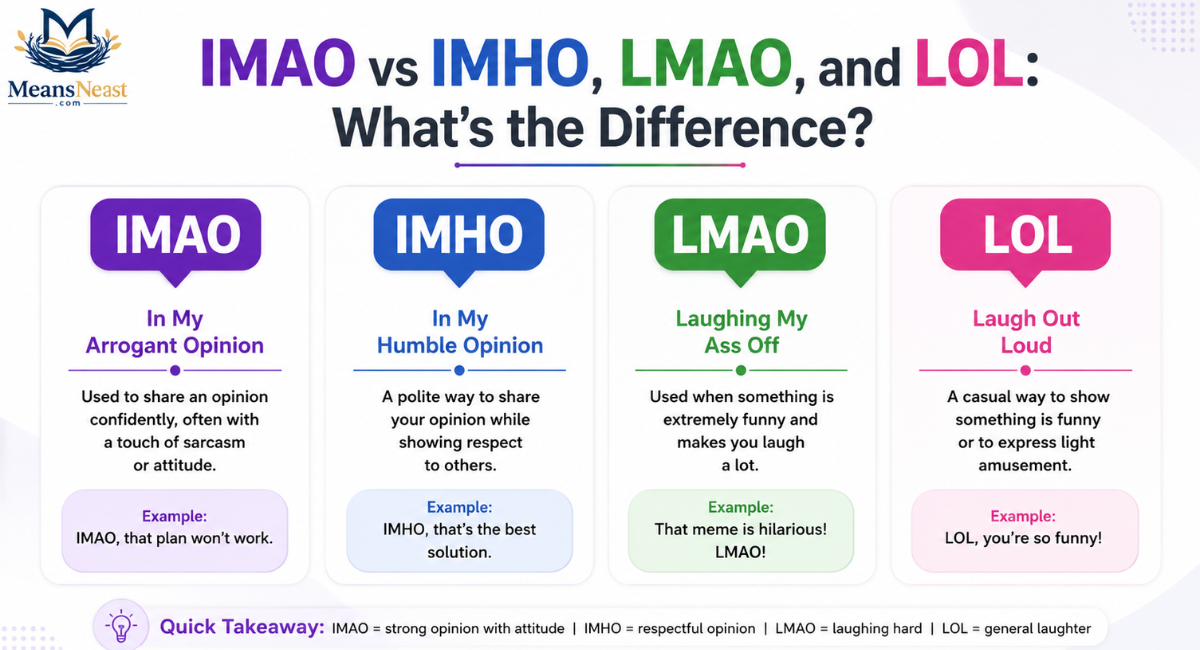
Many internet abbreviations look similar, but they have different meanings. Knowing the difference helps you choose the right expression in the right situation.
IMAO vs IMHO
Both are used to share an opinion, but they have different tones.
IMAO means “In My Arrogant Opinion.” It sounds playful, confident, or sarcastic.
IMHO means “In My Humble Opinion.” It sounds polite and respectful.
Example
IMAO: “This is the best phone ever made.”
IMHO: “This phone offers the best value for most people.”
Use IMAO when joking with friends and IMHO when you want to sound more thoughtful.
See Also: What Does “OF” Mean in Text? Slang, Chat & Social Media
IMAO vs LMAO
Although they look alike, these acronyms have completely different meanings.
IMAO expresses an opinion.
“LMAO” means “Laughing My Ass Off.” It shows that something is extremely funny.
Example
IMAO: “That game has the best graphics.”
LMAO: “That video made me laugh so hard!”
One shares an opinion, while the other expresses laughter.
IMAO vs LOL
LOL stands for “Laugh Out Loud.”
Unlike IMAO, LOL is used to show amusement rather than an opinion.
Example
IMAO: “Cats are smarter than dogs.”
LOL: “That joke was hilarious. LOL!”
LOL is one of the oldest and most popular online acronyms, while IMAO is mainly used to introduce a humorous opinion.
Quick comparison table
| Acronym | Full Form | Main Purpose | Tone | Example |
| IMAO | In My Arrogant Opinion | Share a humorous opinion | Playful, sarcastic | “IMAO, this song is underrated.” |
| IMHO | In My Humble Opinion | Share a polite opinion | Respectful | “IMHO, both options are good.” |
| LMAO | Laughing My Ass Off | Express strong laughter | Funny | “LMAO, that meme is priceless!” |
| LOL | Laugh Out Loud | Show amusement | Casual | “LOL, that’s hilarious.” |
Where Did IMAO Come From?
Like many social media abbreviations, IMAO became popular in the early days of internet forums, online chat rooms, and instant messaging.
As people looked for faster ways to communicate, they created shorter forms of common phrases. While IMO and IMHO became widely accepted, users later started saying IMAO as a humorous twist.
Today, it appears in:
- Group chats
- Gaming communities
- Reddit discussions
- Meme pages
- Social media comments
- Casual texting
Although it isn’t as common as LOL or IMO, many internet users still recognize the phrase.
Real-Life Examples of IMAO in Texting
Here are some natural examples showing IMAO used in a sentence.
Example 1
Sarah: Which Netflix series should I watch?
Jake: IMAO, “Stranger Things” is still the best.
Example 2
Emma: Do you like the new update?
Lucas: IMAO, it’s much better than the old one.
Example 3
Ben: Which football player is the GOAT?
Chris: IMAO, Messi will always be number one.
See Also: What Does NFS Mean in Text? Complete Social Media Guide
Example 4
Sophia: Should I buy the blue dress?
Lily: IMAO, the black one looks much nicer.
Example 5
Mike: Which fast food place is the best?
David: IMAO, burgers beat pizza every time.
These examples show how IMAO in chat is commonly used to introduce a personal opinion in a fun and informal way.
Common Misconceptions About IMAO
Many people misunderstand this acronym because it looks similar to other popular texting slang.
Misconception 1: IMAO Means “Laughing.”
This is incorrect.
People often confuse it with LMAO because the spellings are similar.
Misconception 2: It Is an Offensive Phrase
Not usually.
Most users say IMAO jokingly rather than trying to insult someone.
Misconception 3: It Should Be Used Everywhere
No.
Since it is, IMO, informal language, it’s best for friends, family, and social media—not professional communication.
Misconception 4: Everyone Knows What It Means
Not everyone is familiar with internet slang.
If you’re talking to someone who rarely uses chat slang, it may be better to write your opinion in full.
How to Respond When Someone Says IMAO
There is no single correct reply. Your response depends on the conversation.
Here are a few friendly ways to respond.
If You Agree
- “I totally agree!”
- “Same here!”
- “You’re right!”
- “Good point.”
If You Disagree
- “I see it differently.”
- “Maybe, but I think the opposite.”
- “That’s fair, but here’s my opinion.”
See Also: What Does DW Mean in Text? Simple Meaning and Usage
If They Were Joking
- “😂 Good one!”
- “Haha, that’s funny.”
- “You might be right!”
Keeping the conversation respectful is always better than arguing over a casual opinion.
Is IMAO Still Used Today?
Yes, although it isn’t as common as LOL, IMO, or LMAO, many people still use IMAO in online conversations.
It is especially popular among people who enjoy:
- Meme culture
- Gaming chats
- Reddit discussions
- Group chats
- Casual texting
- Social media comments
Because internet language changes quickly, newer slang appears every year. However, IMAO remains a recognizable IMAO internet slang term that many users understand.
If you want to express a funny or slightly exaggerated opinion, IMAO is still a good choice in informal conversations.
❓ Frequently Asked Questions (FAQs)
What does “IMAO” mean in text?
IMAO means “In My Arrogant Opinion.” It’s used to share a strong or humorous opinion in casual texts, chats, and social media conversations.
Is it IMAO or LMAO?
They mean different things. IMAO expresses an opinion, while LMAO means “Laughing My Ass Off” and is used when something is very funny.
What does IMAO mean in Gen Z?
Among Gen Z, IMAO is used jokingly to give a bold or sarcastic opinion without sounding too serious.
What are some examples of using IMAO?
Example: “IMAO, that was the best movie of the year,” or “IMAO, pineapple belongs on pizza.”
What is IMAO in English?
In English, IMAO stands for “In My Arrogant Opinion,” meaning you’re sharing your opinion in a playful or exaggerated way.
Conclusion
Understanding the IMAO meaning in text makes it easier to follow today’s social media slang and texting abbreviations. Whether you’re chatting with friends, replying to a meme, or sharing your thoughts online, IMAO is a fun way to express a confident or humorous opinion.
Just remember that it means “In My Arrogant Opinion,” and it’s usually intended as a joke rather than a serious claim. Use it in casual conversations, avoid it in formal settings, and pay attention to the context and tone.
Once you know how and when to use IMAO, you’ll be able to communicate more naturally and understand modern online acronyms with confidence.

Hi, I’m Kaif Ali, creator of MeansNest. I’m an SEO professional passionate about helping people understand the meanings of words, text slang, and online expressions through clear, accurate, and easy-to-read content. I create SEO-friendly guides that deliver real value while making learning simple for everyone.