If you have seen “IMA” in a text message, chat, or social media post, you may wonder what it means.
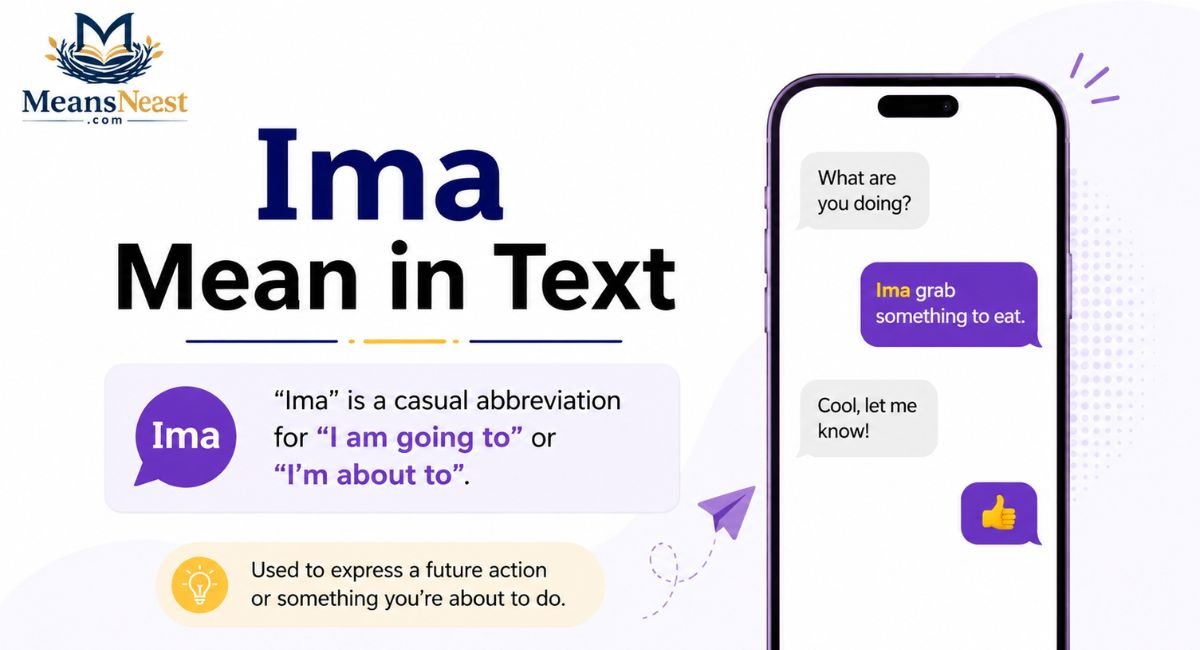
In most cases, Ima means “I’m going to” and is used to talk about something a person plans or intends to do.
It is a common part of texting slang and casual texting language, especially in conversations with friends, group chats, and social media. You may also see it written as “I’ma” or “imma,” depending on the person’s style.
While IMA is easy to understand in online communication, it is considered informal and is usually avoided in professional or academic writing. Understanding the context makes its meaning simple and clear.
What Does IMA Mean in Text?
In text messages, IMA usually means “I’m going to.” It is an informal abbreviation used to express an upcoming action or intention.
For example:
“I’m going to get some food.”
This means:
“I’m going to get some food.”
Another example is:
“I’m going to call you tonight.”
The meaning is
“I’m going to call you tonight.”
The IMA definition is therefore simple: it is a casual way of saying that someone intends to do something.
Common IMA examples
| IMA in a text | Standard English |
| I’m going home. | I’m going to go home. |
| I’m going to call you later. | I’m going to call you later. |
| I’m going to get some coffee. | I’m going to get some coffee. |
| I’m going to finish this tonight. | I’m going to finish this tonight. |
| I’m going to check it out. | I’m going to check it out. |
The exact IMA phrase meaning depends slightly on the sentence, but it almost always communicates an upcoming action.
It is important not to confuse this use with “I’m a,” which has a completely different meaning. Context is the easiest way to understand which meaning is intended.
What Does IMA Mean in Chat and Social Media?
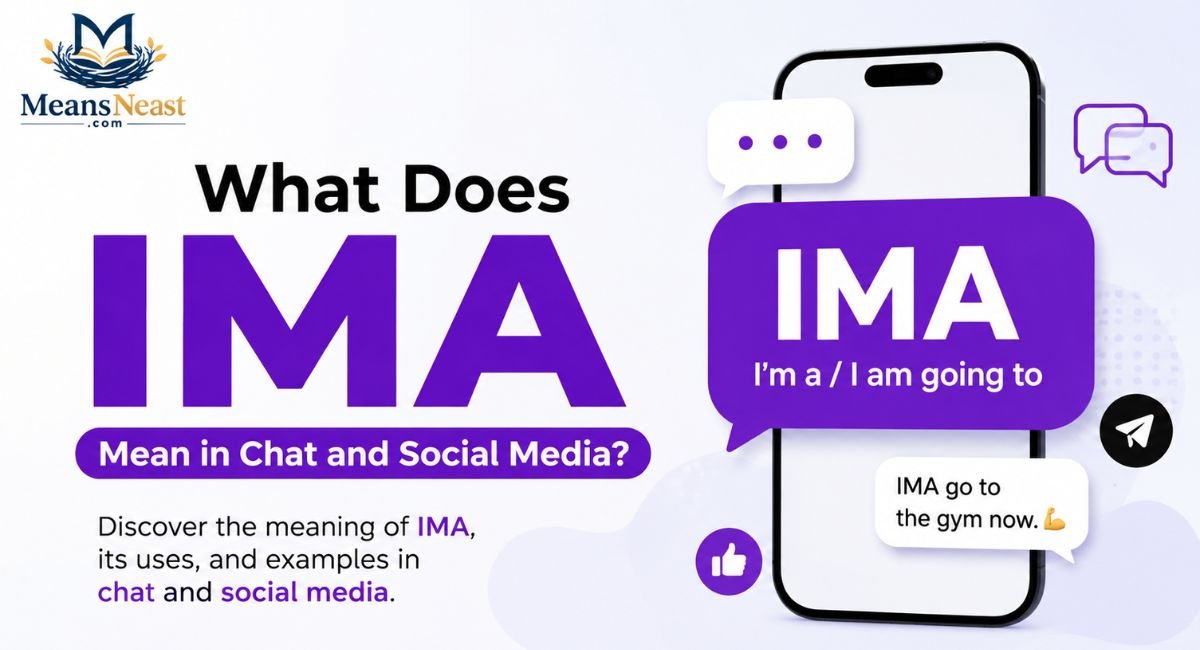
The IMA meaning in chat is generally “I’m going to.” People use it because it is quick, casual, and easy to understand.
You can find IMA in many forms of online communication, including text messages, group chats, comments, and social media conversations.
It may appear on:
- Snapchat
- TikTok
- Gaming chats
- Group chats
- Direct messages
For example, someone might post:
“I’m going to try this trend later.”
Or a friend could text:
“I’ll be there in 10.”
In both cases, the person is describing something they plan to do.
The IMA meaning on social media is therefore usually connected to plans, intentions, or immediate actions.
Because social media encourages fast communication, shortened expressions such as IMA can feel more natural than writing the complete phrase.
However, IMA is not limited to one particular platform or age group. It is part of broader internet slang words, chat abbreviations, and informal English that have developed through everyday digital communication.
Is IMA Gen Z slang?
IMA can appear in Gen Z slang, but it is not exclusively a Gen Z expression.
People of different ages may use it in casual conversations, particularly when they are comfortable with informal texting. Its popularity is connected to spoken language and internet communication rather than belonging to only one generation.
You may see:
- “IMA”
- “ima”
- “I’m a”
- “Imma”
These forms can overlap in casual writing, although individual users may have different preferences for spelling.
How Is IMA Used in Different Contexts?
The IMA usage is mainly connected to future actions, intentions, or plans.
A person can use IMA when they are telling someone what they are about to do, what they intend to do later, or what they have decided to do.
1. Talking about an immediate action
“I’m going to eat first.”
This means the person is saying they are going to eat first.
2. Talking about future plans
“I’m visiting my cousin tomorrow.”
The speaker means:
“I’m going to visit my cousin tomorrow.”
See Also: THB Meaning in Text: What Does THB Mean in Chat?
3. Making a decision
“I’m going to buy the blue one.”
Here, IMA introduces a decision or intention.
4. Promising to do something
“I’m going to send it tonight.”
The speaker is communicating that they intend to send something later.
5. Talking casually with friends
“I’m heading out now.”
This is a natural example of IMA casual meaning in everyday conversation.
IMA in different types of communication
| Context | Example | Meaning |
| Texting | “I’m going to call you.” | I’m going to call you. |
| Group chat | “I’m joining soon.” | I’m going to join soon. |
| Gaming | “I’m going to push mid.” | I’m going to push the mid. |
| TikTok comment | “I’m going to try this.” | I’m going to try this. |
| Instagram DM | “I’m going to send the photo.” | I’m going to send the photo. |
| Snapchat | “IMA sleep.” | I’m going to sleep. |
The expression is particularly suitable for casual conversation, informal communication, and online conversations where speed matters.
It is less suitable for formal emails, academic writing, business reports, or professional documents.
IMA Meaning in Real Text Conversations
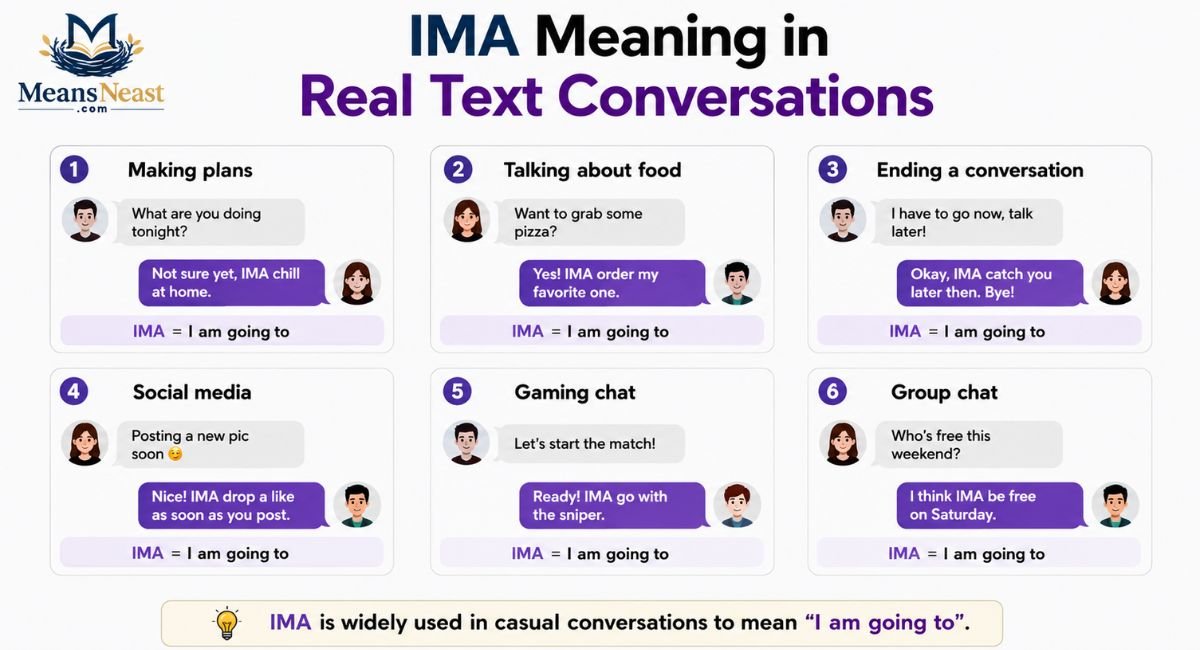
Seeing IMA in a complete conversation makes its meaning easier to understand.
1: Making plans
Alex: Are you coming to the party?
Sam: Yeah, I’m leaving around 8.
Here, IMA means “I’m going to.”
2: Talking about food
Alex: Want anything from the store?
Sam: I’m going to get some snacks. Want something?
The speaker is saying they are going to get snacks.
3: Ending a conversation
Alex: Are you still awake?
Sam: Not for long. IMA sleep.
The meaning is “I’m going to sleep.”
See Also: CS Meaning in Text: Context, Examples & Responses
4: Social media
Alex: That challenge looks fun.
Sam: I’m going to try it tomorrow. 😂
Here, IMA communicates an intention to try something.
5: Gaming chat
Player 1: Where are you going?
Player 2: I’m going to push the left side.
In gaming slang, IMA can quickly communicate the player’s next move.
6: Group chat
Friend 1: Who’s coming with me?
Friend 2: I’m coming.
This means “I’m going to come.”
These IMA text examples show why context matters. The word following IMA usually tells you what action the speaker intends to take.
How Do You Reply When Someone Says “IMA”?
How to reply to IMA depends on what the person is saying.
There is no special response required simply because someone uses the abbreviation. Read the entire message and respond to the action or plan they mention.
If they are telling you their plan
They: “I’m going to go to the mall.”
You: “Cool, what time?”
If they are going somewhere
They: “I’m heading home.”
You: “Okay, text me when you get there.”
If they are going to do something for you
They: “I’m going to send it tonight.”
You: “Thanks!”
If you want to encourage them
They: “I’m starting working out tomorrow.”
You: “Nice! You got this.”
If you are unsure about their meaning
You can simply ask:
“What do you mean?”
However, this is rarely necessary when the surrounding sentence clearly shows the intended meaning.
The best way to reply to an IMA approach is to focus on the complete sentence rather than the abbreviation itself.
Is IMA formal or informal?
IMA is informal.
It is mainly used in texting, social media, online communication, casual conversations, and other relaxed situations.
For example, sending a friend:
“I’m going to call you later.”
is completely natural in casual texting.
But writing:
“I’m going to review the proposal tomorrow.”
in a formal business email would usually look too casual.
Where IMA works well
- Text messages
- WhatsApp chats
- Snapchat messages
- Instagram DMs
- TikTok comments
- Gaming chats
- Group chats
- Casual social media posts
- Conversations with friends
See Also: What Does BTW Mean in Text? Meaning, Uses & Examples
Where you should avoid IMA
- Job applications
- Academic papers
- Formal reports
- Professional emails
- Business proposals
- Official documents
In formal writing, use the complete phrase “I am going to” or an appropriate professional alternative.
This distinction is important because the informal meaning of “IMA” is closely connected to casual digital communication.
“IMA” vs. “I’m a,” “I am,” and Similar Slang Terms
One of the most common sources of confusion is the difference between IMA and phrases such as “I’m a,” “I am,” and “imma.”
Although they can look similar, their meanings are not always identical.
| Term | Typical meaning | Example |
| IMA | I’m going to | “IMA call her.” |
| I’m a | I am a | “I’m a student.” |
| I am | Full form of “I’m” | “I am tired.” |
| I’m a | I’m going to | “I’m going to call you.” |
| Imma | Informal form of I’m going to | “I’m going to leave now.” |
IMA vs. “I’m a”
The “I’m a” meaning is different from IMA when the phrase means “I am a.”
For example:
“I’m a teacher.”
Here, the speaker is identifying themselves as a teacher.
But:
“I’m going to call you.”
means:
“I’m going to call you.”
Context usually makes the difference clear.
IMA vs. “I am”
“I am” is standard English.
For example:
“I am tired.”
IMA does not normally replace “I am” in this type of sentence.
“I’m tired.”
would not normally mean “I am tired.”
Instead, IMA is generally followed by an action:
“IMA sleep.”
meaning:
“I’m going to sleep.”
IMA vs. imma
The comparison “Ima” vs. “imma” is common because both forms can express “I’m going to.”
For example:
“I’m going now.”
and
“Imma go now.”
can communicate essentially the same idea in informal communication.
Spelling varies because these expressions represent casual speech in written form. There is no single universally required spelling for internet slang.
I’m vs. I’ma
“I’m” normally means “I am.”
For example:
“I’m hungry.”
“I’ma” is an informal representation of “I’m going to.”
For example:
“I’ma eat.”
The apostrophe can help distinguish the expression from other phrases, but online users frequently leave punctuation out.
Why Do People Say “IMA” Instead of “I Am Going To”?
People use IMA because texting and online communication are often fast and informal.
Typing:
“I’m going to call you later.”
takes less effort than:
“I am going to call you later.”
The shorter version also reflects how people may pronounce the phrase in casual speech.
Several factors explain its popularity.
1. It saves time
Short expressions are convenient when people are typing quickly.
2. It matches casual speech
IMA represents a pronunciation and rhythm commonly heard in informal conversation.
See Also: FAFO Meaning in Text: Slang, Origin & Real Examples
3. It feels natural online
Texting does not always follow formal grammar rules. People often write the way they speak.
4. It fits social media language
Platforms such as TikTok, Instagram, Snapchat, and other social networks have helped popularize short expressions and social media abbreviations.
5. It creates a relaxed tone
Using IMA can make a message sound friendly, casual, and conversational.
This is why IMA has become a familiar part of modern texting terms, internet language, and slang words in texting.
Is IMA an abbreviation of “I am going to”?
In practical terms, yes, IMA is commonly used online as a shortened form of “I’m going to.”
However, it is better understood as an informal slang spelling rather than a strict abbreviation created by removing specific letters from every word.
Similar forms developed from spoken language and became common in digital communication.
❓ Frequently Asked Questions (FAQs)
What does “IMA” mean in chat?
IMA usually means “I’m going to” and is used in casual texting.
Why do people say “IMA”?
People say IMA because it is a quick, informal way to express an upcoming action or plan.
What is “imo” in Gen Z?
IMO means “in my opinion” and is commonly used in texting and social media.
What does “I’m a girl” mean?
“I’m a girl” simply means the speaker is identifying themselves as a girl or a female.
What is IMA?
IMA is informal texting slang that usually means “I’m going to.”
Conclusion
The IMA meaning in text is usually “I’m going to.” It is a casual expression used when someone wants to describe an upcoming action, plan, or intention.
You may see IMA in text messages, WhatsApp chats, social media posts, gaming conversations, and group chats.
While IMA is useful in informal communication, it should generally be avoided in professional and academic writing.
Understanding context is important because IMA can look similar to “I’m a,” but the meanings are different.
When used naturally, IMA is simply a quick and conversational way to express “I’m going to.” Once you recognize the pattern, understanding this common texting slang becomes easy.

Hi, I’m Kaif Ali, creator of MeansNest. I’m an SEO professional passionate about helping people understand the meanings of words, text slang, and online expressions through clear, accurate, and easy-to-read content. I create SEO-friendly guides that deliver real value while making learning simple for everyone.