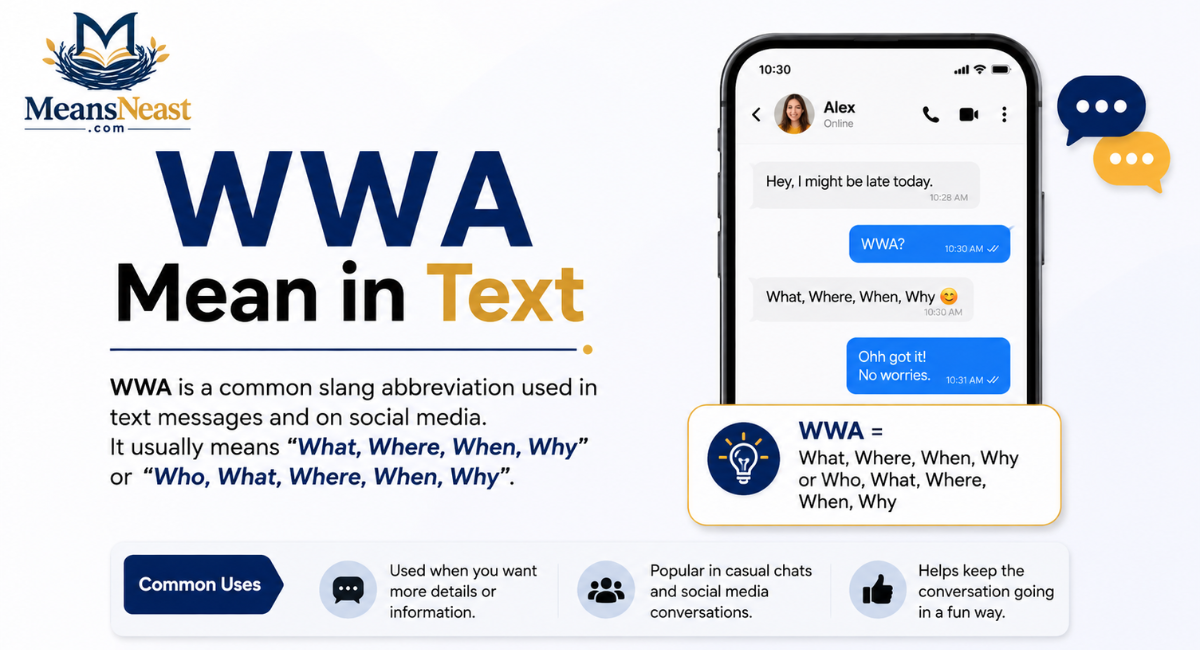
If you’ve come across WWA in a message and wondered what it means, you’re not alone. The WWA meaning in text can vary depending on the conversation, but it most commonly stands for “Where We At?” and is used to ask about someone’s location, plans, or current status.
Like many texting abbreviations, WWA has become part of everyday online slang and social media communication on platforms like WhatsApp, Snapchat, Instagram, and TikTok.
In this guide, you’ll discover the WWA full form, different meanings in various contexts, real chat examples, how to reply, and how it compares with similar chat acronyms and messaging slang used in modern digital conversations.
What Does WWA Mean in Text?
The most common WWA meaning in text is
WWA = Where We At?
People use it to ask where someone is, what they’re doing, or what the current plan is. It’s a casual expression commonly seen in online slang, messaging slang, and everyday conversations between friends.
For example:
Alex: WWA?
Sam: I’m outside the mall.
In many conversations, WWA simply replaces a longer question to save time while texting.
Simple Definition
“WWA” is a short texting abbreviation that usually means “Where We At?” It asks about someone’s location, current status, or plans.
Full Form
| Abbreviation | Full Form | Common Use |
| WWA | Where are we at? | Casual texting and chat |
Quick Answer (Featured Snippet optimized)
WWA means “Where We At?” in texting. It is commonly used to ask someone’s location, current situation, or plans in text messages, WhatsApp, Snapchat, Instagram, TikTok, Discord, and other social media chats. Depending on the context, WWA can also have different meanings in business, technology, and other industries.
What Does WWA Stand For?
The WWA full form depends on the conversation. Although several meanings exist, one is far more common in everyday texting.
Full form in texting
The most common WWA acronym is
Where are we at?
It helps people quickly ask the following:
- Where are you?
- What’s happening?
- What’s the plan?
- How far along are we?
Instead of typing a full sentence, users simply write WWA.
Example:
Mike: WWA?
John: Almost there.
Most common meaning
In WWA in text messages, “Where We At?” is by far the most popular interpretation.
Friends often use it before:
- Meeting up
- Hanging out
- Playing games
- Starting a video call
- Joining an online event
Example:
Emma: WWA tonight?
Sophia: Let’s meet at 7.
This meaning is especially popular among younger users who frequently use text message slang and chat acronyms.
See Also: What Does STSU Mean in Text? Definition, Examples & Social Media Uses
Other possible meanings
Although “Where We At?” is the most common meaning in casual texting, WWA may also stand for different phrases depending on the industry or community.
Some examples include:
| WWA Meaning | Context |
| Where are we at? | Texting and social media |
| World Water Association | Organization |
| World Wide Alliance | Business |
| Women’s Wrestling Association | Sports |
| Working With Animals | Education and training |
Always read the surrounding conversation before deciding which meaning is correct.
Different Meanings of WWA in Different Contexts
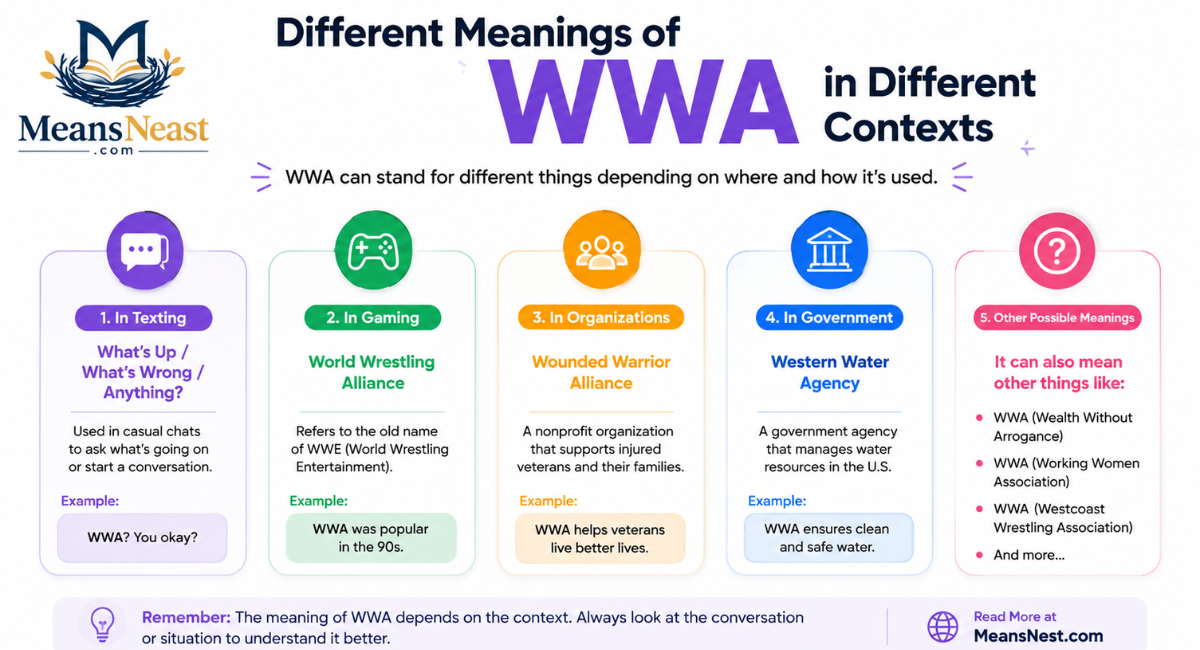
The WWA meaning changes based on where it is used. Context is always the key to understanding abbreviations correctly.
In Text Messages
In everyday texting, WWA almost always means “Where We At?”
Friends use it when they want a quick update.
Examples:
WWA?
WWA for dinner?
WWA after class?
These short messages make conversations faster and fit today’s casual texting language.
Example conversation:
Chris: WWA?
Jake: Just reached home.
In Online Chat
In WWA in online chat, users often ask about someone’s progress rather than their physical location.
Example:
Player 1: WWA?
Player 2: Level 12 already.
Or:
Manager: WWA on the project?
Employee: About 80% finished.
Here, WWA means:
- What’s our current status?
- Where have we reached?
- What’s the progress?
Context determines the exact meaning.
On Social Media
Across Instagram, Snapchat, Facebook Messenger, and TikTok, WWA usually asks what someone is doing or where they are.
Examples:
- WWA tonight?
- WWA this weekend?
- WWA everyone?
- WWA after the concert?
It works as a quick conversation starter and fits naturally into modern social media communication.
Influencers and creators sometimes use it to encourage followers to comment about their plans.
Example:
WWA this Friday? Drop your plans below!
In Gaming
Gamers also use WWA during multiplayer matches.
Instead of asking where someone physically is, it often refers to the following:
- Team position
- Match progress
- Current objective
- Strategy update
Example:
Captain: WWA?
Teammate: Holding the west side.
Another example:
WWA?
Only two enemies left.
Gaming communities prefer short messages because they save time during fast-paced matches.
In Business or Professional Use
In workplaces, WWA is much less common, but some teams use it informally.
Possible meaning:
Where are we at?
Managers may ask:
- WWA on today’s report?
- WWA with the client meeting?
- WWA on the presentation?
Example:
Manager: WWA with the proposal?
Employee: Final review is complete.
Because professional communication usually requires clarity, many companies avoid abbreviations unless everyone understands them.
Other Industry Meanings (Medical, Aviation, Technology, etc.)
Outside texting, the WWA abbreviation may represent completely different phrases.
| Industry | Possible Meaning |
| Medical | Organization or department name |
| Aviation | Internal operational abbreviation |
| Technology | Company-specific project code |
| Education | Working With Animals |
| Sports | Women’s Wrestling Association |
These meanings are usually unrelated to the WWA meaning in texting.
Whenever you see WWA in a professional document, technical report, or organization name, don’t assume it means “Where We At?” Instead, read the surrounding information to determine the intended meaning.
How Is WWA Used on Social Media?
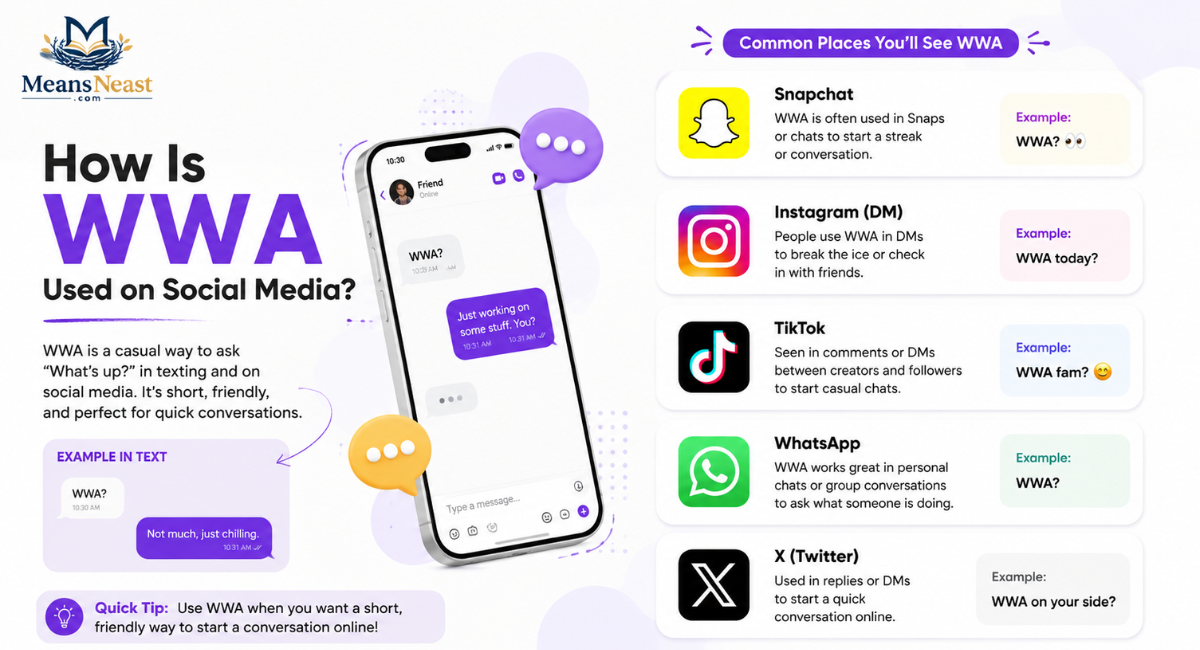
The WWA meaning on social media is usually the same as it is in text messages: “Where We At?” People use it to ask where someone is, what they’re doing, or what the current plan is. Since it is short and easy to type, WWA fits naturally into social media abbreviations, online messaging terms, and modern internet slang.
Although the meaning stays similar across platforms, the way people use it can vary depending on the app.
On WhatsApp, WWA is often used between friends, family, or coworkers to check someone’s location or ask for a quick update.
Examples:
Ali: WWA? Everyone’s waiting.
Sara: Five minutes away.
Another example:
John: WWA for lunch?
Mike: Let’s meet at our usual café.
Because WhatsApp conversations are fast-paced, abbreviations like WWA help keep messages short. It’s a common part of WhatsApp slang and everyday digital communication.
On Instagram, WWA appears in direct messages, Stories, and comment sections. It usually asks what someone is doing or where they’re hanging out.
Examples:
- WWA tonight?
- WWA after the concert?
- WWA this weekend?
Influencers may also use WWA to encourage followers to interact.
Example Story:
WWA today? Tell me your weekend plans!
This makes conversations feel more personal and increases engagement using casual Instagram slang.
Snapchat
Snapchat users often send WWA when they want a quick update before sharing photos or videos.
Examples:
Emma: WWA?
Lily: At the beach. 🌊
Or:
Jake: WWA rn?
Ryan: Heading home.
Since Snapchat focuses on real-time communication, WWA works well as one of many popular Snapchat abbreviations.
See Also: What Does IMAO Mean in Text? Meaning, Uses & Real Examples
TikTok
Although WWA is less common in public TikTok comments, it still appears in private messages and live chats.
Examples include:
- WWA after school?
- WWA this Friday?
- WWA tonight, everyone?
Creators may ask followers where they’re watching from or what they’re doing.
Example:
WWA while watching this video?
The phrase blends naturally with today’s TikTok slang and social media language.
On Facebook and Facebook Messenger, WWA is mostly used in private chats or group conversations.
Examples:
David: WWA?
Chris: Already at the restaurant.
Or:
WWA this weekend?
Thinking about a road trip.
Even though Facebook users often write full sentences, many younger users still prefer short Facebook Messenger slang when chatting.
Discord
Discord users frequently use WWA while gaming or planning voice chats.
Examples:
Leader: WWA?
Player: Joining the lobby now.
Or:
WWA before tonight’s raid?
Everyone is ready.
Because Discord conversations move quickly, short chat shortcuts like WWA help players communicate efficiently.
Real Examples of WWA in Conversations
Understanding real conversations makes the WWA conversation meaning much easier to remember. Here are some natural examples from different situations.
Friend to Friend
Alex: WWA?
Ben: I’m outside your house.
Emma: WWA after class?
Lucy: Let’s grab coffee.
Tom: WWA?
Jack: Still at work.
These are typical examples of WWA in text messages between friends.
Dating Chat
WWA is also common when making plans with someone you’re dating.
Noah: WWA tonight?
Olivia: Home right now. Want to meet later?
Liam: WWA?
Sophia: Just finished dinner.
Chris: WWA this weekend?
Mia: Free on Saturday.
These conversations sound relaxed and natural, making WWA useful in casual texting.
Group Chat
In group chats, WWA helps everyone stay updated.
Sarah: WWA everyone?
Ali: On my way.
Emma: Already there.
Ryan: Parking now.
Another example:
Host: WWA with the party setup?
Jake: Decorations are done.
Emma: Food arrives in 20 minutes.
Gaming Chat
Gamers often use WWA during multiplayer matches.
Captain: WWA?
Player 1: Holding the bridge.
Player 2: Need backup.
Another example:
Leader: WWA on the mission?
Teammate: Final checkpoint.
This quick communication saves valuable time during competitive games.
See Also: What Does IMSG Mean in Text? Meaning, Uses & Real Examples
Social Media Comments
WWA can also appear in comments or replies.
Example:
Creator: WWA this summer?
Follower 1: Traveling to Japan!
Follower 2: Staying home.
Follower 3: Beach vacation!
Another example:
Friend: WWA tonight?
Reply: Movie night with friends.
These simple WWA examples in text show how flexible the abbreviation can be.
How Should You Reply to WWA?
Your reply depends on what the sender is asking. Most of the time, they’re simply looking for a location update, your plans, or your current situation.
Casual replies
These are the most common responses.
Examples:
- I’m at home.
- On my way.
- Almost there.
- Just arrived.
- At work.
- Still busy.
- Heading out now.
- Meet you in 10 minutes.
These short replies match the relaxed style of WWA messaging meaning.
Funny replies
Want to keep the conversation playful? Try these responses.
Examples:
- Lost somewhere on Earth 😂
- Probably where the food is.
- Still trying to wake up.
- Mentally on vacation.
- In bed, avoiding responsibilities.
- Secret location 🤫
- Wherever Wi-Fi exists.
Humor makes everyday chats more engaging.
Formal replies
If WWA is used in a work conversation, answer clearly and professionally.
Examples:
- I’m currently finishing the report.
- The project is approximately 90% complete.
- We’ve reached the testing phase.
- The meeting starts in five minutes.
- I’ll send an update shortly.
Professional replies avoid confusion while keeping communication clear.
Reply examples
| Message | Good Reply |
| WWA? | I’m at home. |
| WWA tonight? | Meeting friends around 7 PM. |
| WWA with the project? | We’re almost finished. |
| WWA after class? | Let’s grab lunch. |
| WWA on the game? | Final round now. |
These examples help you understand the correct WWA reply meaning in different situations.
WWA vs Similar Texting Slang
Many people confuse WWA with other popular internet abbreviations because they all involve quick questions. However, each one has a different meaning.
| Abbreviation | Meaning | Purpose |
| WWA | Where Are We At? | Ask about location or progress |
| WYA | Where Are You At? | Ask someone’s exact location |
| WYD | What are you doing? | Ask what someone is doing |
| HBU | How About You? | Return a question |
| WSG | What’s Good? | Casual greeting |
WWA vs WYA
Although they look similar, these abbreviations ask different questions.
WWA (Where We At?)
- Refers to a group, plan, or current progress.
- Can ask about status as well as location.
Example:
WWA for dinner?
WYA (Where You At?)
- Refers directly to one person’s location.
Example:
WYA? I’m outside.
Difference: WWA is broader, while WYA is more personal.
WWA vs WYD
These abbreviations serve different purposes.
WWA
Asks:
- Where are we?
- What’s the plan?
- What’s our progress?
WYD
Means:
What are you doing?
Example:
WYD tonight?
Watching a movie.
WYD focuses on activities, not location or progress.
WWA vs HBU
HBU means:
How About You?
It’s usually used after answering someone’s question.
Example:
I’m doing great. HBU?
WWA starts a conversation, while HBU keeps one going.
WWA vs WSG
WSG stands for:
What’s Good?
It’s a casual greeting similar to the following:
- What’s up?
- What’s new?
- How’s it going?
Example:
WSG bro?
Nothing much.
Unlike WWA, WSG isn’t asking for someone’s location or progress. It’s simply starting a friendly conversation.
Common Mistakes and Misunderstandings About WWA
Although the WWA meaning in text is usually easy to understand, people sometimes interpret it incorrectly. Like many internet abbreviations, its meaning depends on the conversation. Assuming the wrong definition can lead to confusion, especially in online conversations or professional settings.
Wrong meanings
One of the biggest mistakes is thinking WWA always has the same meaning.
In most text message slang, WWA stands for “Where We At?” However, in business, education, sports, or technology, it may represent something completely different.
For example:
| Context | Correct Meaning |
| Texting | Where Are We At? |
| Business | Company-specific abbreviation |
| Education | Working With Animals |
| Sports | Women’s Wrestling Association |
| Organization | World Water Association |
Always check the surrounding conversation before deciding what WWA means.
Context confusion
Context is the key to understanding any WWA text abbreviation.
Consider these examples:
Example 1
Alex: WWA?
Ben: I’m outside.
Here, WWA asks about someone’s location.
Example 2
Manager: WWA with the presentation?
Employee: Final edits are complete.
In this case, WWA asks about project progress rather than location.
Example 3
Squad Leader: WWA?
Player: Defending the base.
Here, WWA refers to the team’s current position in a game.
The same abbreviation can have different meanings depending on who is speaking and the situation.
See Also: What Does “OF” Mean in Text? Slang, Chat & Social Media
Assuming one meaning everywhere
Another common mistake is believing WWA always means “Where We At?”
While this is the most popular WWA slang meaning, it isn’t the only one.
Before replying, ask yourself:
- Is this a casual chat?
- Is this a work conversation?
- Is this related to gaming?
- Is this an organization or industry abbreviation?
Understanding the context helps avoid misunderstandings and improves digital communication.
Is WWA Still Popular in 2026?
Yes. Although newer slang appears every year, WWA meaning in texting is still recognized and used in casual conversations. It remains part of today’s messaging slang, especially among younger users who prefer short and quick messages.
Current usage
WWA is most commonly used for:
- Asking where someone is
- Checking group plans
- Asking about progress
- Starting casual conversations
- Coordinating meetups
Its simplicity keeps it useful in everyday texting.
Social media trend
WWA continues to appear across different social platforms, although it is more common in private chats than public posts.
You’ll often see it on:
- Snapchat
- Instagram Direct Messages
- Discord
- Facebook Messenger
- TikTok messages
Because people prefer short chat acronyms, WWA still fits naturally into modern social media communication.
Gen Z usage
Gen Z users enjoy fast, informal communication, making abbreviations like WWA a natural part of their conversations.
Instead of typing:
“Where are we now?”
They simply write:
WWA?
It saves time while keeping chats casual and friendly.
Although newer expressions continue to emerge, WWA remains familiar within Gen Z slang and everyday online chat expressions.
Popularity in texting
WWA isn’t as universally popular as abbreviations like LOL, BRB, or WYD, but it still has a place in modern texting vocabulary.
People commonly use it when:
- Meeting friends
- Planning events
- Gaming together
- Checking project progress
- Starting quick conversations
As long as people continue using mobile messaging abbreviations, WWA is likely to remain relevant.
❓ Frequently Asked Questions (FAQs)
What does WWA mean in text?
WWA most commonly means “Where We At?” in texting. It’s used to ask someone’s location, current status, or plans in a casual conversation.
What is WWA on Instagram?
On Instagram, WWA usually means “Where We At?” and is commonly used in DMs or comments to ask where someone is or what they’re doing.
What is WOA in slang?
In slang, WOA usually means “Whoa,” an expression of surprise, excitement, or amazement.
What does WBA mean in chat?
In chat, WBA commonly stands for “Will Be Around,” meaning the person will be available or nearby later. Its meaning can vary depending on the context.
What is WA in chat?
In chat, WA most often refers to WhatsApp, though in some conversations it can simply mean “What’s up?” or have another context-specific meaning.
Conclusion
Understanding the WWA meaning in text helps you communicate more confidently in today’s digital world. In most conversations, WWA stands for “Where We At?” and is used to ask about someone’s location, plans, or current progress.
However, like many texting abbreviations and online slang, its meaning can change depending on the context.
Whether you’re chatting on WhatsApp, Instagram, Snapchat, TikTok, Discord, or Facebook Messenger, recognizing how WWA is used will help you avoid misunderstandings and reply naturally.
As texting continues to evolve, knowing common abbreviations like WWA makes everyday conversations faster, clearer, and more enjoyable.

Hi, I’m Kaif Ali, creator of MeansNest. I’m an SEO professional passionate about helping people understand the meanings of words, text slang, and online expressions through clear, accurate, and easy-to-read content. I create SEO-friendly guides that deliver real value while making learning simple for everyone.