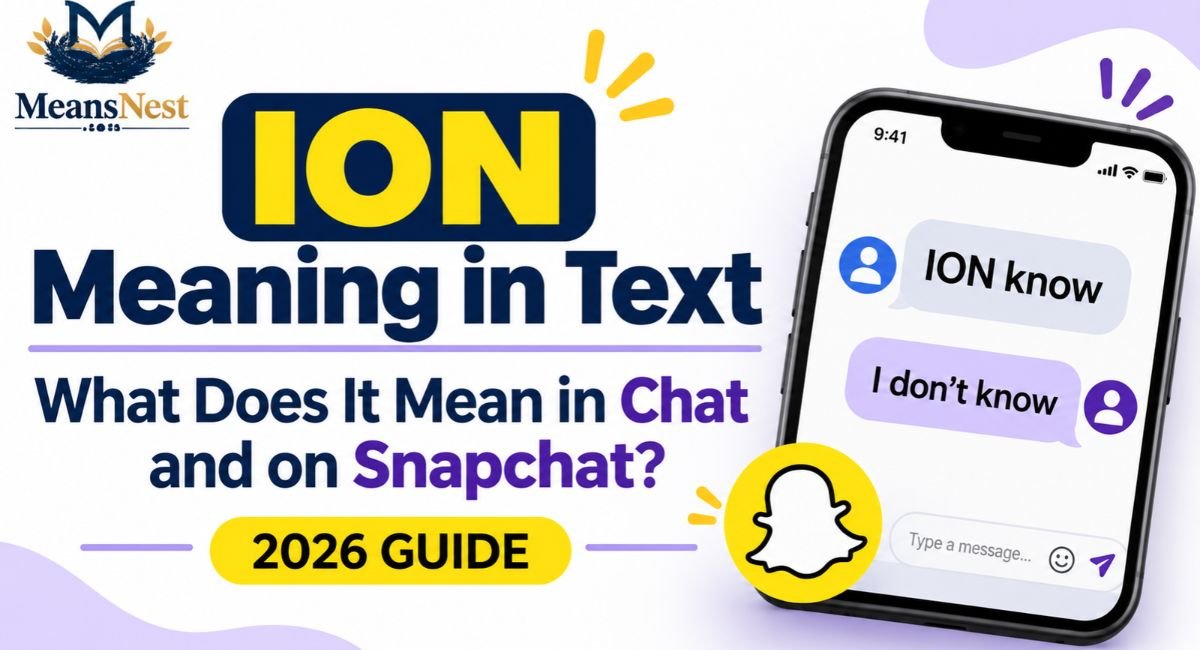
Have you ever received a message with “ION” and wondered what it means? The ION meaning in text can be confusing because it has two common meanings:
“In Other News” and “I Don’t.” People use this popular texting abbreviation on Snapchat, TikTok, Instagram, WhatsApp, and other social media platforms.
Usually, ION helps introduce a new topic or express something casually without typing a complete sentence. Understanding its ION definition makes online conversations easier to follow.
Whether someone sends you ION in a private message, comment, or group chat, the surrounding words help you understand the intended meaning and respond naturally in everyday conversations.
What Does ION Mean in Text Messages?
ION is a popular text message abbreviation used in casual conversations and online messaging.
It has two common meanings:
- In Other News: Used to introduce a new topic or share something different.
- I Don’t: Used as a shortened form of “I don’t” in informal texting.
The correct meaning depends on how someone uses it in a sentence.
For example:
- “ION, did you watch the new movie?” means “In other news, did you watch the new movie?”
- “ION know what you’re talking about” means “I don’t know what you’re talking about.”
People often use ION because it makes typing faster and keeps conversations relaxed.
It is especially common in informal language, social media language, and Gen Z slang.
Quick Answer: ION usually means “In Other News” or “I Don’t” in text messages. Look at the surrounding words to understand which meaning the sender intends.
The Two Different Meanings of ION in Texting
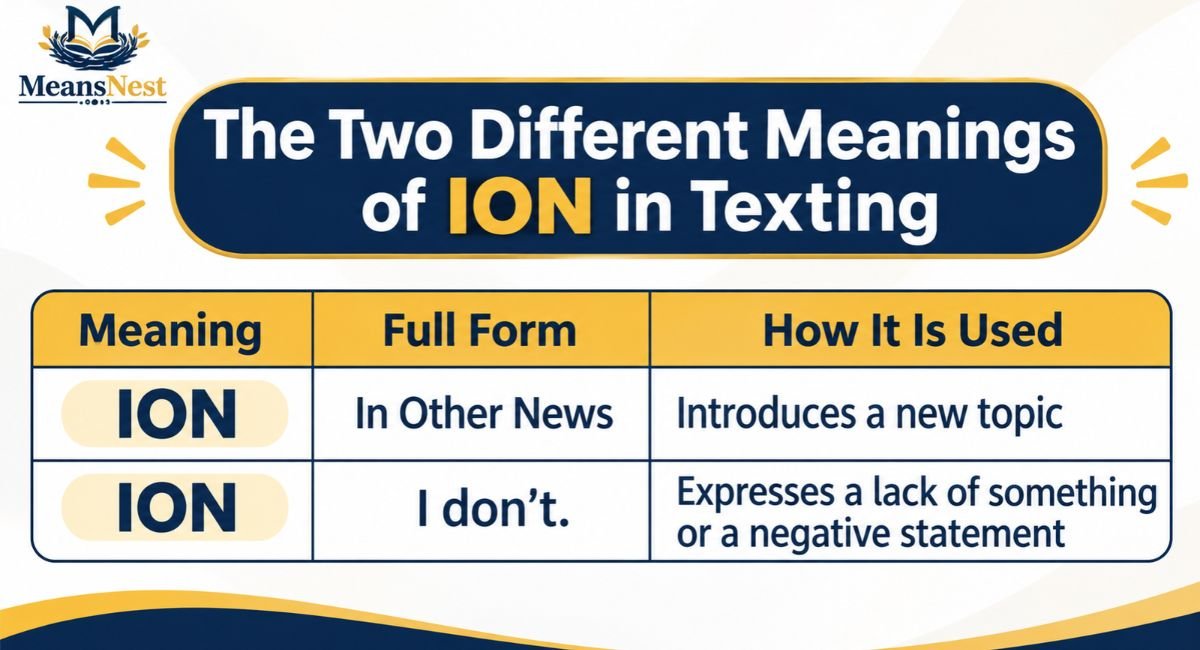
The ION acronym has two different meanings in online conversations. Understanding both can help you follow conversations without misunderstanding the sender.
1. ION means “In Other News.”
The first and widely recognized meaning of ION is “In Other News.”
People use it when they want to change the subject or introduce something new.
It works like a small transition between two topics.
Examples:
- “ION, I finally got my driving license.”
- “ION, are we meeting tomorrow?”
- “ION, that new song is amazing.”
In each example, ION introduces a new subject.
It is commonly used in group chats, Snapchat messages, and casual social media conversations.
Read More: Ditto Meaning in Text: Definition, Examples & Replies (2026)
2. ION Means “I Don’t”
ION can also represent “I Don’t” in informal texting.
This meaning is usually understood from the words that follow it.
For example:
- “I don’t know what happened.”
- “ION wants to go outside.”
- “ION cares about their opinion.”
Here, ION replaces the words “I don’t.”
This usage is often associated with casual typing and internet culture.
Difference Between Both Meanings
| Meaning | Full Form | How It Is Used |
| ION | In Other News | Introduces a new topic |
| ION | I don’t. | Expresses a lack of something or a negative statement |
Remember: The meaning of “ION” depends on the context. If it appears at the beginning of a message, it may mean “In Other News.” If it comes before a verb, it may mean “I Don’t.”
What Does ION Mean on Snapchat, TikTok, Instagram, and Other Platforms?
ION has similar meanings across different social media platforms.
However, the meaning can change depending on the message and conversation.
Here is how people commonly use ION on different platforms.
| Platform | ION Meaning | Example |
| Snapchat | In Other News / I Don’t | “I know what happened.” |
| TikTok | In Other News / I Don’t | “ION, this trend is funny.” |
| In Other News / I Don’t | “ION wants to argue.” | |
| In Other News / I Don’t | “ION, what are your plans?” | |
| Facebook Messenger | In Other News / I Don’t | “ION, did you call me?” |
| Text Messages | In Other News / I Don’t | “Ion, I have time today.” |
ION Meaning on Snapchat
On Snapchat, people use ION in snaps, private messages, and group conversations.
For example:
“ION, did you see my latest story?”
Here, ION means “In Other News.”
Another example:
“Ion feels like going out tonight.”
Here, it means “I don’t.”
ION Meaning on TikTok
On TikTok, ION can appear in video captions, comments, and direct messages.
For example:
“I know why this video has so many views.”
The sender means, “I don’t know why this video has so many views.”
ION Meaning on Instagram
Instagram users may use ION in comments, reels captions, and DMs.
For example:
“ION, your new profile picture looks great.”
Here, the sender is changing the topic.
ION Meaning on WhatsApp
On WhatsApp, ION is mostly used in everyday conversations.
Friends may use it to introduce a new subject or express what they do not want.
For example:
“ION wants to talk about that again.”
The meaning is “I don’t want to talk about that again.”
Where Did ION Slang Come From?
ION developed as part of informal internet language and texting shorthand.
People have always looked for quicker ways to communicate online. As texting became popular, users started shortening common phrases to save time.
“In Other News” was already used in journalism and everyday speech to introduce a different topic.
Over time, people began shortening it to ION in digital conversations.
The “I Don’t” interpretation is also connected to informal typing habits, where users shorten spoken phrases in messages.
Social media platforms helped spread these slang expressions.
Read More: What Does LMS Mean in Text? Slang Meaning and Examples (2026)
Today, ION appears in:
- Private text messages.
- Snapchat conversations.
- TikTok comments.
- Instagram captions.
- Online group chats.
- Everyday conversations between friends.
There is no single confirmed creator or exact starting date for this slang term.
It is best understood as part of the wider development of modern internet slang.
How to Use ION in Text Messages Naturally
Using ION is simple once you understand its two meanings.
The most important thing is to use it where the meaning is clear.
Here are some practical tips.
1. Use ION to Change the Topic
When you want to introduce something different, use ION to mean “In Other News.”
Example:
“ION, I got a new job today.”
2. Use ION Instead of I Don’t
You can use it in relaxed conversations with friends.
Example:
“ION thinks that’s a good idea.”
3. Use It in Casual Conversations
ION is suitable for texting friends, siblings, and people who understand internet slang.
4. Pay Attention to the Context
Make sure the receiver can understand which meaning you intend.
For example:
- “ION, let’s go shopping.” = In Other News.
- “ION wants to go shopping.” = I don’t.
5. Avoid Using It in Professional Messages
In emails, business discussions, or formal communication, write the complete phrase instead.
How to Use ION in a Sentence
Here are some simple sentences:
- “ION, I have some exciting news.”
- “I don’t know what you’re saying.”
- “ION wants to miss the party.”
- “ION, are you free this weekend?”
- “I don’t have anything planned today.”
These examples show how ION works in different situations.
Real Examples of ION in Text Conversations
The easiest way to understand ION is to see how people use it in real-life messaging situations.
Below are some original ION conversation examples.
1: Changing the Topic
Alex: “Did you finish your homework?”
Sam: “Yeah, finally.”
Alex: “ION, are you coming to the party?”
Meaning: Alex uses ION to introduce a new topic.
2: Saying I Don’t
Mia: “Do you know where John went?”
Liam: “I don’t know.”
Meaning: Liam means “I don’t know.”
3: Talking About Plans
Sarah: “Are you going out tonight?”
Emma: “I don’t feel like going anywhere.”
Meaning: Emma does not feel like going out.
4: Snapchat Conversation
Jake: “Did you see my new snap?”
Ryan: “ION, I was busy.”
Meaning: Ryan uses ION to mean “In Other News” if he is changing the subject. However, this sentence may sound unclear without more context.
Read More: What Does PSA Mean in Text? Meaning, Examples & Uses (2026)
5: Instagram DM
Noah: “What do you think about this picture?”
Chris: “ION like the background.”
Meaning: Chris means “I don’t like the background.”
6: Talking With Friends
Ava: “Let’s watch a movie tomorrow.”
Mia: “ION, there’s a new horror movie coming out.”
Meaning: Mia uses ION to introduce another topic.
7: Expressing an Opinion
Daniel: “Everyone likes that song.”
Ryan: “I don’t think it’s that good.”
Meaning: “Ryan” means “I don’t think it’s that good.”
8: Group Chat
Lily: “Who is coming to dinner?”
Sophie: “ION, did anyone invite Mark?”
Meaning: Sophie uses ION to change the subject.
What Does ION Mean for a Boy or Girl?
If a boy or girl sends you ION, the meaning usually depends on the conversation rather than the sender’s gender.
There is no separate official meaning for boys and girls.
However, the context can help you understand their intention.
When a Boy Uses ION
A boy might use ION to introduce another topic or express that he does not want something.
Examples:
- “I don’t know what you’re talking about.”
- “ION, what are you doing later?”
- “ION wants to go there.”
Depending on the message, he may simply be texting casually or changing the subject.
Read More: What Does “DP” Mean in Text? Meaning, Origin, Examples & Usage Guide
When a Girl Uses ION
A girl may use ION in exactly the same way.
Examples:
- “I don’t feel like going out.”
- “ION, did you hear the news?”
- “I don’t know why he said that.”
These messages do not automatically indicate romantic interest, anger, or a particular emotion.
Important: Don’t assume someone is flirting, ignoring you, or upset just because they use ION. Read the complete message and consider your previous conversation.
Common Misunderstandings About ION Slang
ION is easy to misunderstand because it has multiple meanings.
Here are some common mistakes people make.
1. Thinking ION Has Only One Meaning
Some people believe ION always means “In Other News.”
However, it can also mean “I don’t” in informal texting.
2. Confusing ION With IDK
ION and IDK are different abbreviations.
| Slang | Full Form | Meaning |
| ION | In Other News | Introduces a new topic |
| ION | I don’t. | Expresses a negative statement |
| IDK | I Don’t Know | Shows a lack of knowledge |
For example:
- “ION knows what happened.” = I don’t know what happened.
- “IDK what happened.” = I don’t know what happened.
- “ION, what happened yesterday?” = In other news, what happened yesterday?
The second and third examples show why context matters.
3. Confusing Uppercase ION with Lowercase Ion
The uppercase ION is often used as internet slang.
The lowercase “ion” can have other meanings depending on the subject.
In science, an ion is an atom or molecule with an electrical charge.
For example, sodium ions and chloride ions are important in chemistry.
Therefore, ION vs ion depends on the context in which the word appears.
4. Assuming It Is a Formal Abbreviation
“ION” is informal language.
It is suitable for casual texting but may not be appropriate in professional emails or official documents.
5. Misunderstanding the Sender’s Intention
A short message can sometimes sound confusing.
For example:
“ION care.”
This usually means “I don’t care.”
But:
“ION, I have something to tell you.”
This means “In Other News.”
Always consider the complete sentence before deciding what someone means.
Is ION Appropriate to Use in Every Conversation?
No, ION is not appropriate for every situation.
It is mainly used in informal conversations and online messaging.
Whether you should use it depends on who you are talking to and the situation.
When ION Is Appropriate:
- Talking with close friends.
- Sending Snapchat messages.
- Chatting on Instagram.
- Commenting on TikTok.
- Messaging in group chats.
- Having casual conversations.
When You Should Avoid ION:
- Writing professional emails.
- Communicating with your manager.
- Sending official messages.
- Writing academic assignments.
- Talking to someone unfamiliar with internet slang.
For example, instead of writing:
“I know the answer.”
Write:
“I don’t know the answer.”
This makes your message clearer and more professional.
Similarly, instead of writing:
“ION, I have another question.”
Write:
“In other news, I have another question.”
The complete phrases are easier for everyone to understand.
❓ Frequently Asked Questions (FAQs)
What does “ion” stand for in slang?
ION commonly stands for “In Other News” or “I Don’t,” depending on the context.
Is “ion” Black slang?
“Ion” as a shortened form of “I don’t” is associated with African American English (AAE) and is also used widely in internet slang.
What does “ion know” mean in slang?
“Ion know” means “I don’t know.” It is an informal way to express uncertainty.
What does “ion” mean?
In texting, ION usually means “In Other News” or “I Don’t,” depending on how it is used.
What does “ion run it” mean on TikTok?
“Ion run it” generally means “I don’t run it,” suggesting that someone is not in control or does not manage something.
Conclusion
Understanding the ION meaning in text is easy once you know there are two common interpretations. It usually means “In Other News” when someone wants to introduce a new topic. It can also mean “I don’t” in casual messages.
People use this abbreviation on Snapchat, TikTok, Instagram, WhatsApp, and other messaging platforms. The most important thing is to understand the context before responding.
Whether you see uppercase ION or lowercase ion, check the complete sentence to identify its intended meaning.
Now that you know its definition, examples, and usage, you can understand this popular texting abbreviation and use it naturally in everyday conversations.

Hi, I’m Kaif Ali, creator of MeansNest. I’m an SEO professional passionate about helping people understand the meanings of words, text slang, and online expressions through clear, accurate, and easy-to-read content. I create SEO-friendly guides that deliver real value while making learning simple for everyone.