The term “ditto” is commonly used in text messages and online conversations to express agreement or show that you feel the same way as someone else.
Instead of repeating a whole sentence, you can simply say “ditto” to mean “same here” or “me too.” Understanding ditto meaning in text can help you interpret messages on Snapchat, TikTok, Instagram, and WhatsApp.
Depending on the conversation, it can sound friendly, funny, or even romantic. For example, when someone says, “I miss you,” replying “ditto” means you feel the same way.
In this guide, you’ll discover its definition, texting slang, examples, tone, and similar expressions.
What Does Ditto Mean in Text?
Ditto means the same thing as what someone has just said. In texting, it usually expresses agreement, shared feelings, or a similar experience.
For example:
- Friend: “I can’t wait for the weekend!”
- You: “Ditto!”
Your reply means that you feel the same way.
The ditto definition is not limited to texting. In everyday English, the word can refer to something repeated or something that is the same as what was mentioned before.
What Does Ditto Stand For?
Ditto is a complete word, not a texting abbreviation. It does not have an official full form.
If someone asks what does ditto stand for, the answer is that it means “the same as stated before.” It is often used as a quick way to agree with another person.
What Is the Meaning of Ditto in Slang?
The ditto meaning in slang is usually “same,” “me too,” or “I agree.”
People use it as a short text response when they share the same opinion, mood, or experience.
Examples:
- “This movie is amazing.” — “Ditto!”
- “I need a vacation.” — “Ditto.”
- “You’re my favorite person.” — “Ditto ❤️”
The last example can sound affectionate because the word reflects the other person’s feelings.
Ditto Meaning in Chat: Simple Examples
Here are a few examples of how ditto works in online conversations.
| Conversation | Meaning of ditto |
| “I’m hungry.” — “Ditto.” | I’m hungry too. |
| “That song is beautiful.” — “Ditto.” | I agree; I like it too. |
| “I miss our old days.” — “Ditto.” | I feel the same way. |
| “Monday mornings are the worst.” — “Ditto!” | I agree completely. |
| “Good luck with your exam!” — “Ditto!” | The same good wishes to you. |
In each case, the surrounding message helps explain the intended meaning.
How Is Ditto Used in Text Messages and Online Chats?
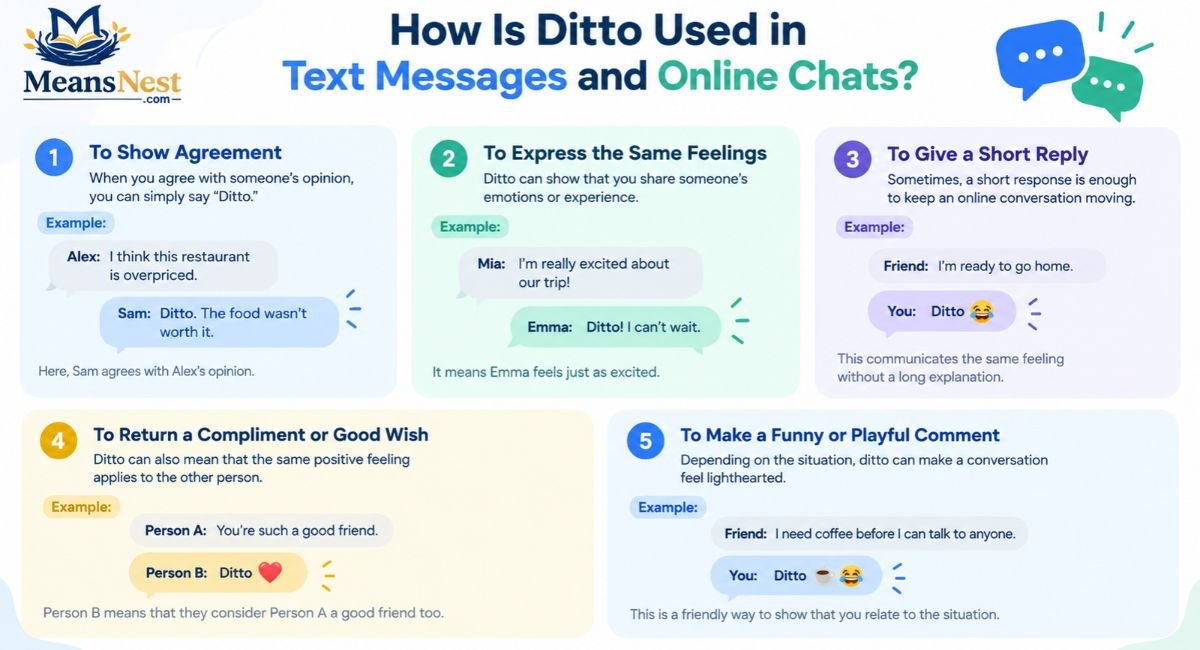
People use ditto to keep conversations short and natural. It is especially useful when repeating the other person’s words would feel unnecessary.
This makes it one of the simple casual texting expressions used in digital communication.
1. To Show Agreement
When you agree with someone’s opinion, you can simply say “Ditto.”
Example:
- Alex: “I think this restaurant is overpriced.”
- Sam: “Ditto. The food wasn’t worth it.”
Here, Sam agrees with Alex’s opinion.
2. To Express the Same Feelings
Ditto can show that you share someone’s emotions or experience.
Example:
- Mia: “I’m really excited about our trip!”
- Emma: “Ditto! I can’t wait.”
It means Emma feels just as excited.
Read More: What Does LMS Mean in Text? Slang Meaning and Examples (2026)
3. To Give a Short Reply
Sometimes, a short response is enough to keep an online conversation moving.
Example:
- Friend: “I’m ready to go home.”
- You: “Ditto 😂”
This communicates the same feeling without a long explanation.
4. To Return a Compliment or Good Wish
Ditto can also mean that the same positive feeling applies to the other person.
Example:
- Person A: “You’re such a good friend.”
- Person B: “Ditto ❤️”
Person B means that they consider Person A a good friend too.
5. To Make a Funny or Playful Comment
Depending on the situation, ditto can make a conversation feel lighthearted.
Example:
- Friend: “I need coffee before I can talk to anyone.”
- You: “Ditto ☕😂”
This is a friendly way to show that you relate to the situation.
What Does Ditto Mean on Snapchat, TikTok, Instagram, and WhatsApp?
The ditto meaning generally stays the same across social media platforms. It usually means “same here,” “me too,” or “I agree.”
Ditto is not a platform-specific abbreviation. Its meaning depends more on the conversation than on the app.
Ditto on Snapchat
Someone might reply “Ditto 😂” to your snap or message when they share your feelings, opinion, or experience.
Example: “I’m bored at home.” — “Ditto.”
Ditto on TikTok
People can use ditto in comments, direct messages, or discussions to show agreement with a creator or another user.
Example: “This song deserves more attention.” — “Ditto!”
Ditto on Instagram
In comments and DMs, ditto can express shared opinions, affection, or agreement with a friend’s message.
Example: “Your outfit looks amazing.” — “Ditto, you look great too!”
Ditto on WhatsApp
Friends, family members, and couples may use ditto in private or group chats as a quick response.
Example: “I miss everyone.” — “Ditto ❤️”
Remember that ditto does not have a different official meaning on each platform. Emojis, previous messages, and the relationship between the people help clarify the tone.
What Does Ditto Mean From a Boy or Girl?
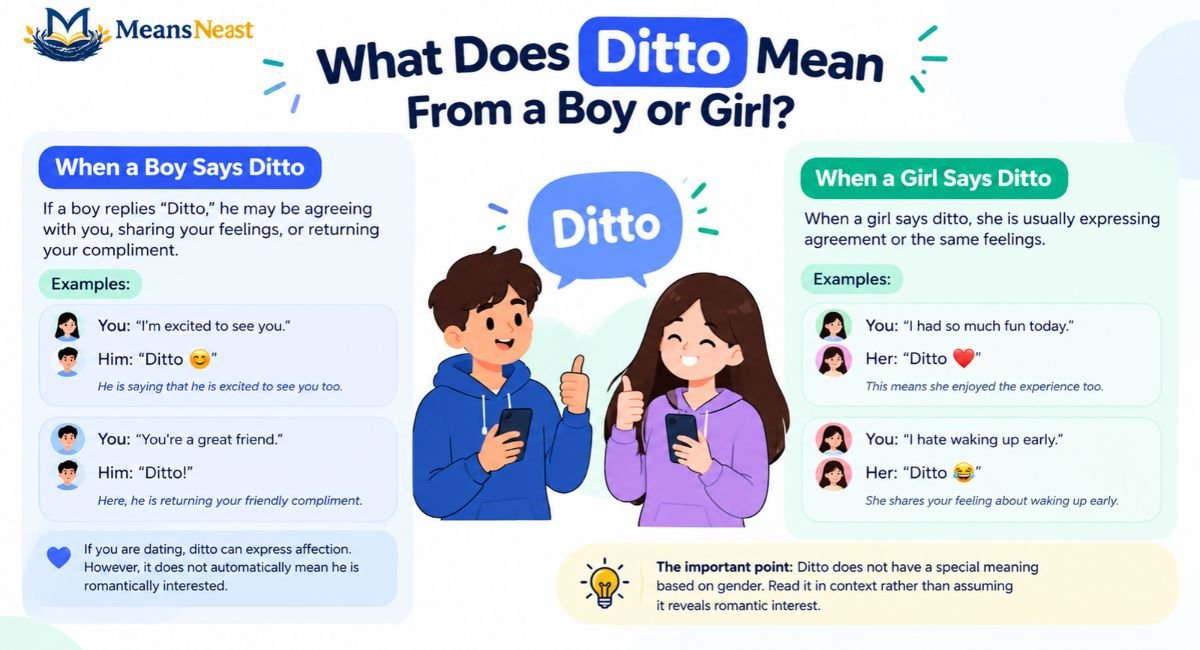
The ditto meaning from a boy or girl is usually the same: the person feels the same way or agrees with what you said.
However, the exact meaning can depend on your relationship, the topic, and how the person normally texts.
When a Boy Says Ditto
If a boy replies “Ditto,” he may be agreeing with you, sharing your feelings, or returning your compliment.
Examples:
- You: “I’m excited to see you.”
- Him: “Ditto 😊”
He is saying that he is excited to see you too.
Another example:
- You: “You’re a great friend.”
- Him: “Ditto!”
Here, he is returning your friendly compliment.
If you are dating, ditto can express affection. However, it does not automatically mean he is romantically interested.
Read More: What Does PSA Mean in Text? Meaning, Examples & Uses (2026)
When a Girl Says Ditto
When a girl says ditto, she is usually expressing agreement or the same feelings.
Examples:
- You: “I had so much fun today.”
- Her: “Ditto ❤️”
This means she enjoyed the experience too.
Another example:
- You: “I hate waking up early.”
- Her: “Ditto 😂”
She shares your feeling about waking up early.
The important point: Ditto does not have a special meaning based on gender. Read it in context rather than assuming it reveals romantic interest.
What Does Ditto Mean After “I Love You”?
When someone says “Ditto” after “I love you,” it generally means “I love you too.” The person is returning the sentiment without repeating the exact words.
For example:
- Alex: “I love you ❤️”
- Jamie: “Ditto ❤️”
Jamie is most likely expressing the same feeling.
However, the emotional tone can vary. Some people use ditto because they feel shy, playful, or comfortable with their partner. Others simply prefer short replies.
Consider these examples:
| Conversation | Possible meaning |
| “I love you ❤️” — “Ditto ❤️” | Affection returned |
| “Love you!” — “Ditto 😘” | Playful or romantic affection |
| “I love you so much.” — “Ditto 😂” | Possibly playful, depending on the relationship |
| “I love you.” — “Ditto.” | The same feeling, but the tone may seem brief or neutral |
If the reply feels too short, don’t assume the person is being cold. Look at their usual communication style and the wider conversation.
If you want a clearer response, you could ask gently, “You mean you love me too? ❤️” This gives the other person room to explain what they mean.
What Are the Different Tones of Ditto?
Ditto can sound warm, funny, neutral, or sarcastic. The word itself is not strongly emotional, so the surrounding words and emojis often make the difference.
| Tone | Example | What it communicates |
| Friendly | “Ditto!” | I feel the same way. |
| Romantic | “Ditto ❤️” | I share your affection. |
| Funny | “Ditto 😂” | I relate to that in a playful way. |
| Neutral | “Ditto.” | Same here, without extra emotion. |
| Enthusiastic | “Ditto!!” | Strong agreement or excitement. |
| Sarcastic | “Oh, ditto. What a surprise.” | Possibly teasing or expressing annoyance. |
| Dry | “Ditto.” | May feel brief, depending on the context. |
Friendly and Positive Ditto
A friendly ditto usually shows agreement or a shared experience.
For example, “I loved hanging out with you today!” followed by “Ditto 😊” feels warm and natural.
Romantic Ditto
In romantic text messages, ditto can return affection without a long declaration.
For example, “I miss you so much” followed by “Ditto, come back soon ❤️” communicates shared feelings.
Read More: What Does “DP” Mean in Text? Meaning, Origin, Examples & Usage Guide
Sarcastic Ditto
A sarcastic response depends on the words around ditto.
For example, “Oh, ditto. Another meeting that could have been an email.”
Here, the speaker is expressing frustration rather than simply agreeing.
Dry or Neutral Ditto
A plain “Ditto” can sound neutral because it provides little emotional detail. But some people naturally prefer short text responses.
One word alone is not enough to determine someone’s mood.
How Do You Reply When Someone Says Ditto?
The best reply depends on what the person is agreeing with. You can respond with humor, affection, agreement, or a follow-up question.
Here are some natural ways to reply when someone says ditto.
| Situation | Their message | Your possible reply |
| Casual chat | “Ditto!” | “Haha, glad we’re on the same page.” |
| Friendship | “Ditto ❤️” | “Besties think alike!” |
| Romantic conversation | “Ditto 😘” | “Aww, that’s sweet.” |
| Shared frustration | “Ditto.” | “At least we’re in this together.” |
| Funny conversation | “Ditto 😂” | “Great minds think alike!” |
| Shared excitement | “Ditto!!” | “It’s going to be amazing!” |
| Returning a compliment | “Ditto!” | “You just made my day.” |
Short Replies to Ditto
If you prefer short text responses, try these:
- “Same here!”
- “I knew you’d agree.”
- “Exactly!”
- “Great minds think alike.”
- “Haha, right?”
- “❤️❤️”
- “We’re on the same page.”
- “You get me!”
How to Reply to Ditto in a Romantic Conversation
If your partner says ditto after you express affection, you can keep your response warm and natural.
For example:
- “Aww, I love that.”
- “You mean so much to me ❤️”
- “I knew we felt the same way.”
- “That’s all I wanted to hear.”
- “Come here, you 😘”
Choose a response that matches your relationship and comfort level. You don’t need to turn every short message into a serious conversation.
Read More: PFP Meaning in Text: What It Means in Chats & Online Slang (2026 Guide)
How to Reply When You Don’t Understand
If the meaning is unclear, ask a simple question.
For example:
- “Ditto to which part? 😂”
- “You mean you feel the same way?”
- “Haha, explain what you mean.”
These replies help you understand the person’s message without making the conversation awkward.
Is Ditto Rude, Dry, or Disrespectful?
No, ditto is not inherently rude or disrespectful. It is a normal English word used to express agreement or the same feeling.
However, it can sometimes sound dry if the conversation calls for a more personal response.
For example, if you tell a friend, “I had a really difficult day,” and they reply only “Ditto,” the response may feel brief. They might be tired or distracted, though, rather than dismissive.
Compare these examples:
- Friendly: “I’m so happy for you!” — “Ditto! You deserve it!”
- Neutral: “I need a break.” — “Ditto.”
- Potentially dismissive: “I’ve been trying to explain how I feel all day.” — “Ditto.”
In the last example, the reply may feel unhelpful because the conversation needs more empathy and detail.
When Can Ditto Sound Dry?
It may sound dry when:
- Someone shares something deeply personal.
- You expect a thoughtful or emotional response.
- The person repeatedly gives one-word answers.
- The reply appears dismissive in the wider conversation.
How Can You Tell What They Really Mean?
Look at the full context rather than judging the word alone.
Consider their usual texting habits, the previous messages, their use of emojis, and whether they continue the conversation.
A single “Ditto” does not prove that someone is angry, uninterested, or disrespectful.
When Should You Use Ditto in Everyday Communication?
Ditto works best when you want to show agreement without repeating someone else’s words. It is especially useful in informal communication, friendly chats, and casual online conversations.
Here are some situations where it fits naturally.
1. With friends: Use it when you share the same opinion or feeling.
Example: “I’m ready for the weekend.” — “Ditto!”
2. In group chats: It can show that several people agree with a comment.
Example: “We should order pizza tonight.” — “Ditto 🍕”
3. With family: Use it to express a shared experience or preference.
Example: “I miss our family dinners.” — “Ditto ❤️”
4. In romantic relationships: It can return affection or express shared excitement.
Example: “I can’t wait to see you.” — “Ditto 😘”
5. In social media comments: Use it when you agree with a post, opinion, or reaction.
Example: “This is the best show I’ve watched all year.” — “Ditto!”
When Should You Avoid Using Ditto?
Although ditto is useful, it may not be the best choice in every situation.
Avoid relying on it when:
- Someone needs emotional support or a thoughtful response.
- You’re writing a formal business email.
- The other person’s statement is unclear.
- You need to explain your own opinion in detail.
For example, if a colleague asks for your specific feedback on a report, replying “Ditto” may not answer their question.
Use a complete sentence when clarity matters. Ditto is a convenient expression, not a replacement for every kind of response.
Where Did the Word Ditto Come From?
The word ditto has a much longer history than texting and social media.
It comes from the Italian word detto, meaning “said” or “stated.” The word is related to the Latin dictus, meaning “said.”
English adopted ditto to refer to something already mentioned. It was particularly useful in lists, records, and business documents where repeating the same information was unnecessary.
For example, if several entries in a list had the same location, a writer could use ditto to indicate that the location was unchanged.
Over time, the word became common in everyday English. People began using it in conversation as a quick way to say “the same applies to me.”
Today, ditto is used in spoken English, written communication, text messages, and social media.
It is sometimes described as slang in texting, but it is actually an established English word with a much older history.
Ditto vs. Similar Words and Common Misconceptions
Ditto is similar to expressions such as “same,” “me too,” and “likewise.” However, these expressions can differ slightly in tone and usage.
Understanding these differences helps you choose the most natural response.
Ditto vs. Same
Both expressions can mean that you share someone’s feelings or opinion.
- Person A: “I’m exhausted.”
- Person B: “Same.”
Or:
- Person A: “I’m exhausted.”
- Person B: “Ditto.”
The meaning is almost identical. Same is very common in casual texting, while ditto can sound slightly playful or more deliberate.
Ditto vs. Me Too
“Me too” directly says that you share the same feeling or experience.
For example:
- “I love this song.” — “Me too!”
- “I love this song.” — “Ditto!”
Both express agreement. Me too is more explicit, while ditto refers back to what the other person said.
Ditto vs. Likewise
Likewise generally means “in the same way” or “the same applies to you.” It can sound a little more formal than ditto.
For example:
- Person A: “It was nice meeting you.”
- Person B: “Likewise.”
Here, likewise means that Person B also enjoyed meeting Person A.
Ditto can work in casual conversations, too, but it may sound less polished in a formal setting.
Ditto vs. I Agree
“I agree” clearly expresses agreement with an opinion or statement.
For example:
- Person A: “We should leave earlier.”
- Person B: “I agree.”
Ditto could also work here, but I agree makes the person’s position more explicit.
Comparison Table
| Expression | Main meaning | Typical tone |
| Ditto | The same applies to me | Casual, sometimes playful |
| Same | I feel or think the same | Very casual |
| Me too | I share that feeling or experience | Natural and direct |
| Likewise | The same applies to you or me | Neutral or slightly formal |
| I agree | I share your opinion | Clear and direct |
| Same here | I have the same experience or feeling | Friendly and conversational |
Common Misconceptions About Ditto
Misconception 1: Ditto is an abbreviation.
No. Ditto is a complete word, not an acronym with a full form.
Misconception 2: Ditto always means “I love you too.”
No. It means the same as the preceding statement. In a romantic conversation, that may mean “I love you too,” but in other contexts it could mean “I’m tired too” or “I agree.”
Misconception 3: Ditto is always rude or dry.
No. Its tone depends on the context and how the person communicates.
Misconception 4: Ditto has a different meaning on every social media platform.
No. Its basic meaning remains the same on Snapchat, TikTok, Instagram, and WhatsApp.
Misconception 5: Ditto is only internet slang.
No. The word existed long before modern texting and social media became popular.
❓ Frequently Asked Questions (FAQs)
What does “ditto” mean in slang?
“Ditto” means “same here,” “me too,” or “I agree.” It shows that you feel or think the same way as someone else.
When a woman says Ditto?
When a woman says “ditto,” she usually means she feels the same way or agrees with you. The exact meaning depends on your conversation.
Why do they say Ditto?
People say “ditto” to express agreement or shared feelings without repeating the same words. It makes conversations shorter and more casual.
Why do they say Ditto?
They use “ditto” as a quick way to say “same here” or “me too,” especially in text messages and everyday conversations.
How do you reply to Ditto?
You can reply with “Glad we agree,” “Haha, same here!” or “Aww, that’s sweet,” depending on the context.
Conclusion
The ditto meaning in text is simple: it means “same here,” “me too,” or “I feel the same way.” People use it in everyday conversations, friendships, romantic messages, and social media comments to express agreement without repeating themselves.
Its meaning generally stays the same on Snapchat, TikTok, Instagram, and WhatsApp. However, the tone can be friendly, romantic, funny, neutral, or occasionally sarcastic.
If someone says ditto after you express your feelings, consider the context before interpreting their response. When used naturally, ditto is a simple and useful way to keep conversations short, clear, and engaging.

Hi, I’m Kaif Ali, creator of MeansNest. I’m an SEO professional passionate about helping people understand the meanings of words, text slang, and online expressions through clear, accurate, and easy-to-read content. I create SEO-friendly guides that deliver real value while making learning simple for everyone.