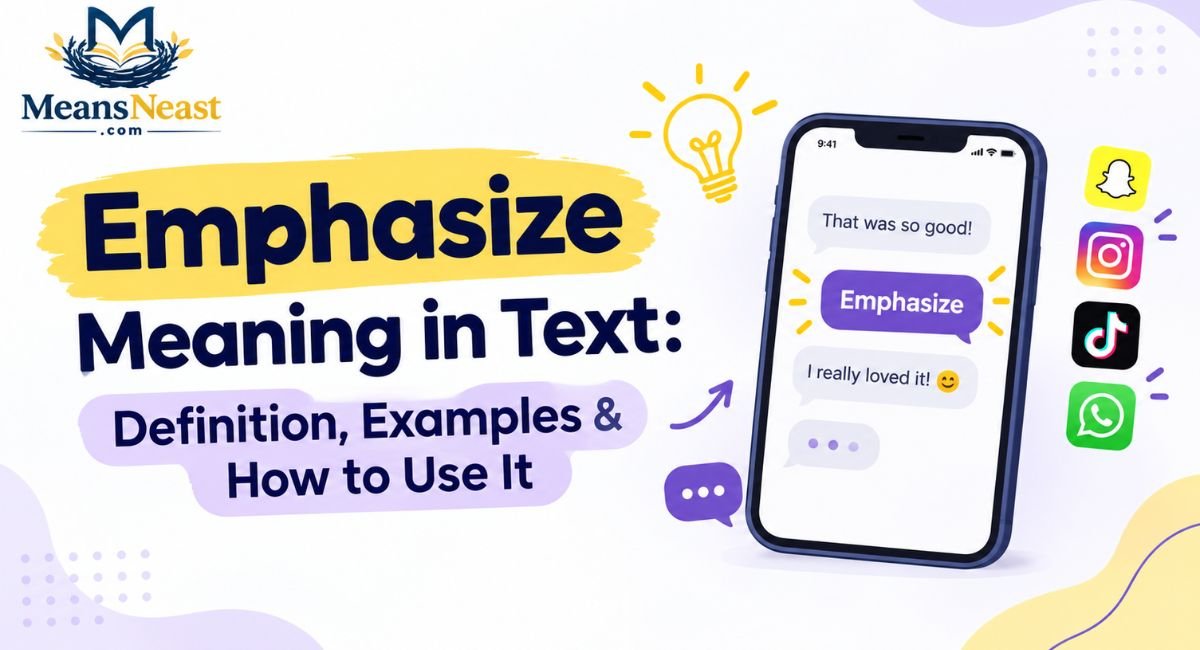
When someone uses the word “emphasize” in a text, they usually mean to give extra importance, attention, or stress to a particular point.
Understanding the emphasis meaning in text can help you interpret messages, comments, emails, and online conversations more accurately.
People may use “emphasize” when they want to make something clear, highlight an important detail, or ensure that their main idea is noticed.
The word can appear in both casual and formal communication, depending on the situation. In this guide, we’ll explain the meaning of “emphasize,” how it is used in text messages, common examples, and related expressions so you can understand exactly what someone means when they use this word.
What Does “Emphasize” Mean in Text?
The word “emphasize” means to give extra importance, attention, or focus to something.
In simple English, when someone emphasizes something, they want you to notice it or understand that it is particularly important.
Simple Definition
“Emphasize” means to give special importance to a word, idea, statement, fact, or feeling.
For example:
“I really want you to come tomorrow.”
The word “really” adds emphasis. It shows that the speaker strongly wants the person to come.
The emphasized definition does not change significantly when the word appears in texting. However, the way people create emphasis can be different in digital conversations.
They may use:
- Capital letters
- Repeated words
- Exclamation marks
- Italics or bold text
- Emojis
- Stronger wording
- Extra punctuation
For example:
“PLEASE remember to call me.”
The capitalized word “PLEASE” gives it extra importance.
What Does “Emphasize” Mean in Text?
When someone asks, “What does ‘emphasize’ mean in text?”, the easiest answer is:
It means to make a particular word, idea, message, or point more noticeable or important.
The person may want to stress a point, highlight something, or make something clear.
For example:
“I said I was NOT angry.”
Here, “NOT” is emphasized because the writer wants to make their meaning very clear.
Emphasize Meaning in English
In general English, “emphasise” means to give special importance to something.
Example:
“The teacher emphasized the importance of studying regularly.”
The teacher is giving extra attention to the importance of studying.
The same basic emphasis on meaning in English applies to conversations and messages.
Emphasize vs. Emphasis
These two words are closely related.
| Word | Meaning | Example |
| Emphasize | To give extra importance | “I want to emphasize this point.” |
| Emphasis | Special importance or attention | “There is strong emphasis on safety.” |
So, “emphasize” is the action, while “emphasis” refers to the importance or attention given to something.
What Does “Emphasize” Mean in Chat and Social Media?
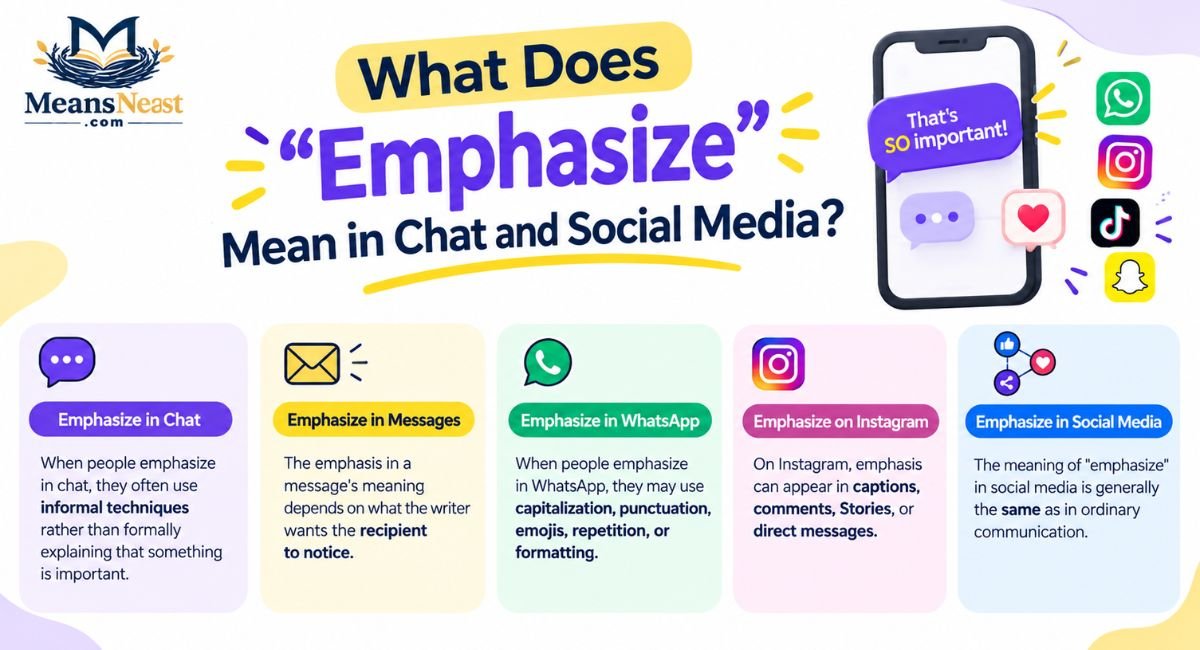
In chat and social media, “emphasize” in texting means making a particular part of a message stand out.
The purpose is usually to help the other person understand what matters most.
For example:
“I REALLY need your help.”
The capitalized word “REALLY” creates emphasis.
Someone could also write:
“That was sooooo funny!”
The repeated letters make the emotion or intensity stand out.
Emphasize in Chat
When people emphasize in chat, they often use informal techniques rather than formally explaining that something is important.
Common methods include:
- “I really mean it.”
- “NO, that’s not what I said.”
- “Please remember this!”
- “That was AMAZING.”
- “You have to come tomorrow.”
- “I said today, not tomorrow.”
These techniques create emphasis without requiring a separate explanation.
Emphasize in Messages
The emphasis in a message’s meaning depends on what the writer wants the recipient to notice.
For example:
“Please don’t forget the documents.”
The writer is emphasizing the importance of remembering the documents.
Another example:
“I’m serious. Please listen.”
The second sentence reinforces the first one and creates stronger emphasis.
Emphasize in WhatsApp
When people emphasize in WhatsApp, they may use capitalization, punctuation, emojis, repetition, or formatting.
For example:
“Please call me ASAP!”
The phrase “ASAP” and the exclamation mark make the request stand out.
Another example:
“I REALLY need to talk to you ❤️”
The capitalized word adds extra importance.
Read More: HMJ Meaning in Text: What Does HMJ Mean in Chat & Social Media?
Emphasize on Instagram
On Instagram, emphasis can appear in captions, comments, Stories, or direct messages.
For example:
“This is the BEST day ever!”
The word “BEST” is emphasized to express strong positive feelings.
The exact method may vary, but the goal is usually to make a message stand out or express importance.
Emphasize in Social Media
The meaning of “emphasize” in social media is generally the same as in ordinary communication.
Someone might emphasize:
- An opinion
- A warning
- A feeling
- A specific fact
- A particular word
- A personal experience
- An important instruction
For example:
“Always check the source before sharing information.”
The word “always” gives the statement a stronger sense of importance.
How Is “Emphasize” Used in Different Contexts?
The word “emphasize” can be used in many different situations.
Its core meaning stays the same, but the thing being emphasized can change.
1. Emphasizing an Important Point
Someone may emphasize a point because they do not want it to be misunderstood or overlooked.
“I want to emphasize that this is completely optional.”
The speaker is making the point especially clear.
2. Emphasizing a Feeling
People can emphasize emotions in conversations.
“I’m REALLY happy for you!”
The capitalized word shows stronger emotion.
3. Emphasizing a Warning
A warning may use emphasis to encourage someone to take it seriously.
“Do NOT open this file.”
The capital letters make the warning more noticeable.
4. Emphasizing an Idea
Someone may emphasize an idea during a discussion.
“She emphasized the importance of communication.”
The sentence says that communication received special attention.
5. Emphasizing a Word
Sometimes only one word needs attention.
“I said yours, not their.”
The emphasized word helps clarify the intended meaning.
Read More: WYLL Meaning in Text: What Does WYLL Mean on Snapchat & TikTok?
6. Emphasizing a Statement
A person may repeat or strengthen a statement when they want to make it clear.
“I will be there. I promise.”
The second sentence reinforces the first.
7. Emphasizing Importance
People often use the word when discussing something significant.
“The manager emphasized the importance of meeting the deadline.”
This means the manager gave the deadline extra attention.
Different Contexts at a Glance
| Context | What Is Emphasized? | Example |
| Casual chat | Feeling | “I REALLY miss you.” |
| Work message | Important information | “Please submit it TODAY.” |
| Warning | Risk or instruction | “DO NOT touch this.” |
| Social media | Opinion or emotion | “This is AMAZING!” |
| School | Main idea | “The teacher emphasized this concept.” |
| Personal conversation | Clarification | “I meant you, not him.” |
Emphasize Meaning With Real Texting Examples
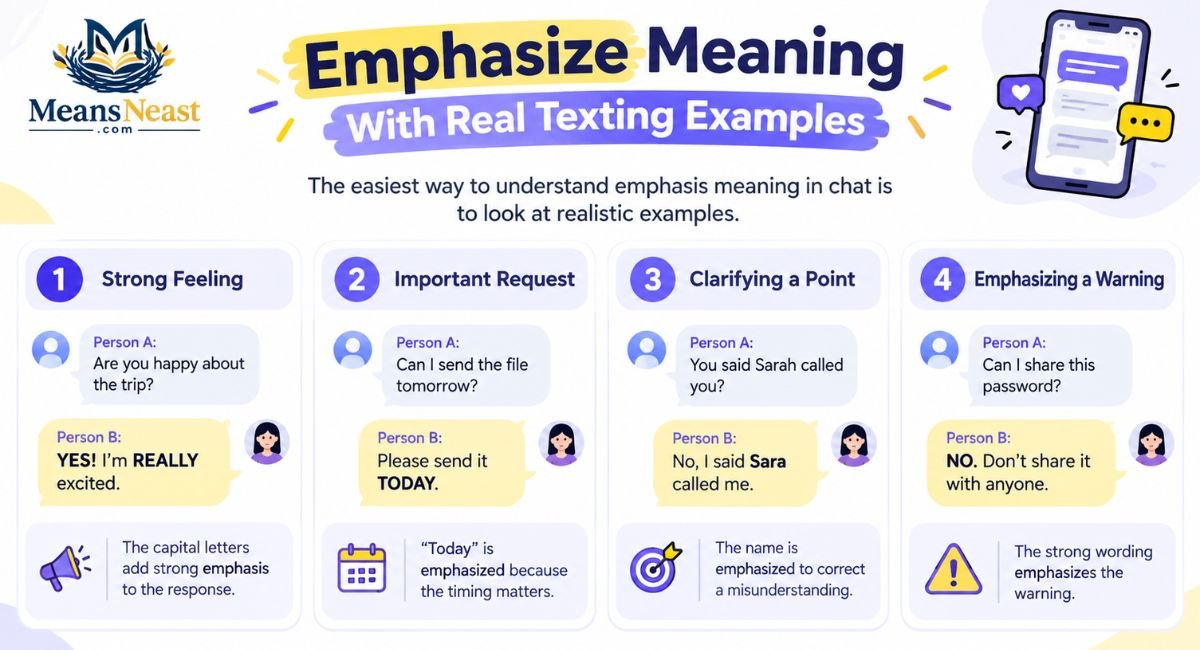
The easiest way to understand emphasis meaning in chat is to look at realistic examples.
1: Strong Feeling
Person A: Are you happy about the trip?
Person B: “YES! I’m REALLY excited.”
The capital letters add strong emphasis to the response.
2: Important Request
Person A: Can I send the file tomorrow?
Person B: “Please send it TODAY.”
“Today” is emphasized because the timing matters.
3: Clarifying a Point
Person A: You said Sarah called you?
Person B: “No, I said Sara called me.”
The name is emphasized to correct a misunderstanding.
4: Emphasizing a Warning
Person A: Can I share this password?
Person B: “NO. Don’t share it with anyone.”
The strong wording emphasizes the warning.
5: Emphasizing Appreciation
“I REALLY appreciate your help.”
“Really” gives extra emotional importance to the statement.
6: Emphasizing a Message
“Please read this carefully.”
The word “carefully” signals that the message deserves extra attention.
7: Making Something Stand Out
“This is the ONE thing you need to remember.”
“One” is emphasized to make something stand out.
8: Reinforcing an Idea
“Communication matters. It REALLY matters.”
The repetition and capitalization reinforce an idea.
9: Pointing Out a Detail
“I just want to point out that the deadline is Friday.”
Here, the writer wants to call attention to something specific.
10: Casual Social Media Use
“That movie was SO good!”
The word “SO” adds extra intensity.
How Tone Changes the Meaning of Emphasize in Text
Tone plays an important role in digital communication.
The same emphasized word can sound friendly, excited, angry, sarcastic, or serious depending on the surrounding message.
For example:
“THANK YOU!”
This could sound genuinely excited.
But:
“THANK YOU.”
could sometimes sound cold or sarcastic depending on the conversation.
Friendly Tone
“I REALLY appreciate you helping me!”
This usually communicates genuine appreciation.
Excited Tone
“We FINALLY did it!!!”
The capitalization and punctuation create excitement.
Read More: What Does NGL Mean in Text? Meaning, Examples & How to Use It
Angry Tone
“I told you NOT to do that!”
The emphasis makes the message sound forceful.
Serious Tone
“Please understand that this is IMPORTANT.”
The emphasis signals that the subject should be taken seriously.
Sarcastic Tone
“Great job.”
Depending on the conversation, this could be sincere or sarcastic.
This is why emphasis meaning cannot always be understood from one word alone.
You need to consider the complete message, punctuation, previous messages, and relationship between the people.
How Digital Emphasis Can Affect Tone
| Type of Emphasis | Possible Tone |
| “REALLY?” | Surprise or disbelief |
| “NO!” | Strong disagreement |
| “YES!!!” | Excitement |
| “Please, PLEASE listen.” | Urgency |
| “I said TODAY.” | Frustration or seriousness |
| “That was SO nice.” | Appreciation or excitement |
In online conversations, context matters as much as the emphasized word itself.
Common Misconceptions About “Emphasize”
There are several common misunderstandings about the word “emphasize.”
1: Emphasize Always Means Shouting
Not necessarily.
Someone can emphasize something without using capital letters.
For example:
“I really want you to understand this.”
The word “really” provides emphasis without appearing aggressive.
2: Emphasize Is Only Used in Formal English
This is also incorrect.
The word is common in everyday conversations, messages, social media posts, school discussions, and professional communication.
For example:
“I just want to emphasize one thing.”
This can sound natural in both casual and professional conversations.
3: Emphasizing Something Means Repeating It
Repetition is one way to create emphasis, but it is not the only method.
You can emphasize something through:
- Word choice
- Capitalization
- Formatting
- Punctuation
- Repetition
- Stronger language
- Context
4: Emphasize “Always” Means Something Is Extremely Important
Emphasis can be strong or mild.
For example:
“I especially liked the ending.”
This gives extra attention to the ending without suggesting that it is extremely important.
5: Emphasis Always Changes the Meaning
Usually, emphasis changes the focus or tone, rather than completely changing the basic meaning.
Compare:
“I want to go.”
with:
“I REALLY want to go.”
The basic message remains the same, but the second sentence expresses stronger desire.
6: “Emphasize” and “Highlight” Always Mean Exactly the Same Thing
They are closely related, but they are not identical in every situation.
“Highlight” often means to make something noticeable.
“Emphasize” more strongly suggests giving something importance or focus.
Emphasize vs Similar Words
Several words have meanings that are closely connected to “emphasize.”
Understanding the differences can help you choose the right word.
| Word | Basic Meaning | Example |
| Emphasize | Give extra importance or attention. | “I want to emphasize this point.” |
| Highlight | Make something noticeable | “She highlighted the main issue.” |
| Stress | Give strong importance | “He stressed the importance of safety.” |
| Underline | Give special attention to something. | “The report underlined the problem.” |
| Reinforce | Make an idea or message stronger. | “The example reinforced the idea.” |
| Accentuate | Make a feature more noticeable. | “The design accentuates the main feature.” |
| Point out | Direct attention toward something | “She pointed out the mistake.” |
Emphasize vs Highlight
“Emphasize” means to give importance or focus.
“Highlight” means to make something particularly noticeable.
Example:
“The teacher emphasized the importance of practice.”
“The teacher highlighted the most important section.”
Both sentences involve attention, but the focus is slightly different.
Read More: What Does HU Mean in Text, Chat, and Social Media?
Emphasize vs Stress
“Stress” can be used as a synonym for emphasize.
“The doctor emphasized the importance of rest.”
“The doctor stressed the importance of rest.”
Both sentences communicate similar ideas.
Emphasize vs Underline
“Underline” can be literal or figurative.
For example:
“The report underlined the need for change.”
Here, “underlined” means the report strongly pointed to or emphasized the need.
Emphasize vs Reinforce
“Reinforce” means to strengthen an existing idea, message, or belief.
“The example reinforced her argument.”
The example makes the argument stronger.
Emphasize vs Point Out
“Point out” is usually about directing attention to something.
“I want to point out one small mistake.”
This draws attention to the mistake, while “emphasize” can also communicate that the issue has special importance.
How to Use “Emphasize” Correctly in a Sentence
Learning how to use emphasis becomes easier when you understand the sentence structure.
The most common structure is
emphasize + noun/object
Examples:
“She emphasized the importance of honesty.”
“He emphasized the main problem.”
“The teacher emphasized the key idea.”
You can also use:
emphasize that clause
Examples:
“She emphasized that the deadline was Friday.”
“He emphasized that everyone needed to arrive early.”
Emphasize a Point
A common phrase is “emphasize a point.”
Example:
“I want to emphasize a point before we continue.”
This means you want to give a particular point extra attention.
Emphasize an Idea
You can also say:
“The article emphasizes the idea that communication is important.”
Here, the writer gives special attention to a particular idea.
Emphasize a Message
Example:
“The campaign emphasizes the importance of staying informed.”
The main message receives special attention.
Emphasize a Sentence
When talking about writing or formatting, you can say:
“Use bold text to emphasize a sentence.”
This means making the sentence visually stand out.
Emphasize a word.
Example:
“I want to emphasize the word ‘only.’”
This indicates that the specific word is important to the intended meaning.
Common Sentence Patterns
| Pattern | Example |
| Emphasize + noun | “She emphasized the problem.” |
| Emphasize importance. | “He emphasized its importance.” |
| Emphasize that | “She emphasized that it was urgent.” |
| Emphasize a point. | “Let me emphasize one point.” |
| Emphasize an idea. | “The article emphasizes this idea.” |
| Emphasize a word. | “The speaker emphasized one word.” |
Is “Emphasize On” correct?
A common mistake is saying:
“She emphasized the importance of education.”
In standard English, “emphasized the importance” is generally the better construction.
Correct:
“She emphasized the importance of education.”
You normally use “emphasize” + object rather than “emphasize on.”
Emphasize in Everyday Conversation
The word can sound completely natural in everyday communication.
For example:
“I just want to emphasize that I’m not upset.”
“Let me emphasize one thing: we’re still friends.”
“She really emphasized how important the meeting was.”
These sentences show how the word works naturally outside formal writing.
❓ Frequently Asked Questions (FAQs)
What is meant by “emphasize”?
“Emphasize” means to give extra importance, attention, or stress to something.
How do you emphasize in a text?
You can emphasize something by using bold text, capital letters, italics, or words like “really” and “especially.”
Can I say “emphasize on”?
Usually, no. The standard phrase is “emphasize something” rather than “emphasize on something.”
What does “empathize” mean in text?
“Empathize” means to understand and share someone’s feelings or perspective.
What does “emphasized” mean on iPhone text?
“Emphasized” can indicate that someone reacted to a text message using the emphasis reaction, showing that they wanted to highlight or stress the message.
Conclusion
The “emphasize” meaning in text is simple: it means giving extra attention, importance, or focus to something.
In texting and social media, people can emphasize a word, sentence, message, or statement through capitalization, repetition, punctuation, formatting, or stronger wording.
The meaning can also change slightly with tone and context. A phrase such as “I REALLY mean it” may express seriousness, while “YES!!!” may show excitement.
Similar words such as highlight, stress, underline, reinforce, and point out can sometimes be used in related situations, but each has its own nuance.
When you understand how people use emphasis in digital communication, it becomes easier to recognize what they want you to notice, clarify a point, reinforce an idea, or give importance to something.

Hi, I’m Kaif Ali, creator of MeansNest. I’m an SEO professional passionate about helping people understand the meanings of words, text slang, and online expressions through clear, accurate, and easy-to-read content. I create SEO-friendly guides that deliver real value while making learning simple for everyone.