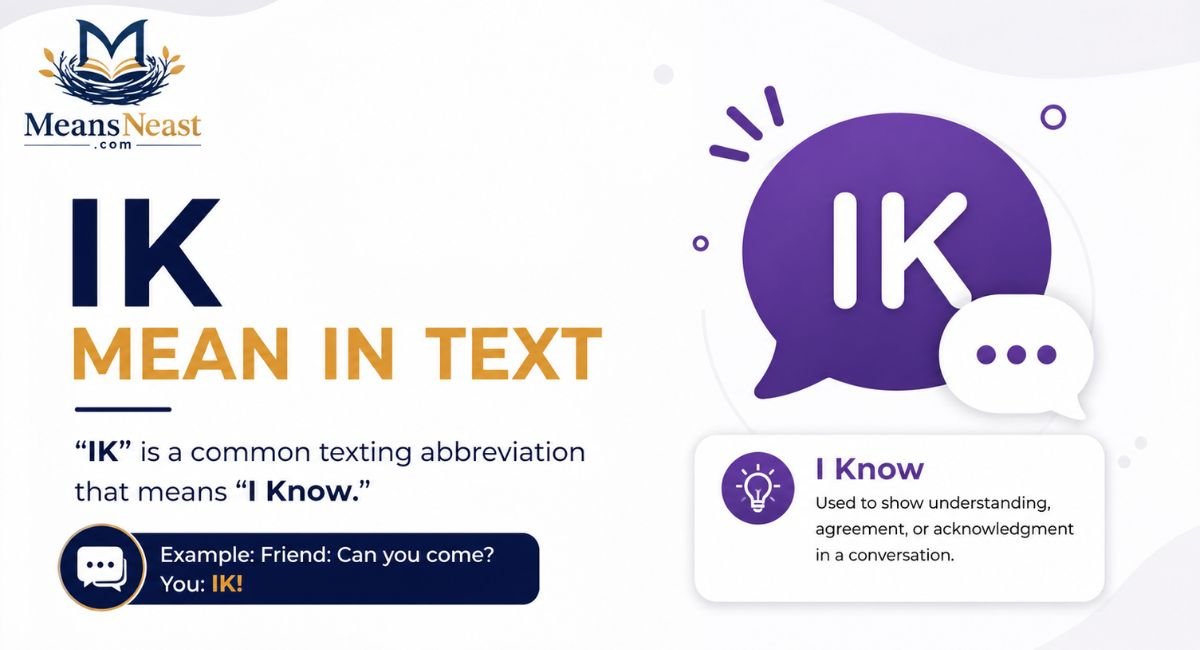
“IK” in text usually means “I know” and is one of the most common abbreviations used in casual online communication.
You may see IK in messages, social media comments, or everyday chats when someone wants to show that they already know or understand something. The exact tone can change with the IK context.
For example, “IK!” may sound enthusiastic, while “IK.” can sometimes seem short or annoyed. Understanding the conversation helps you interpret the intended meaning correctly.
Whether you see IK on Instagram, Snapchat, TikTok, WhatsApp, or in a private chat, it generally has the same basic meaning: “I know.”
What Does IK Mean in Text?
In text messages, IK usually means “I know.”
It is a short form that people use when they already understand or know something that another person has mentioned.
For example:
Person 1: “The exam is tomorrow.”
Person 2: “IK 😭”
Here, IK simply means “I know.”
It is common in casual texting because people often prefer quick expressions instead of writing complete sentences.
The meaning is usually straightforward, but IK tone depends on the context.
For example:
- “IK!” = I know!
- “ik lol” = I know, haha.
- “IK 😭” = I know, and I feel the same way.
- “ik…” = I know, possibly with an emotional or tired tone.
- “IK” = I know. This may sound more serious or slightly annoyed.
So, when reading IK slang, look at the complete message rather than the abbreviation alone.
What Does IK Stand For?
IK stands for “I know.”
It is an informal abbreviation used in digital communication.
Unlike some abbreviations that can have several popular meanings, IK in everyday texting most commonly means “I know.”
You may see it in:
- Text messages
- Chat messages
- WhatsApp conversations
- Snapchat
- TikTok comments
- Facebook Messenger
- Online communities
- Gaming chats
IK is generally considered casual internet slang rather than formal English.
See Also: What Does LCR Mean in Text? Meanings, Uses, and Examples
For example:
“That movie was amazing.”
“IK! I loved it too.”
The second person is saying, “I know! I loved it too.”
How Is IK Used in Text Messages and Chats?
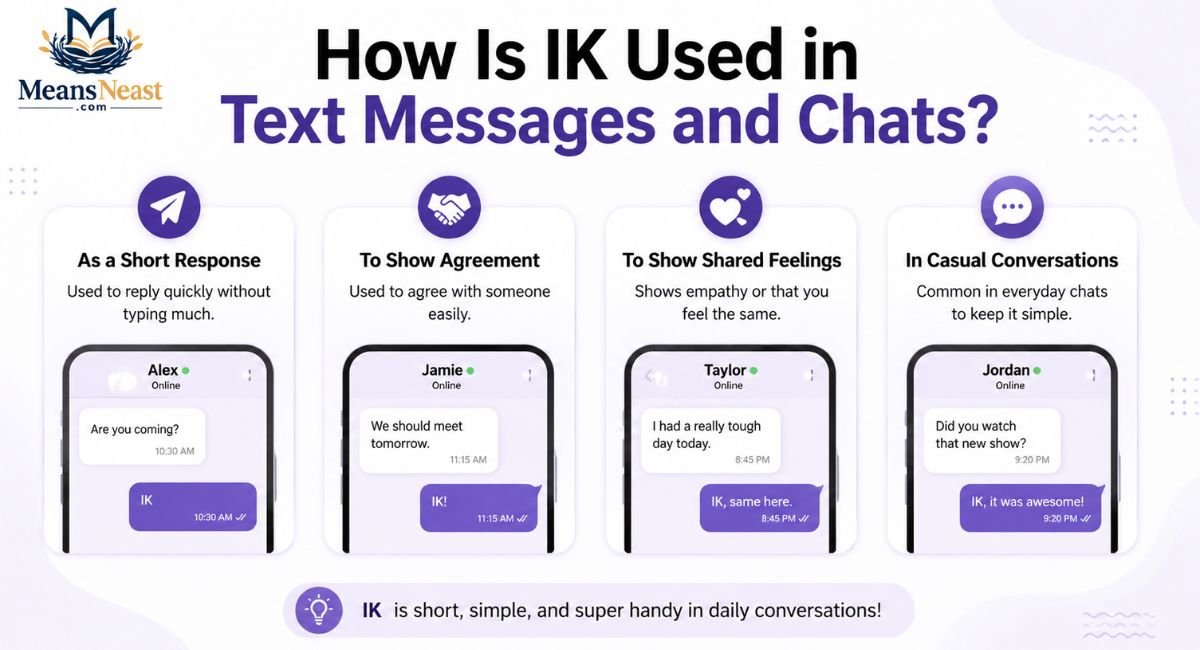
IK is used when someone wants to show that they already know, understand, or agree with something.
It can work as a complete response or as part of a longer sentence.
As a Short Response
Friend: “You need to bring your ID.”
You: “IK.”
Here, IK means “I know.”
To Show Agreement
Friend: “This weather is crazy.”
You: “IK! It’s so hot.”
Here, IK means “I know,” while also showing agreement.
To Show Shared Feelings
Friend: “I’m exhausted today.”
You: “IK 😭. Same.”
The abbreviation helps create a relaxed and natural conversational style.
In Casual Conversations
People often use IK because it is quicker than typing the full phrase.
This is especially common in everyday texting and instant messaging, where short responses are normal.
However, IK is usually better suited to informal communication. It may not be appropriate in a formal email, professional report, or serious business message.
IK Meaning on Social Media
The meaning of IK on social media is usually still “I know.”
However, social media slang can be more expressive because users often combine abbreviations with emojis, punctuation, memes, and reactions.
IK on Snapchat
On Snapchat, IK can appear in private chats or replies.
Example:
“Your story was hilarious.”
“IK 😂”
The person may be agreeing with the comment or joking about the situation.
IK on Instagram
You may see IK in Instagram DMs, comments, or replies.
Example:
“Everyone is talking about this song.”
“ik 😭”
Here, the person means “I know,” often with an emotional or playful tone.
See Also: CYA Meaning in Text: What Does CYA Stand For?
IK on TikTok
IK can appear in TikTok comments when users agree with another person’s observation.
Example:
Comment: “This part gets me every time.”
Reply: “IK 😭”
The reply means “I know,” with the emoji adding emotional emphasis.
IK in WhatsApp
IK in WhatsApp conversations is common among friends and family members.
Example:
“Don’t forget we have plans tonight.”
“ik lol.”
This simply means “I know, haha.”
IK in Facebook Messenger
People may also use IK in Facebook Messenger when having informal conversations.
Example:
“You already told me this yesterday.”
“IK 😂”
Here, the speaker acknowledges the information in a lighthearted way.
IK Texting Examples in Different Situations
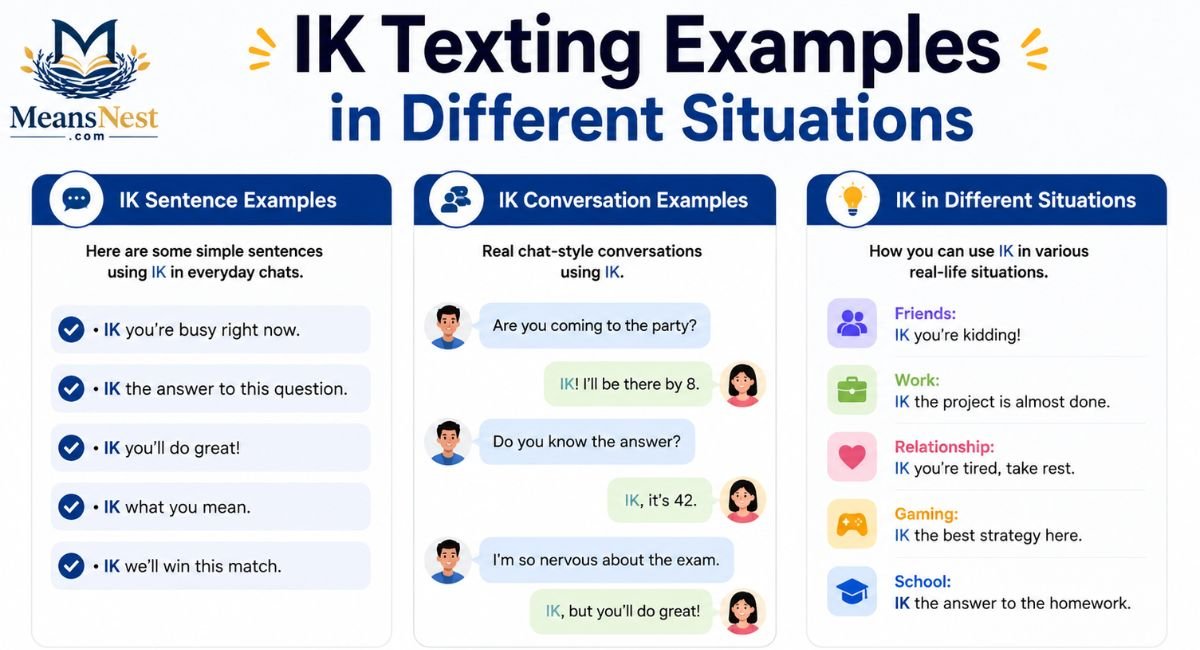
The best way to understand IK is to look at how it works in different contexts.
| Situation | Example | Meaning |
| Agreement | “That test was hard.” — “IK!” | I know! |
| Reminder | “Bring your charger.” — “IK.” | I know. |
| Shared emotion | “I miss summer.” — “IK 😭” | I know; I feel the same. |
| Humor | “He really thought that would work.” — “IK 😂” | I know, right? |
| Mild annoyance | “You need to finish this.” “IK.” | I know. |
| Casual reply | “This place is crowded.” — “ik” | I know. |
IK Sentence Examples
Here are some simple IK sentence examples:
- “IK, I already saw the message.”
- “IK! That was so funny.”
- “ik lol, you told me yesterday.”
- “IK 😭 I’m tired too.”
- “IK, but what can we do?”
- “IK! That’s exactly what I was thinking.”
IK Conversation Examples
Friends
Alex: “The new episode is out.”
Sam: “IK! I’m watching it tonight.”
Making Plans
Alex: “We have to leave at 7.”
Sam: “IK, I’ll be ready.”
Shared Reaction
Alex: “That ending was wild.”
Sam: “I know 😭.”
In each case, the basic IK casual meaning remains “I know,” while the context changes the tone.
How to Use IK Correctly
Knowing how to use IK is simple.
Use it when you want to communicate that you already know or understand something.
Good Situations for IK
IK works well when:
- Talking with friends
- Replying to casual text messages
- Chatting on social media
- Responding to reminders
- Showing agreement
- Reacting to something familiar
- Having relaxed online conversations
When to Avoid IK
Avoid using IK in situations that require formal or highly professional language.
For example, instead of writing:
“IK, I received the document.”
In a professional email, you could write:
“Yes, I received the document. Thank you.”
The full sentence sounds clearer and more professional.
See Also: MYF Meaning in Text: What Does MYF Stand For?
Consider the context.
The same abbreviation can sound different depending on punctuation and wording.
Compare:
“IK!”
This can sound enthusiastic.
“ik lol.”
This sounds relaxed and friendly.
“IK.”
This may sound blunt or annoyed.
Therefore, the correct use of IK depends on the relationship, conversation, and tone.
Is IK rude, sarcastic, or friendly?
IK is not inherently rude.
Most of the time, it is friendly or neutral in casual communication.
However, it can sometimes sound rude or sarcastic depending on the context.
For example:
Friend: “You should study for tomorrow.”
Reply: “IK.”
This could simply mean “I know.”
But if the person has repeatedly reminded you, “IK” might sound irritated.
Friendly IK
“IK 😂 That’s exactly what I was thinking.”
This sounds friendly and conversational.
Sarcastic IK
“IK, thanks for reminding me for the tenth time.”
Here, IK is part of a sarcastic response.
Rude or Polite?
The IK rude or polite question depends mainly on context.
The abbreviation itself is neutral, but a short response without additional words can sometimes appear dismissive.
If you want your IK reply to sound warmer, add an emoji or a few extra words.
For example:
“IK 😭”
or
“IK, I’ll do it soon!”
These can sound more friendly than simply saying
“IK.”
What Is the Origin of IK?
IK developed as part of the broader growth of internet slang and short-form digital communication.
As texting and instant messaging became popular, people began shortening common phrases to make communication quicker.
“I know” naturally became “IK.”
Like many online abbreviations, it became common through casual conversations, chat platforms, forums, and social media.
There is no need to treat IK as a formal acronym. In everyday texting, it is simply a convenient abbreviated expression for “I know.”
Today, IK is recognized as one of the common texting terms used in informal digital communication.
See Also: What Does “YT” Mean in Text? Meanings, Slang & Examples
Other Meanings of IK
Although “I know” is the most common meaning of IK in casual texting, the abbreviation can have other meanings in different contexts.
For example, IK may represent a name, organization, technical term, or phrase outside social conversations.
The intended meaning depends on where you see it.
| Context | Possible Meaning |
| Casual texting | I know |
| Social media | I know |
| Informal chat | I know |
| Professional or technical context | May have a specialized meaning |
| Names or organizations | Could represent initials |
If you are unsure about the meaning, check the surrounding words and the platform where it appears.
For everyday texting, however, IK usually means “I know.”
Related Texting Abbreviations Like IK
Many other texting abbreviations work similarly to IK.
| Abbreviation | Meaning |
| IDK | I don’t know |
| IMO | In my opinion |
| IMHO | In my humble opinion |
| TBH | To be honest |
| BTW | By the way |
| FYI | For your information |
| NGL | Not gonna lie |
| LOL | Laughing out loud |
| OMG | Oh my God |
| BRB | Be right back |
Understanding these related abbreviations makes texting language easier to follow.
For example:
“IK, TBH, that movie was amazing.”
This means:
“I know. To be honest, that movie was amazing.”
If someone sends you “IDK,” the meaning is almost the opposite of IK. IDK means “I don’t know.”
How to Respond to IK
Your response depends on the conversation.
If someone says:
“IK 😭”
You could reply:
“Right? 😂”
or:
“Exactly!”
If they simply say:
“IK.”
You can continue the conversation naturally:
“Then you know why I’m stressed.”
The best IK response is one that matches the tone and context of the conversation.
❓ Frequently Asked Questions (FAQs)
What does “ik” mean in chat?
“IK” usually means “I know” and is commonly used in casual text messages and chats.
Is “iykyk” Gen Z slang?
Yes, “IYKYK” is popular Gen Z internet slang meaning “If you know, you know.”
What does “ik” mean from a girl?
If a girl says “IK,” it usually means “I know.” The exact tone depends on the conversation and context.
What is “ik” short for?
“IK” is short for “I know.”
What is the full form of IK?
The full form of IK in texting is “I know.”
Conclusion
So, what does “IK” mean in text? In most casual conversations, IK means “I know.” It is a simple and widely used short form in texting, social media, and online chats.
The basic meaning stays the same, but the IK tone can change depending on punctuation, emojis, and context. It can sound friendly, neutral, emotional, or occasionally sarcastic.
Understanding the surrounding conversation is the easiest way to interpret an IK response correctly.
If you are chatting casually with friends or using social media, IK is a natural way to say that you already know something without typing the full phrase.

Hi, I’m Kaif Ali, creator of MeansNest. I’m an SEO professional passionate about helping people understand the meanings of words, text slang, and online expressions through clear, accurate, and easy-to-read content. I create SEO-friendly guides that deliver real value while making learning simple for everyone.