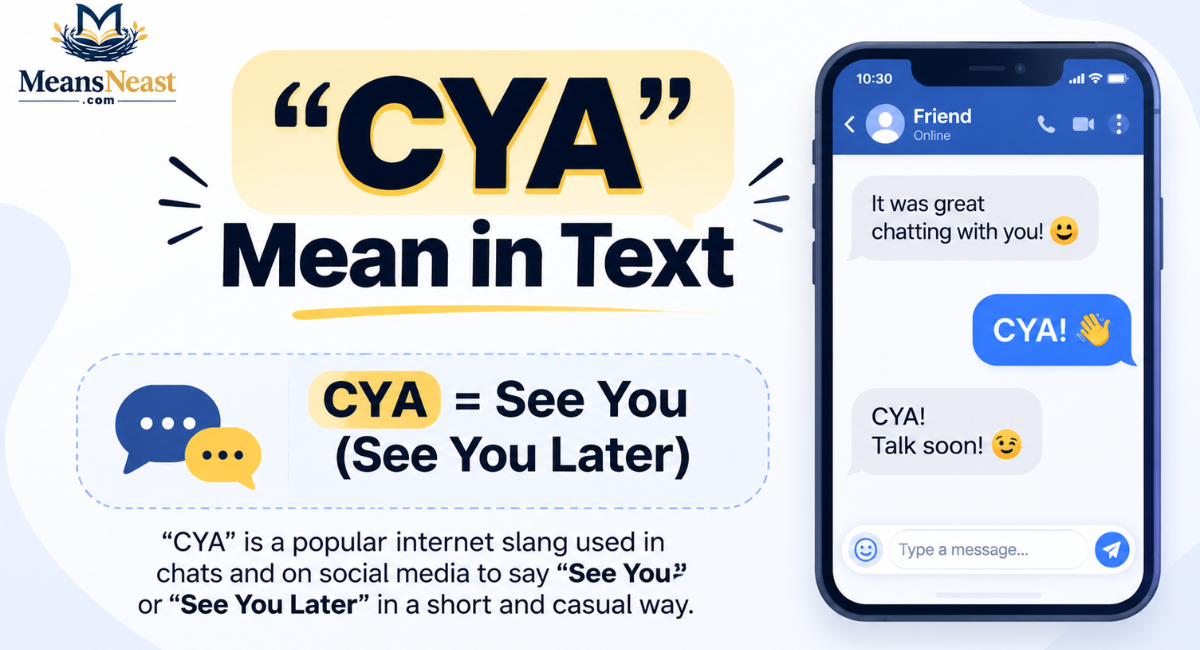
If you have seen “CYA” in a text message or online chat, you may wonder what it means. The CYA meaning in text is usually “see ya,” a casual way to say goodbye or “see you later.”
This texting abbreviation is common in friendly conversations, social media messages, and everyday digital communication.
People often use CYA when they are leaving a chat but expect to talk or meet again. It has a relaxed and friendly tone rather than a formal one.
You may also see it used as casual texting slang on platforms such as Instagram, Snapchat, TikTok, and Facebook.
Understanding CYA can make online conversations easier to follow and help you respond naturally when someone uses this popular chat abbreviation.
What Does CYA Mean in Text?
CYA meaning in text is usually “see ya.” The phrase is a shortened, informal version of “see you” or “see you later.”
What does CYA mean?
“CYA” is a chat abbreviation and texting abbreviation commonly used in casual conversations. The letters sound similar to the words “see ya” when spoken aloud.
CYA stands for “See Ya.”
It can work as a simple farewell phrase when someone is leaving a conversation.
For example:
“I have to go now. CYA!”
This means:
“I have to go now. See ya!”
The CYA full form in casual texting is therefore “see ya,” rather than a formal phrase such as “goodbye.”
See Also: MYF Meaning in Text: What Does MYF Stand For?
CYA definition in simple words
The easiest CYA definition is
CYA = “See ya,” an informal way to say goodbye or see you later.
The meaning of CYA can be slightly flexible. Sometimes it means “see you later,” while in other conversations it simply means “bye.”
Is CYA always “see ya”?
In ordinary texting, CYA usually refers to “see ya.” However, abbreviations can have different meanings in other contexts. The surrounding conversation is always important.
For everyday messaging, though, CYA in texting is most commonly understood as “see ya.”
What Does CYA Mean on Social Media?
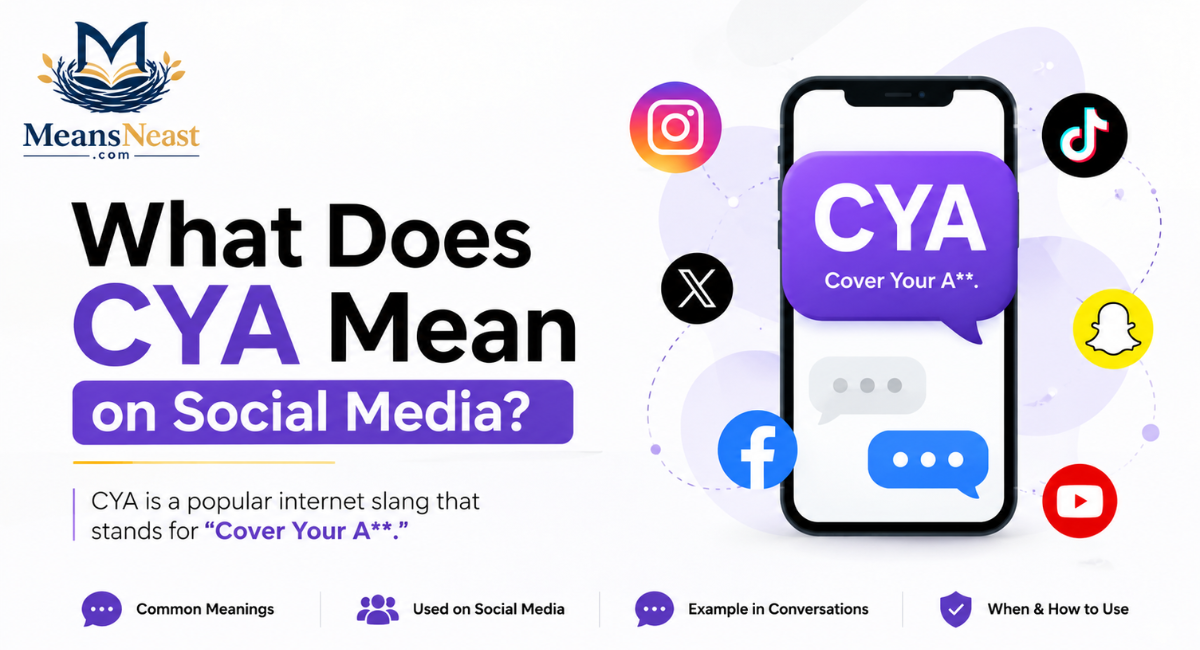
The CYA meaning on social media is generally the same as it is in private messages: “see ya.”
You might see CYA on Instagram, CYA on Snapchat, CYA on TikTok, or CYA on Facebook when someone is ending a conversation or saying goodbye.
For example:
“Heading offline now, CYA!”
Someone might also write:
“CYA tomorrow!”
This means “See ya tomorrow.”
CYA fits naturally into social media slang, internet slang, and casual online conversations because these platforms often encourage short and informal communication.
CYA in different social media chats
The exact setting does not normally change the meaning.
| Platform | Common meaning | Example |
| See ya | “I’m logging off, CYA!” | |
| Snapchat | See ya | “CYA later!” |
| TikTok | See ya | “Gotta go, CYA.” |
| See ya | “CYA tomorrow!” | |
| Group chat | See ya | “I’m heading out, CYA, everyone.” |
So, when you see CYA in social media chats, read the surrounding message before assuming anything unusual.
How Is CYA Used in Text Messages?
Knowing how to use CYA is simple. You can place it near the end of a conversation when you want to say goodbye in a relaxed way.
For example:
“I’ll send you the details tonight. CYA!”
Or:
“I need to finish my homework. CYA later.”
When using CYA in a text, the tone is usually friendly and brief.
CYA texting usage
CYA works well when:
- You are ending a casual conversation.
- You expect to see the person again.
- You want a short goodbye.
- You are chatting with friends or people you know well.
- The conversation already has an informal tone.
It is especially useful in short text messages because it communicates the idea without requiring a complete phrase.
CYA in chat
A typical CYA conversation might look like this:
Alex: “Are you still coming to the game?”
Sam: “Yep, leaving in five minutes.”
Alex: “Great. CYA there!”
Here, CYA means “see you there.”
This shows that the meaning can depend slightly on what comes before it.
CYA Texting Examples in Different Situations
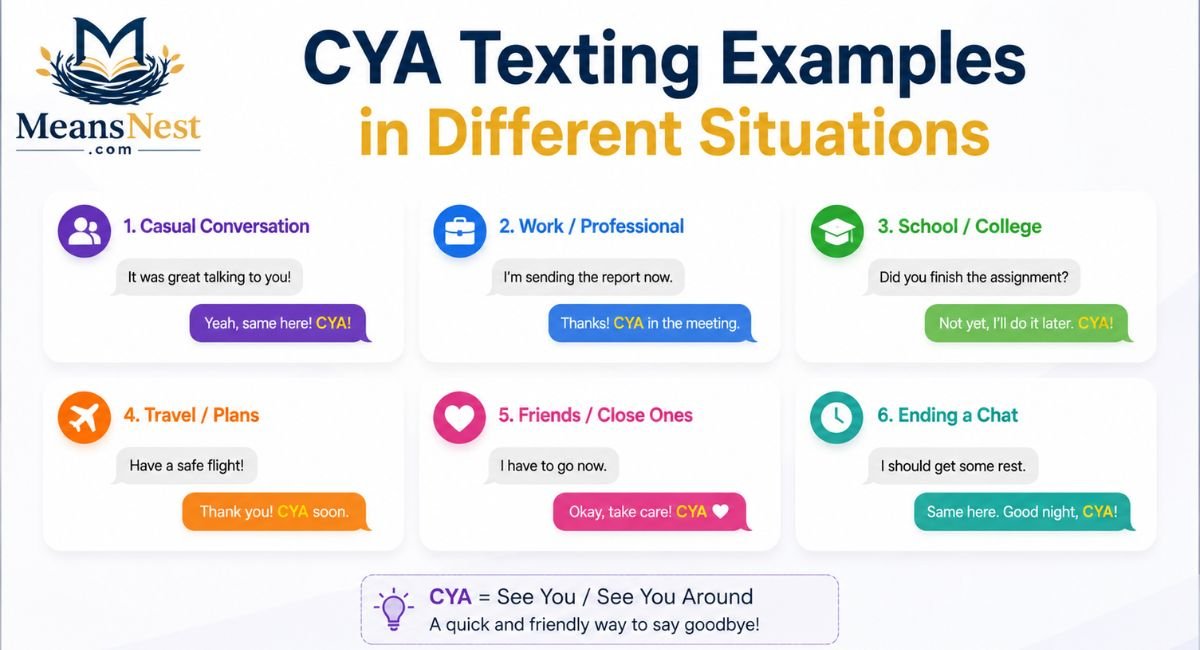
These CYA texting examples show how the abbreviation can appear naturally in everyday messages.
Friendly text example
Mike: “I’m going to grab some food.”
John: “Okay, CYA later!”
Here, CYA is a relaxed goodbye.
CYA message between friends
Sara: “I have to study now.”
Emma: “No worries. CYA tomorrow!”
The message means “See ya tomorrow.”
Social media message
“I’m getting off TikTok for tonight. CYA!”
This is a typical informal message on social media.
See Also: What Does “YT” Mean in Text? Meanings, Slang & Examples
Workplace texting
Coworker 1: “The meeting is finished. I’ll send the notes this afternoon.”
Coworker 2: “Sounds good. CYA tomorrow.”
Although CYA can appear in workplace texting, it is best suited to workplaces where communication is already relaxed.
CYA chat example
A: “Are you joining us later?”
B: “Probably around 8.”
A: “Cool, see ya then!”
This means “See ya then.”
More CYA text examples
| Situation | Example | Meaning |
| Friends | “I gotta go, CYA!” | See ya! |
| Gaming | “I’m logging off; CYA tomorrow.” | See you tomorrow. |
| School | “Class is starting, CYA later.” | See you later. |
| Group chat | “I’m heading out, CYA guys.” | See you, everyone. |
| Social media | “Going offline now, CYA!” | Goodbye for now. |
These CYA conversation examples show that the abbreviation is mainly used for casual goodbyes.
How to Reply When Someone Says “CYA”
If you are wondering how to reply to CYA, there is no complicated rule. A short, friendly response is usually enough.
You can reply with:
- “CYA!”
- “See ya!”
- “See you later!”
- “Bye!”
- “Take care!”
- “Catch you later!”
- “See you soon!”
- “Talk later!”
What to reply when someone says CYA
For example:
Person A: “I need to head home. CYA!”
Person B: “CYA! Take care.”
Or:
Person A: “CYA tomorrow!”
Person B: “See you tomorrow!”
Your CYA response should match the tone of the original conversation.
CYA reply examples
| CYA message | Natural reply |
| “CYA later!” | “See ya!” |
| “CYA tomorrow!” | “See you tomorrow!” |
| “Okay, CYA!” | “Bye, take care!” |
| “CYA soon!” | “Definitely!” |
| “I gotta go, CYA!” | “Catch you later!” |
There is no need for a long response to a simple farewell.
Is CYA Rude, Offensive, or Safe to Use?
People often ask, “Is CYA rude?” In most casual conversations, no. CYA is generally friendly, harmless, and informal.
It is not normally considered an offensive expression.
Is CYA offensive?
CYA is not usually offensive. Its meaning is simply “see ya.”
However, tone matters. If someone uses an abbreviation during a serious conversation, it could feel too casual or dismissive.
For example, sending:
“CYA.”
After someone shares serious personal news might not feel appropriate.
The problem in that situation is not the abbreviation itself. It is the mismatch between the language and the situation.
Is CYA safe to use?
Yes, CYA is generally safe to use in casual conversations.
Still, remember that CYA is an informal abbreviation, not formal communication.
| Situation | CYA appropriate? |
| Chatting with friends | Yes |
| Family group chat | Usually |
| Gaming chat | Yes |
| Casual social media messages | Yes |
| Relaxed workplace chat | Sometimes |
| Formal email | Usually not. |
| Job application | No |
| Official business communication | Avoid |
For professional communication, “See you later,” “See you tomorrow,” or “Best regards” may be more suitable depending on the context.
Why Do People Use CYA in Texting?
There are several reasons why people use CYA instead of writing “see you” or “goodbye.”
The main reason is convenience.
Quick and easy communication
CYA is short and immediately recognizable in casual conversations. It helps people save time while texting and keeps messages compact.
Instead of:
“Okay, I have to go now. See you later!”
Someone can simply write:
“Gotta go. CYA!”
See Also: What Does TS Stand For in Text? Complete Guide
Familiar texting shortcut
CYA is one of many texting shortcuts created around quick digital communication.
People use abbreviations because they are convenient, especially when conversations move quickly.
Other reasons include:
- Convenience: It takes fewer characters.
- Speed: It can be typed quickly.
- Casual tone: It sounds relaxed and friendly.
- Familiarity: Many users recognize it immediately.
- Messaging efficiency: It communicates the basic idea without extra words.
CYA is therefore a practical example of short-form communication and evolving internet slang.
CYA Origin and Background
The CYA origin comes from shortening the spoken phrase “see ya.”
“See ya” itself is an informal pronunciation of “see you.” Over time, people began representing the sounds with letters, producing CYA.
Where did CYA come from?
There is not one universally established moment when CYA was invented. Like many chat abbreviations, it developed from ordinary informal language and became more visible as digital communication grew.
The rise of texting, online chat rooms, instant messaging, and social platforms helped shortened phrases become common.
The basic evolution can be understood as the following:
See you → See ya → CYA
This reflects broader slang evolution in which spoken expressions become shortened forms for digital communication.
CYA slang history
The history of CYA is connected to the broader development of texting history and internet language.
People have long shortened phrases in casual speech. Digital communication simply made these shortcuts more useful because people wanted quick ways to communicate.
CYA is therefore best understood as an informal abbreviation rather than a word created for one particular platform.
CYA vs Similar Texting Terms
CYA can look similar to several other texting expressions, but the tone or meaning may differ slightly.
| Term | Meaning | Typical tone |
| CYA | See ya | Casual |
| See ya | See you | Casual |
| Bye | Goodbye | Casual/general |
| CU | See you | Very informal |
| TTYL | Talk to you later | Casual |
| Goodbye | Goodbye | Neutral/formal |
| See you later | See you later | Casual/neutral |
| Catch you later | See you later | Friendly |
CYA vs see ya
CYA and “see ya” mean essentially the same thing. CYA is simply the abbreviated written form.
CYA vs bye
“Bye” is a general farewell. CYA suggests “see you” and can imply that you expect another interaction.
For example:
“CYA tomorrow!”
specifically suggests seeing the person tomorrow.
CYA vs see you later
These are very close in meaning. “See you later” is clearer and more natural in formal or neutral situations, while CYA is more casual.
See Also: What Does GC Mean in Texting? Full Guide & Examples
CYA vs CU
Both CYA and CU can mean “see you.” CYA is based on the sound of “see ya,” while CU uses the letter-name pronunciation of “C” and “U.”
CYA vs TTYL
TTYL means “talk to you later.”
CYA focuses on seeing someone again, while TTYL focuses on talking again.
For example:
“I have class now. TTYL.”
means “Talk to you later.”
Meanwhile,
“I’m leaving now. CYA.”
means “See ya.”
These are useful CYA texting alternatives when you want a similar casual farewell.
When Should You Use or Avoid CYA?
Knowing when to use CYA is mostly about audience and context.
Use CYA when the conversation is relaxed and the other person is comfortable with informal language.
Good situations for CYA
CYA works well in:
- Casual texting
- Conversations with friends
- Family group chats
- Gaming chats
- Informal social media conversations
- Relaxed workplace texting
- Conversations where abbreviations are already common
For example:
“I’m heading out now. CYA tomorrow!”
sounds natural in a conversation between friends.
When to avoid CYA
You may want to avoid CYA in the following:
- Professional emails
- Job applications
- Formal business messages
- Official documents
- Serious or sensitive conversations
- Messages to someone who prefers formal communication
Instead of:
“CYA.”
In a formal email, you might write:
“I look forward to speaking with you tomorrow.”
This is a better example of texting etiquette and adapting your communication style to the audience.
CYA in professional messages
CYA is not automatically wrong in every workplace. If your team regularly uses casual language, it may be acceptable in an internal chat.
However, formal communication requires more care.
The safest approach is simple:
Match the language to the person, platform, and situation.
❓ Frequently Asked Questions (FAQs)
What does “CYA” mean in chat?
CYA means “see ya” and is a casual way to say goodbye or “see you later” in a chat.
What does CYA mean in Gen Z?
For Gen Z, CYA generally means “see ya” and is used as a quick, informal goodbye in texts and online chats.
What does “cya” mean from a girl?
If a girl says “cya,” it usually simply means “see ya” or “see you later”; the exact tone depends on the conversation.
What does CYA stand for?
CYA stands for “see ya,” an informal shortened version of “see you.”
What is “CYA” in text speak?
In text speak, CYA means “see ya” and is commonly used as a casual farewell.
Conclusion
The CYA meaning in text is simple: “see ya.” It is an informal farewell used to end casual conversations, often with friends, family, social media contacts, or people you regularly chat with.
CYA can mean “see you,” “see you later,” or simply “bye,” depending on the surrounding conversation.
It is generally safe and friendly, but it is better suited to informal communication than formal emails or professional situations.
If someone texts “CYA,” a simple response such as “See ya,” “Take care,” or “Catch you later” is usually all you need.
Like other texting abbreviations, CYA works best when you consider the audience, context, and overall communication tone.

Hi, I’m Kaif Ali, creator of MeansNest. I’m an SEO professional passionate about helping people understand the meanings of words, text slang, and online expressions through clear, accurate, and easy-to-read content. I create SEO-friendly guides that deliver real value while making learning simple for everyone.