If you have seen WFH in texting, emails, or workplace chats, it usually means “Work From Home.” This common abbreviation describes a work arrangement where someone performs their job from home instead of going to a traditional office.
You may also see WFH in messages, job postings, and on social media, especially when people talk about their daily routines or work schedules.
Understanding the WFH abbreviation can help you quickly understand what someone means in a conversation.
For example, “I’m WFH today” simply means “I’m working from home today.” In this guide, we’ll explain WFH meaning at work, common uses, examples, and how WFH differs from remote and hybrid work.
What Does WFH Mean? (Quick Answer)
WFH stands for “Work From Home.”
It describes a work arrangement where an employee performs their job from home instead of physically going to an office.
Simple example:
“I’m WFH today because I have a delivery coming.”
Here, WFH means the person will be working from home during the day.
WFH is both a work-related abbreviation and a common workplace acronym. It is especially common in emails, messaging apps, team chats, and casual conversations between coworkers.
The term can refer to different situations. Someone might WFH occasionally, several days each week, or almost every day.
It is also important to understand that WFH does not always mean the same thing as a fully remote job. A person can work from home temporarily while still being employed by a company that normally operates from an office.
WFH Meaning in Text Messages and Social Media
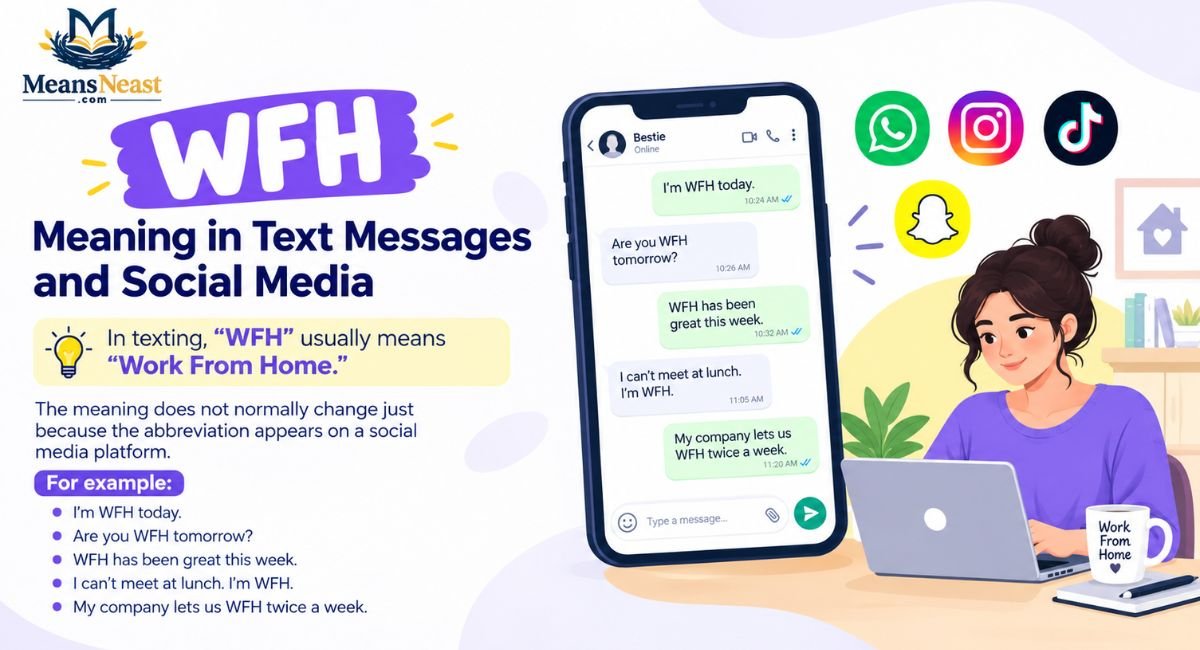
In texting, “WFH” usually means “Work From Home.”
The meaning does not normally change just because the abbreviation appears on a social media platform.
For example:
- “I’m WFH today.”
- “Are you WFH tomorrow?”
- “WFH has been great this week.”
- “I can’t meet at lunch. I’m WFH.”
- “My company lets us WFH twice a week.”
WFH in texting
When WFH appears in a personal conversation, it often simply explains where someone is working.
Example:
Friend: “Want to grab coffee at 11?”
You: “I can’t. I’m WFH today.”
The person is saying they are working from home and may not be available.
WFH in chat
WFH in chat is especially common among coworkers.
For example:
“Anyone WFH tomorrow?”
A coworker may ask this to find out who will be working remotely the next day.
WFH in messages
The abbreviation can also appear in short messages to friends or family.
“I’ll call you later. WFH right now.”
The meaning is still “work from home.”
WFH on WhatsApp
WFH on WhatsApp is commonly used in both personal and professional conversations.
“I’m WFH today, so message me here if you need anything.”
WFH on Instagram
WFH on Instagram may appear in captions, comments, Stories, or direct messages.
For example:
“WFH with my favorite coffee ☕”
Here, WFH means the person is working from home.
Read More: What Does TBF Mean? Full Meaning, Usage, Examples & Replies (2026 Guide)
WFH on Snapchat
On Snapchat, someone might use WFH casually in a Story or chat.
“WFH today 😴”
The abbreviation gives followers a quick idea of what the person is doing.
WFH on Facebook
WFH on Facebook can appear in posts about someone’s work routine or daily schedule.
“Another WFH day. Trying to stay productive!”
WFH on TikTok
WFH on TikTok is often connected with content about productivity, home offices, careers, or daily routines.
A creator might use a caption such as:
“My realistic WFH morning routine.”
WFH in social media
Across social media, WFH generally keeps the same meaning: work from home.
The tone may be casual, but the basic definition does not change.
How to Use WFH in a Sentence
Using WFH is simple when you are talking about working from home.
It can be used as an abbreviation in casual conversations, workplace messages, emails, and social media posts.
Here are some useful WFH examples in sentences:
- “I’m WFH today.”
- “Are you WFH tomorrow?”
- “She has been WFH all week.”
- “Our team is WFH on Friday.”
- “I prefer WFH because I save time commuting.”
- “He is WFH while the office is being renovated.”
- “Can we have a WFH day next week?”
- “My manager approved my WFH request.”
- “I’m WFH, but I’m still available for the meeting.”
- “The company offers a flexible WFH schedule.”
How to use WFH
WFH works best when the context is clear.
In a conversation with coworkers, you can simply write:
“I’m WFH today.”
In a more formal document, however, it may be better to write “working from home” the first time and use WFH afterward if the abbreviation is appropriate for the audience.
For example:
“Employees may work from home (WFH) two days per week.”
This approach makes the meaning clear to everyone.
WFH Meaning in Professional Communication
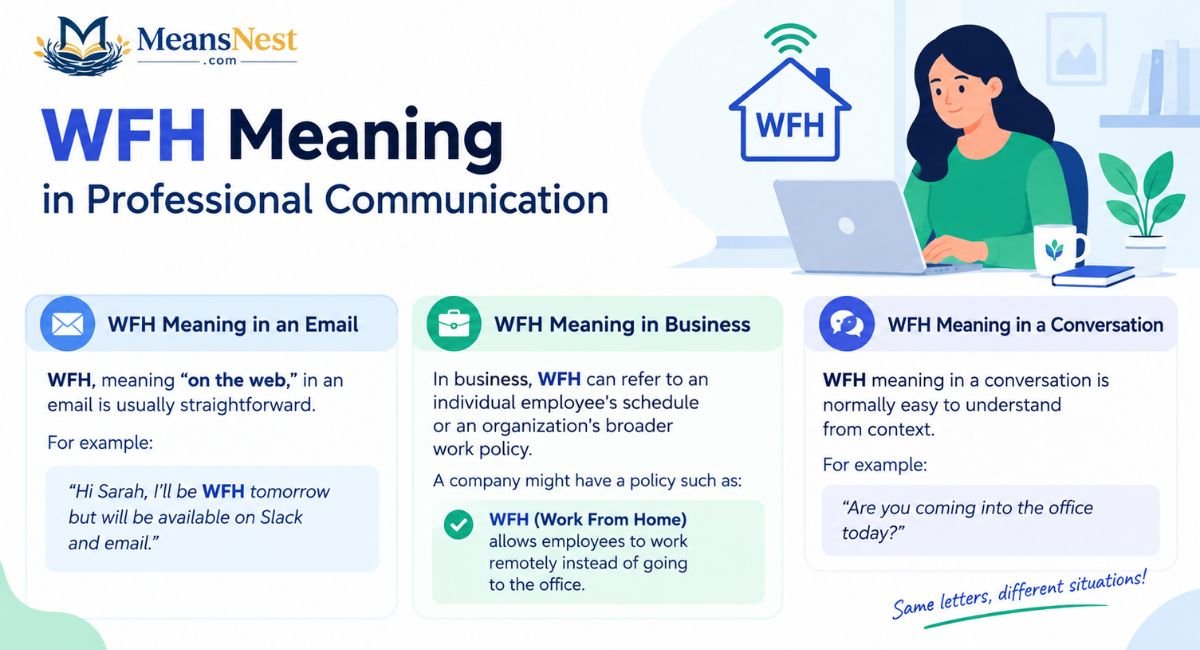
In professional communication, WFH means “work from home” and usually refers to where an employee performs their duties.
You may see WFH in emails, calendars, workplace messaging apps, company policies, and internal announcements.
For example:
“I’ll be WFH on Monday and Tuesday.”
This tells coworkers that the employee will not be physically present in the office.
WFH meaning in an email
WFH, meaning “on the web,” in an email is usually straightforward.
For example:
“Hi Sarah, I’ll be WFH tomorrow but will be available on Slack and email.”
The sender is explaining their work location while confirming that they are still available.
Another example is
“Please note that I’ll be WFH this Friday.”
This can be useful when coworkers need to know whether someone will be at the office.
Read More: What Does NS Mean in Text? Meaning, Examples & Replies (2026)
WFH meaning in business
In business, WFH can refer to an individual employee’s schedule or an organization’s broader work policy.
A company might have a policy such as
“Employees may WFH up to three days per week.”
This means employees are allowed to perform their duties from home on those days.
WFH may also appear in discussions about productivity, workplace flexibility, employee benefits, and office policies.
WFH meaning in a conversation
WFH meaning in a conversation is normally easy to understand from context.
For example:
“Are you coming into the office today?”
“No, I’m WFH.”
The second person is saying they are working from home instead.
Because WFH is widely recognized in many professional environments, it can make workplace communication faster without changing the meaning.
WFH vs. Remote Work vs. Hybrid vs. WFO
WFH, remote work, hybrid work, and WFO are related terms, but they are not always interchangeable.
| Term | Meaning | Typical Work Location |
| WFH | Work From Home | Employee’s home |
| Remote Work | Work performed away from a traditional office | Home or another location |
| Hybrid | Combination of office and remote work | Home + office |
| WFO | Work From Office | Traditional workplace |
WFH vs remote work
WFH vs remote work is one of the most common points of confusion.
WFH specifically emphasizes working from home.
Remote work is broader. A remote employee might work from home, a coworking space, a library, or another suitable location.
For example:
“I’m WFH today.”
means the person is working from home.
But:
“I work remotely.”
does not necessarily tell you where they are working.
Hybrid work
Hybrid work combines office work with remote working.
For example, an employee might work:
- Monday: Office
- Tuesday: Home
- Wednesday: Office
- Thursday: Home
- Friday: Office
This is a flexible work arrangement because the employee has both office and home-based work days.
WFO
WFO usually means Work From Office.
For example:
“I’m WFO today.”
This means the person is working from the office rather than from home.
The exact use of WFO can vary between companies, so context still matters.
Types of WFH Arrangements
Not every WFH arrangement works the same way.
Companies can create different policies depending on the role, industry, and employee’s responsibilities.
Occasional WFH
An employee normally works in an office but is allowed to work from home occasionally.
For example:
“Employees can WFH when they have an appointment or personal commitment.”
This is sometimes called an occasional or flexible WFH arrangement.
Part-time WFH
An employee regularly works from home for part of the week.
For example:
“Employees can WFH every Tuesday and Thursday.”
The remaining days may be spent at the office.
Read More: What Does WDYM Mean in Text? Complete Guide with Examples (2026)
Full-time WFH
A full-time WFH employee performs their regular duties from home.
They may rarely or never need to visit a physical office.
This can be common in online work, technology, customer support, writing, design, and other roles that can be performed digitally.
Temporary WFH
Temporary WFH is used for a limited period.
For example, a company might allow employees to work from home while an office is being renovated.
After the situation ends, employees may return to office work.
Flexible WFH
A flexible WFH policy gives employees some choice about when or how often they work from home.
The exact rules depend on the employer.
Some companies may require employees to attend certain meetings or maintain specific working hours.
What Does WFH Mean in a Job Posting?
In a job posting, WFH usually means that the position allows the employee to work from home.
However, the exact arrangement can vary.
A job advertisement might say:
“WFH available.”
This means the employer offers some form of work-from-home option.
Another posting might say:
“Full-time WFH position.”
This generally means the employee can perform the role from home on a full-time basis.
You may also see phrases such as:
- WFH opportunity
- WFH position
- WFH available
- Flexible WFH schedule
- Hybrid/WFH
- Remote/WFH
- Work-from-home job
It is important to read the complete job description because WFH does not always mean that the job is completely location-independent.
For example, a company may require employees to live in a particular city, country, or time zone even if they work from home.
A good job seeker should check:
- Whether WFH is full-time or part-time
- Whether occasional office visits are required
- Required working hours
- Geographic restrictions
- Equipment requirements
- Internet requirements
- Whether the company provides a home-office setup
- Whether the position is permanent or temporary
A work-from-home job can offer flexibility, but the actual conditions depend on the employer.
Pros and Cons of WFH
Working from home can be convenient, but it also has challenges.
The experience depends heavily on the type of job, home environment, and employee’s working habits.
| Pros of WFH | Cons of WFH |
| No daily commute | Possible distractions |
| Flexible environment | Less face-to-face interaction |
| Can save commuting time | Can feel isolating |
| Comfortable home office | Work-life boundaries may become unclear. |
| Useful for focused tasks | Home internet can cause problems. |
| Greater location flexibility | Some people miss office collaboration. |
Benefits of WFH
One major advantage is saving commuting time.
Instead of spending an hour traveling to work, an employee can use that time for personal activities, sleep, exercise, or family responsibilities.
WFH can also provide a comfortable home office environment.
Some people find it easier to focus without constant office interruptions.
Another benefit is flexibility.
Depending on company policy, working remotely can make it easier to manage personal responsibilities while maintaining a professional schedule.
Read More: What Does “IT” Mean in Text? (Complete Guide with Examples)
Challenges of WFH
WFH is not perfect for everyone.
Home distractions can make it difficult to concentrate.
Family members, household chores, notifications, and other interruptions can affect productivity.
Another challenge is communication.
Remote employees need reliable internet, messaging tools, video calls, and clear workplace processes.
Some people may also miss spontaneous conversations with coworkers.
For this reason, successful WFH often requires good communication and clear boundaries.
Tools and Tips for a Productive WFH Setup
A productive WFH setup does not have to be expensive.
The most important thing is creating an environment where you can focus and communicate effectively.
Create a dedicated workspace.
If possible, use one specific area for work.
A desk, comfortable chair, good lighting, and organized workspace can make working from home easier.
You do not necessarily need a separate room.
Even a small corner can work if it is quiet and comfortable.
Use reliable communication tools.
Remote employees often depend on digital tools for communication.
Common tools can include:
- Team messaging
- Video conferencing
- Project management platforms
- Cloud storage
- Shared documents
- Online calendars
The right tools depend on the company’s workplace system.
Set clear working hours.
One common WFH problem is allowing work to continue throughout the entire day.
Set a clear start and finish time whenever possible.
This helps separate professional responsibilities from personal time.
Take regular breaks.
Working continuously for hours can reduce focus.
Short breaks can help you reset and return to work with better concentration.
A quick walk, stretch, or drink of water can make a difference.
Keep communication clear.
When working remotely, coworkers cannot always see what you are doing.
That makes communication especially important.
Let your team know when you are available, when you are in a meeting, and when you may be away.
Protect your home-office environment.
Keep work files, devices, and accounts secure.
Use strong passwords and follow your employer’s security policies.
If your company provides specific rules for remote employees, follow them carefully.
Other WFH Meanings and Related Abbreviations
WFH overwhelmingly means “work from home” when it appears in workplace conversations, texting, job postings, and social media.
Unlike some slang abbreviations, WFH usually does not have many common alternative meanings in everyday chat.
The context still matters, especially when an abbreviation is used outside a professional setting.
Here are some related abbreviations:
| Abbreviation | Meaning | Common Context |
| WFH | Work From Home | Work and messaging |
| WFO | Work From Office | Workplace communication |
| WFH | Work From Home | Job postings |
| FT | Full-Time | Employment |
| PT | Part-Time | Employment |
| OOO | Out of Office | Email and work chat |
| PTO | Paid Time Off | Workplace |
| FYI | For Your Information | Professional communication |
| EOD | End of Day | Workplace messages |
WFH is particularly useful because it quickly communicates a person’s work location.
For example:
“I’m OOO Friday but WFH Thursday.”
A coworker can immediately understand that the person will be working from home on Thursday and will be out of the office on Friday.
The main takeaway is simple: when you see WFH in a work-related context, it almost always means work from home.
❓ Frequently Asked Questions (FAQs)
What does “WFH” mean in slang?
WFH usually means “Work From Home” in casual texting and online conversations.
What does WFH stand for?
WFH stands for “Work From Home,” meaning someone is working from their home instead of an office.
What does “WFH girl” mean?
“WFH girl” usually refers to a girl or woman who works from home, often describing her work routine or lifestyle.
What does WFH mean in dating?
In dating conversations, “WFH” usually still means “Work From Home” and may simply describe someone’s work situation.
What is WFH in chatting?
In chatting, WFH means “Work From Home.” For example, “I’m WFH today” means “I’m working from home today.”
Conclusion
WFH in text is simple: WFH stands for “Work From Home.” It describes working from home instead of going to a traditional office.
You can see WFH in texting, workplace chats, emails, job postings, and social media. The abbreviation is useful because it quickly explains someone’s work location.
WFH can describe occasional home-based work, a regular flexible schedule, or a full-time work-from-home job. However, it is not always identical to remote work because remote working can happen from locations other than home.
If you see WFH in a message or job advertisement, the surrounding context will usually tell you exactly how the arrangement works.

Hi, I’m Kaif Ali, creator of MeansNest. I’m an SEO professional passionate about helping people understand the meanings of words, text slang, and online expressions through clear, accurate, and easy-to-read content. I create SEO-friendly guides that deliver real value while making learning simple for everyone.